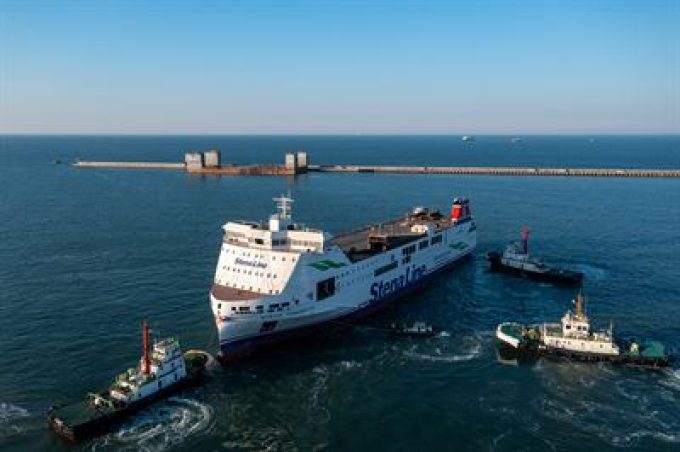
Stena Connecta
Photo: Stena Line

The 5 June launch of the UK government’s ports policy overhaul – with proposals to reduce red tape for port expansion plans – unsurprisingly went largely unnoticed, outside a small circle of industry executives and civil servants.

Nonetheless, those involved dutifully issued their welcomes to the Department for Transport’s (DfT) assertion that proposals – part of the government’s Plan for Change economic boost policy – would “increase the likelihood of achieving successful planning approvals and saving time and money during the planning process”.

“Greater clarity, fewer delays, and reduced costs will give ports the confidence they need to expand, creating more local skilled jobs and driving money back into communities,” it said.

“The draft National Policy Statement rightly recognises the need to speed up consents for sustainable port development. With the right policy frameworks, major ports can double the levels of private investment,” noted Geraint Evans, UK Major Ports Group chief executive.

At face value, UK ports aren’t doing too badly for themselves under the current regime, with a slew of recent developments either recently completed or launched.

UK-Europe trade

Source: The Loadstar

Sincere apologies to any ports left off this table and feeling snubbed. It was… the cost of the Brocklebank terminal, understood to be jointly financed by Liverpool owner Peel Ports and CLdN, was undisclosed, but said to be “many millions”, while given that Tilbury’s T3 plans have only just been submitted, the expected cost remains undetermined… nonetheless, it is safe to assume that current and recently completed total investment in UK ports’ unitised capacity is well north of £1.1bn.

The lion’s share of that is clearly DP World greenlighting the £1bn investment in Berths 5 & 6 at London, completing a masterplan drawn up in the mid-1990s to convert the old BP Shell Haven facility for containers and proving once again Britain’s unparalleled mastery of dithering.

However, plenty of containers actually arrive on road trailers, shipped on freight-only ro-ro vessels such as CLdN’s rapidly expanding fleet, as Ian Cressey, Liverpool Port director reminded delegates at last week’s Multimodal event in Birmingham.

“There are three different parts to this – there’s the accompanied ro-ro, unaccompanied ro-ro, and then there’s ro-ro that’s actually a container.

“From a business point of view, looking at how we move goods around the UK, those three types of transport mechanism are very much dependent on the type of product you’re trying to move.

“If you’re looking for something that’s going to move fast, potentially across the water, then it’s likely to be accompanied; if it doesn’t matter much that it sits around for a day or so, it’s likely to be unaccompanied; if it’s travelling a very long distance, it’s likely to be in a box on a trailer.

“That’s pretty much it.”

And the key theme connecting UK port development over the past six months is that they are all focused on the ro-ro trades and, by extension, Europe-UK trade. Whatever one thinks of Brexit and the damage it has done to this hugely important trade – critical for the UK, and nearly as important for many UK-facing continental European economies – UK port companies, overwhelmingly financed by private capital, continue to invest heavily in the sector. Which tells its own story.

Also telling are the latest DfT freight forecasts for the country and a few takeaways:

Source: DfT

First, almost unique among maritime economies, the UK is as dependent on ro-ro shipping as it is on container shipping, and according to the DfT’s forecasts, the ro-ro sector set to grow at a higher rate over the next 25 years.

The DfT recorded 2023’s cumulative UK throughput of 9.1m teu and predicted it would grow to 11.3m teu by 2035, and 15.2m teu by 2050, representing an annual compound growth rate of 1.2%, while the ro-ro sector is expected to increase from 7.5m units in 2023, to 9.6m units in 2035, and 13.2m units in 2050, a compound annual growth rate of 2.1%.

Source: DfT

Second, the nature of UK shipping is to change fundamentally as the country winds down its offshore North Sea fossil fuel industry. Measured by tonnage, the port of Sullum Voe in the Shetland Islands (no? don’t worry, not many people have heard of it) has traditionally been the country’s largest, as it is effectively the marshalling point for the North Sea oil volumes.

Source: DfT

Third, despite the very positive outlook, the vast amounts of investment going into port facilities, as well as ro-ro and container carriers continuing to upgrade their fleets, the data shows just how flatlined the UK’s economy, in terms of goods traded, continues to be, with prospects showing little sign of material improvement – container throughput across the country is not expected to reach pre-pandemic 2019 levels until some time between 2030 and 2035, with ro-ro traffic reaching 2019 levels at some point in the next five years.

Source: DfT

This final point ought to give policy makers, as well as port and carrier strategy planners pause for thought – the pace, regularity and, in some cases, scale of port developments imply a belief in strong future UK economic growth, because the DfT doesn’t appear to share the same optimism, and London Gateway’s berths five and six aside, what’s actually happening in terms of investment suggests operators on land and at sea are betting on a more mature and open relationship with Europe, given that all of the projects in Table 1 serve intra-Europe trades.

Someone has their projections awry.

Or maybe there are things we can’t yet see happening, as according to Mr Cressey at Multimodal: “We have a massive waterway around the UK – very much as there is in Europe – it’s just called our coastline.

“And we potentially have the opportunity for all the ports around the UK to consider that waterway as a roadway. It’s not something that’s, at the moment, in the general purview – but who’s to say it couldn’t be?”

Comment on this article


You must be logged in to post a comment.