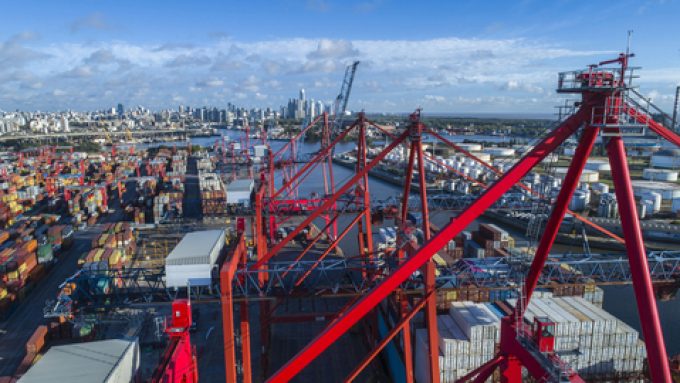
Adani pushes to complete Mundra's fifth terminal as competition looms
Adani Ports (APSEZ) is pushing hard to open of its under-construction fifth container terminal (CT5) ...


JBHT: NEW HIGHS EVERYWHEREPLD: STRONG DELIVERYJBHT: FAIR-VALUE CONSENSUS ESTIMATE AT ALL-TIME HIGH KNIN: AI TECH ADVANTAGEPLD: TRADING UPDATE ON THE WAY KNIN: UPSIDEJBHT: STRONG TRADING UPDATE DSV: EVERY LITTLE HELPSJBHT: CEO REMARKS WMT: VERTICAL INTEGRATION IN LOGISTICS
JBHT: NEW HIGHS EVERYWHEREPLD: STRONG DELIVERYJBHT: FAIR-VALUE CONSENSUS ESTIMATE AT ALL-TIME HIGH KNIN: AI TECH ADVANTAGEPLD: TRADING UPDATE ON THE WAY KNIN: UPSIDEJBHT: STRONG TRADING UPDATE DSV: EVERY LITTLE HELPSJBHT: CEO REMARKS WMT: VERTICAL INTEGRATION IN LOGISTICS
The change in global trading patterns has been a key characteristic of container flows this year, and nowhere has that change been more apparent than in the Asia-Latin America trades, where head-haul volumes have shown unprecedented strength.
According to the latest figures from Container Trades Statistics, year-to-date volumes for the first seven months of the year were up 14% on the 2024 period, to reach just over 3.32m teu.

Source: Container Trades Statistics
However, as CTS chief executive Nigel Pusey noted to The Loadstar during the recent podcast, one particular country has stood out in the past few months for spectacular growth: the ‘basket-case’ economy that is Argentina.
“Argentina is up nearly 100% on a year-to-date basis – you’ve got some very interesting geopolitical changes where people are moving cargo to places they hadn’t thought of before,” he said.
According to CTS data, Argentine imports over the first seven months were up 99% versus the same period in 2024, while its imports from China increased even more, by 113% in the same period.
Container volumes through the country’s main gateway of Buenos Aires represented 80% of this growth, according to CTS.
These figures might look like an anomaly, but they were accompanied by a step change in the capacity offering from Asia to the east coast of South America that began in April, when the number of weekly services jumped from a long-standing average of seven a week, to nine.
This meant monthly capacity into the region went from a proforma 239,000 teu in March – with 174,000 teu actually available to the market, with the remainder blanked or omitted – to a proforma 255,000 teu in April, with just 8,000 teu omitted.
Capacity continued to be scaled-up over the peak summer period, and showed significant growth on the year before:

Source: eeSea/The Loadstar
The difference can be explained by the introduction of two new Asia-South America East Coast services in April – the SEAS3/ASAS2, jointly operated by CMA CGM and Maersk, and the FL2/SX2, jointly operated by HMM and ONE.
The SEAS3/ASAS2 is something of an express Asia-SAEC service, calling at Asia’s chief export nodes and offering one call in South America – Santos, as a regional hub. It deploys 11 vessels with an average capacity of 7,300 teu, and offers a port rotation of Shanghai-Shekou-Cai Mep-Singapore-Santos.
According to the latest liner reliability data from Sea-Intelligence for July/August, the service offers shippers by far the highest on-time reliability on the trade, 85.7% of vessels arriving on their scheduled date.
Meanwhile, the smaller FL2/SX2 service, with both HMM and ONE providing tonnage, also deploys 11 ships with an average capacity of 4,800 teu, according to eeSea, and with a provision for South Korean exporters offers a port rotation of Busan-Shekou-Singapore-Rio Grande-Itapoa-Santos-Singapore-Cai Mep.
In terms of schedule reliability, the FL2/SX2’s on-time arrival rate, of 27.8%, is well below the Asia-SAEC market average of 41.4%.
However, freight rates have not kept up with the booming volumes and. given that their decline coincides with the capacity additions discussed above, it probably indicates that carriers over-adjusted for the new level of demand.

Source: Container Trades Statistics
The enormous growth in Argentina’s imports is attributed to President Javiar Milei’s economic liberalisation agenda, which has seen import restrictions lifted, currency control reforms, and substantial reductions in import tariffs and related taxes, releasing a wave of pent-up demand.
According to Argentina’s ministry of foreign affairs and international trade figures from September, in monetary terms, imports between January and August grew 32.1% year on year, with a range of commodities that are normally containerised showing significant gains.
The automotive sector led the way, with imports of small passenger cars up 203%, larger sedan-type models up 67% and trucks up 321%. Other verticals such as consumer goods, capital goods and telecoms equipment also saw significant growth.


Source: Argentine Centre of International Economy
It has come at a cost, however, with Argentina’s foreign currency reserves depleted as a result, and its erratic peso value shedding some 30% against the dollar over the past year, which is likely to hike import costs once again, threatening demand levels.
However, this could be alleviated, should a proposal from US treasury secretary Scott Beasant to support the peso via a $20bn loan come to pass.
Listen to The Loadstar’s News in Brief Podcast if you’re looking for a recap of recent supply-chain news items!
For uninterrupted access, sign in or sign up to The Daily News, Premium or The Loadstar Enterprise Plan.

Comment on this article