WiseTech defends DSV relationship, as CargoWise volumes rise 20%
In what has been a troubled week, WiseTech Global is seeking to reassure investors over ...

DSV: FREE CASH FLOW DSV: QUESTION TIMEDSV: CEO ON SCHENKER INTEGRATIONDSV: CFO PREPARED REMARKSDSV: CEO PREPARED REMARKSDSV: CONF CALL FWRD: SHOOTING UPKNX: TRADING UPDATE ON THE WAY GM: TRADING UPDATE OUTUPS: REMEMBER THE TAILWINDS PLD: NEW RELEASEPLD: OUCHVW: NEW PARTNERS SOUGHTEXPD: AIRCRAFT ON GROUND SERVICESTSLA: JUST AS VW STRUGGLESBA: NEW BIG ORDER
DSV: FREE CASH FLOW DSV: QUESTION TIMEDSV: CEO ON SCHENKER INTEGRATIONDSV: CFO PREPARED REMARKSDSV: CEO PREPARED REMARKSDSV: CONF CALL FWRD: SHOOTING UPKNX: TRADING UPDATE ON THE WAY GM: TRADING UPDATE OUTUPS: REMEMBER THE TAILWINDS PLD: NEW RELEASEPLD: OUCHVW: NEW PARTNERS SOUGHTEXPD: AIRCRAFT ON GROUND SERVICESTSLA: JUST AS VW STRUGGLESBA: NEW BIG ORDER

A conversation about freight pricing at a party has turned into a bid to challenge CargoWise, the dominant software platform used by many of the world’s largest freight forwarders.
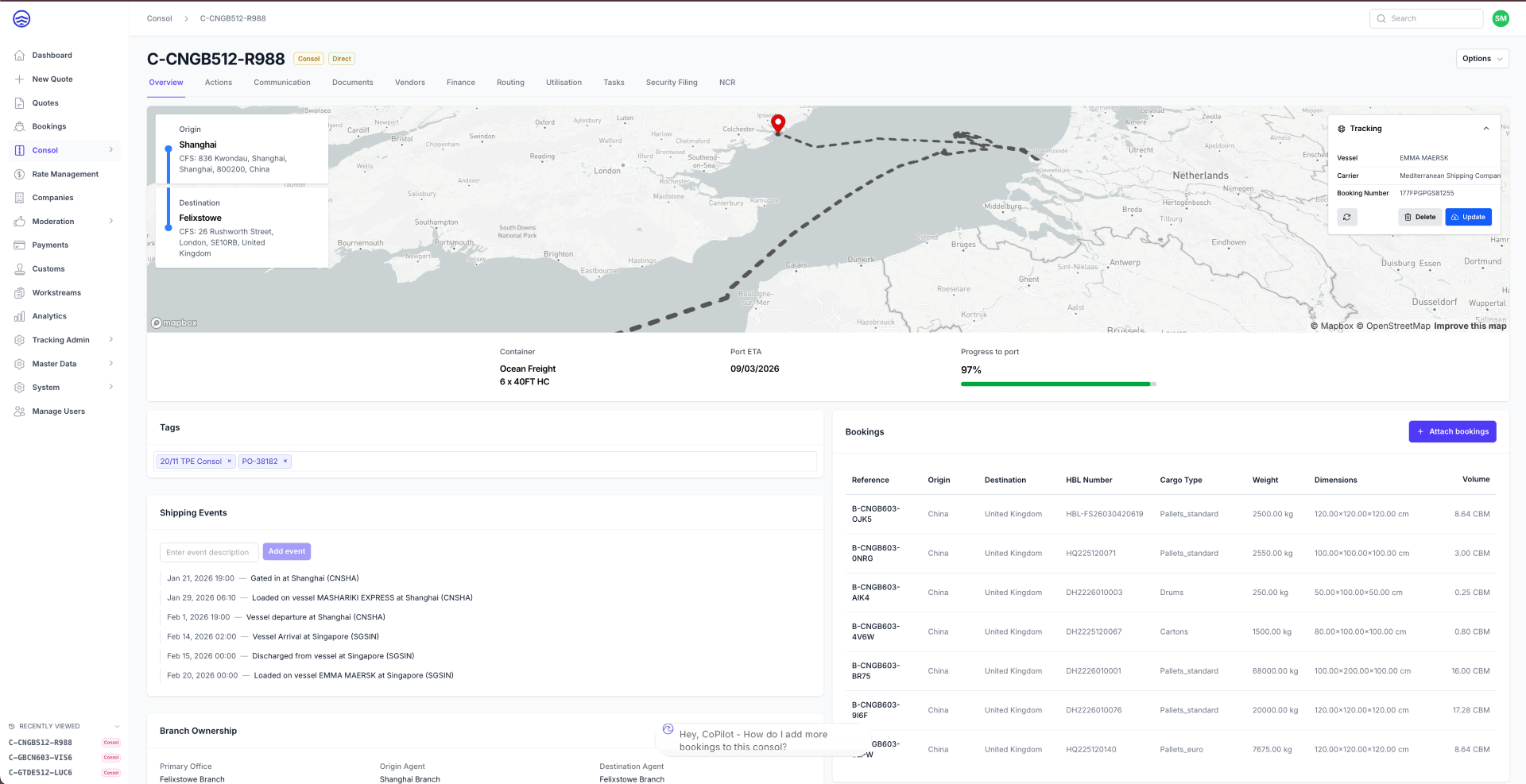
FreightSuite, founded by Samuel Moore and software engineer William Jacobs, is pitching an AI-driven transport management system as a potential alternative to CargoWise.
The idea for the platform emerged after they found themselves discussing Mr Moore’s frustrations with freight pricing while standing in a corner at a party.
At the time, Mr Moore was running a business shipping large volumes of containerised goods globally and repeatedly losing deals because forwarders could not provide full door-to-door logistics pricing quickly enough.
“I could get the price of the goods straight away,” he recalled. “But the logistics costs could take days to assemble. And by the time we had that, someone else had won the deal.”
Mr Jacobs, whose background includes engineering roles at Apple and Goldman Sachs, believed the problem could be solved through software.
The discussion eventually led the pair to leave their respective roles to begin building a freight management platform designed to automate much of the administrative work involved in forwarding.
Today, FreightSuite says its platform is beginning to attract attention from forwarders exploring alternatives to legacy systems.
The company positions the software not as a bolt-on automation tool, but as a full replacement for traditional transport management systems. Mr Moore explained: “Our vision is to allow forwarders to move the most amount of cargo using the smallest number of people.”
The platform aims to automate tasks ranging from quotation generation and document processing to shipment tracking and invoicing, with workflows triggered automatically by shipment events.
Unlike some enterprise systems, FreightSuite does not attempt to build customs filing capability itself. Instead, it integrates with specialist customs platforms in different regions, including Clearport in the UK, AEB in Europe, and CrimsonLogic in North America.
The approach allows the company to avoid building and maintaining country-specific customs compliance systems internally – widely considered one of the most complex parts of global freight software – while still allowing users to process customs submissions directly from within the TMS.
Mr Moore said this partner-led approach helped accelerate development of the platform.
“Building the customs technology itself isn’t necessarily the hardest part,” he said. “It’s the regulatory maintenance that becomes extremely complex across multiple regions.”
According to FreightSuite, its system matches incoming emails and documents to the correct shipment record without human intervention roughly 90.7% of the time. Data extraction accuracy across documents, such as invoices and customs filings, stands at about 92%, with ‘lower-confidence’ cases automatically routed to operators for verification.
The company argues that this level of automation allows forwarders to increase throughput without expanding headcount.
One customer, ASI Logistics, reportedly increased jobs handled per employee by 41% within six months of adopting the system.
FreightSuite currently has around 10 live customers and another 10 onboarding. Its largest active deployment covers about 105 users handling roughly 3,000 shipments a month, alongside around 2,900 customs entries.
While modest compared with established enterprise platforms, the company says several much larger forwarders are currently trialling the system.
One of those is European logistics group Hegelmann, which has allowed its name to be disclosed. Other companies evaluating the platform remain under non-disclosure agreements, FreightSuite said.
The interest reflects a broader shift in the freight technology landscape.
CargoWise, developed by WiseTech Global, has become the industry’s dominant forwarding platform over the past two decades. Its scale, global customs integrations, and deep operational functionality have made it difficult for new competitors to challenge.
FreightSuite itself acknowledges that the technology is often the easier part.
“The technical side isn’t actually the barrier,” Mr Moore said. “The challenge is change management – getting operators comfortable moving from systems they’ve used for years.”
The company’s approach has been to roll out the system gradually, typically starting with a single office before expanding across a forwarder’s wider network.
To accelerate development, the founders also launched their own small freight forwarding operation to act as a testing environment, allowing engineers and logistics operators to work side by side. That setup, the company says, helped it build a full transport management system far more quickly.
FreightSuite has raised around $4.6m in venture funding and is preparing a larger Series A round. It also plans to open a US office in Austin, Texas, this year amid growing interest from North American customers and investors.
The company argues that newer systems have an advantage over legacy platforms because they can embed automation directly into core workflows, rather than layering it on top.
Much of forwarding today still involves manual tasks such as sorting emails, uploading documents, and updating customers on shipment status. But Mr Moore said: “If you’re growing revenue by 100%, you shouldn’t have to double your workforce.”
Whether start-ups can meaningfully dislodge entrenched systems such as CargoWise remains uncertain. But the number of forwarders willing to test alternatives appears to be increasing.
And if those trials convert into wider deployments, it could mark the first serious attempt in years to challenge CargoWise’s dominance of freight forwarding software.
For uninterrupted access, sign in or sign up to The Daily News, Premium or The Loadstar Enterprise Plan.
Comment on this article
James Miller
March 11, 2026 at 4:01 pmSam spoke at our Hive Connect event recently. Their automation of manual processes improves cashflow, and for sure there isn’t a forwarder alive who wouldn’t want to improve cashflow.