E-Smart to launch the 'virtual integrator' – a 'game-changing' airline
A new airline is born: e-Smart Avia. E-Smart Group, the new entity formed by SASI World, ...

PLD: TRADING UPDATE ON THE WAY KNIN: UPSIDEJBHT: STRONG TRADING UPDATE DSV: EVERY LITTLE HELPSJBHT: CEO REMARKS WMT: VERTICAL INTEGRATION IN LOGISTICSJBHT: HERE WE GOPG: STEADYEXPD: NEW RECORD BA: DELIVERIESMAERSK: BEAR CAMP MUSINGS
PLD: TRADING UPDATE ON THE WAY KNIN: UPSIDEJBHT: STRONG TRADING UPDATE DSV: EVERY LITTLE HELPSJBHT: CEO REMARKS WMT: VERTICAL INTEGRATION IN LOGISTICSJBHT: HERE WE GOPG: STEADYEXPD: NEW RECORD BA: DELIVERIESMAERSK: BEAR CAMP MUSINGS
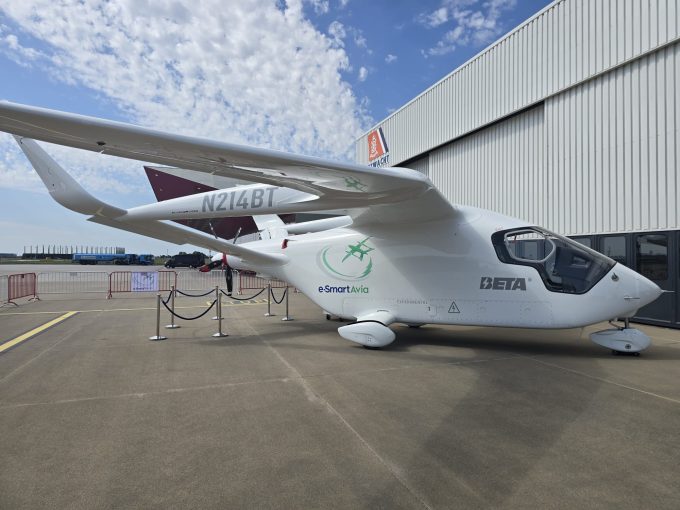
One of the first operating lease agreements for electric cargo aircraft has been signed – a move that could help accelerate their commercial rollout by removing one of the biggest barriers to adoption: financing.
e-Smart Group has agreed a deal with aerospace asset finance specialist Space Leasing International (SLI) for up to 20 BETA Technologies ALIA aircraft, converting an order placed last year into an operating lease arrangement, under which SLI will own the aircraft while e-Smart makes fixed monthly payments.
While aircraft orders for electric and advanced air mobility (AAM) platforms have become increasingly common, financing agreements seem relatively uncommon, making the deal a significant milestone.
SLI chief executive Praveen Vetrivel believes leasing is key. “We believe leasing will play a significant role in getting electric aviation off the ground,” he told The Loadstar.

“The benefits of lower operating costs can very quickly be offset by competitive financing costs, making leasing an efficient way for established and new operators to take on new assets with lower capital commitments.
“Just as the availability of leasing fuelled growth in the conventional aviation sector starting in the 1970s, we believe the same will happen with electric aviation.”
He added that many new operators would prefer to lease aircraft rather than commit scarce capital to assets built around rapidly evolving technology.
“We create lease agreements that ensure the lessee feels entirely comfortable, knowing they have access to the latest technology without undue long-term commitment.”
That is particularly relevant for electric aircraft, where battery lifecycles and long-term asset values remain a developing area for both operators and financiers.
Mr Vetrivel acknowledged financing these assets required consideration of issues such as battery life and depreciation, but said the underlying principles remained similar to conventional aviation leasing.

Praveen Vetrivel
“The well-proven principles of both fixed and rotary-wing aviation broadly apply to electric aircraft,” he said.
SLI, which was established by Libra Group in 2023, now has commitments covering up to 190 electric aircraft and autonomous cargo drones. Mr Vetrivel said he expected about 20 aircraft to be flying within the next two years, although certification timelines would largely determine the pace of deployment.
On the operational side, e-Smart is positioning the aircraft to complement existing logistics networks rather than a replacement for trucks or larger freighters.
“The air service will and should complement the road networks for time-sensitive shipments,” said CEO Denis Ilin. “This might apply to point-to-point deliveries as well as air-feeder services for long-haul air cargo operations.”
He argued that conventional aircraft were often uneconomic on short regional routes, while electric aircraft offered another advantage.
“The BETA aircraft will allow for zero-emission operations even during night-ban hours,” he said.
The first five conventional take-off and landing (CTOL) aircraft are scheduled for delivery in the second half of 2027, with commercial operations expected to begin later in the year.
Those aircraft will operate airport-to-airport services carrying payloads of up to about 500kg over sectors of around 350km, with eventual expansion to 500km. The company plans to operate both scheduled services and ad hoc charter flights for urgent deliveries.
Mr Ilin said profitability would require utilisation of more than 80 block hours a month, although charging infrastructure could initially increase turnaround times.
While BETA’s mobile charging units would allow operations from day one, he acknowledged that permanent charging infrastructure would be essential for wider deployment.
“Prompt development of ground charging infrastructure is going to be an important factor to roll out electric aircraft operations across Europe,” he said.
“Fortunately, most airports are already developing charging infrastructure for ground vehicles, which can also be used for electric airplanes.”

Denis Ilin
Despite those challenges, Mr Ilin said, customer interest had exceeded expectations.
The company has been in discussions with potential customers across emergency logistics, express freight, and ecommerce, alongside plans to begin securing commercial commitments once its initial route network has been confirmed.
“The feedback has been very positive, and even enthusiastic,” he said.
Indeed, he believes the initial fleet could prove far too small.
“Our business plan started with five aircraft, which would be the bare minimum for any large gateway,” he said.
“But through discussions with potential clients, we quickly realised that any large city in Europe can become home to at least five to seven units, creating a network of regional stations with a total fleet of more than 100 aircraft.
“Again, this niche is empty and demand is there.”
BETA’s aircraft will be present at next week’s Farnborough Air Show.
This article is © The Loadstar. Reproduction, rewriting, or derivative use requires a license. Contact [email protected] for licensing enquiries.
For uninterrupted access, sign in or sign up to The Daily News, Premium or The Loadstar Enterprise Plan.

Comment on this article