A calmer transatlantic as box carriers balance supply and demand
Following a turbulent 2025 and early 2026, marked by shrinking volumes and rates, the transatlantic ...

WTC: NO LUCKCHRW: 'NUCLEAR VERDICT'DSV: DEEP CUTKNIN: UPGRADEDKNIN: AI BENEFITSKNIN: NOT WORTH ITPLD: DEAL TIMEKNIN: CONF CALL CLOSING KNIN: PRICING POWER KNIN: MARKET SHARE GAINS IN ROAD KNIN: AI-RELATED COST INFLATION OUTLOOKKNIN: APEX LOGISTICS IPO UPDATEKNIN: QUESTION TIMEKNIN: 'COST REDUCTION PROGRAMME IS ON TRACK'KNIN: CFO REMARKSKNIN: MONETARY IMPACT FROM AI KNIN: AI UPSIDEKNIN: STRONG ROAD UNIT DELIVERY KNIN: AIR LOGISTICS SHINES
WTC: NO LUCKCHRW: 'NUCLEAR VERDICT'DSV: DEEP CUTKNIN: UPGRADEDKNIN: AI BENEFITSKNIN: NOT WORTH ITPLD: DEAL TIMEKNIN: CONF CALL CLOSING KNIN: PRICING POWER KNIN: MARKET SHARE GAINS IN ROAD KNIN: AI-RELATED COST INFLATION OUTLOOKKNIN: APEX LOGISTICS IPO UPDATEKNIN: QUESTION TIMEKNIN: 'COST REDUCTION PROGRAMME IS ON TRACK'KNIN: CFO REMARKSKNIN: MONETARY IMPACT FROM AI KNIN: AI UPSIDEKNIN: STRONG ROAD UNIT DELIVERY KNIN: AIR LOGISTICS SHINES

Despite mounting geopolitical tensions and widespread talk of near-shoring, global supply chains are actually stretching, rather than shrinking, according to the latest DHL Global Connectedness report.
Produced with New York University’s Stern School of Business, the report found that international trade flows in 2025 travelled the longest average distances on record, suggesting companies are continuing to diversify supply chains globally rather than regionalising production.
Average trade distances reached 5,010 km, while greenfield foreign direct investment projects averaged 6,250 km, both new highs.

The findings challenge a prevailing narrative that geopolitical tensions, US tariffs, and supply chain disruptions are driving a fundamental shift toward regionalised production networks. Instead, the data suggests globalisation has proved more resilient than many policymakers and analysts expected.
“Predictions of a broad move from global to regional business have not materialised – at least not yet,” the report notes.
While companies are adjusting sourcing strategies, the changes appear to involve re-routing trade through new partners, rather than shortening supply chains. Countries such as India and Vietnam are emerging as key alternative hubs as firms diversify from geopolitical rivals.
The report does confirm that economic ties between the US and China are weakening. Trade between them accounted for 3.6% of global trade at its peak in 2015, falling to 2.7% in 2024, and around 2% in 2025, according to the study.
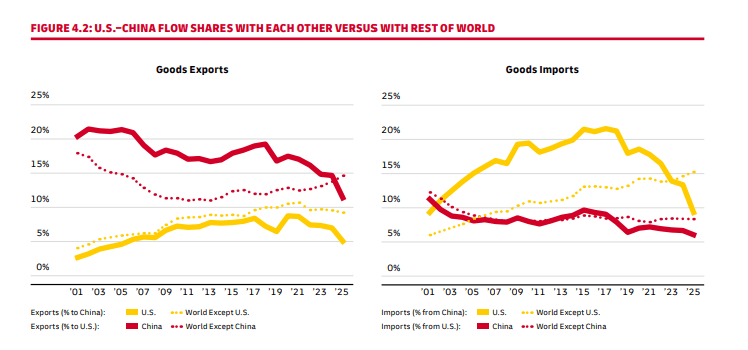
However, the authors stress that this shift represents only a small share of global economic flows and does not signal a wider fragmentation of the world economy. Instead, most countries continue to trade and invest primarily with longstanding partners.
Overall, the DHL Global Connectedness Index shows the level of globalisation remaining close to a historic peak.
The index measures cross-border flows of trade, capital, information, and people and stood at around 25% in 2025, unchanged from the record high reached in 2022. That means international flows are still expanding roughly in line with domestic economic activity.
Global trade also proved surprisingly robust last year, growing faster than in any year since 2017, outside the post-pandemic rebound. Investment in artificial intelligence infrastructure played a major role, with AI-related goods accounting for 42% of global trade growth in the first three quarters of 2025.
Looking ahead, global goods trade is expected to expand by around 2.6% annually through 2029, roughly in line with the pace of the past decade.
“Globalisation is not reversing,” the report concludes. “It is reshaping and rebalancing, while remaining at historically high levels.”
For uninterrupted access, sign in or sign up to The Daily News, Premium or The Loadstar Enterprise Plan.
Comment on this article
Andrew C
March 10, 2026 at 1:38 pmIt is interesting to see the data actually backing up how hard it is to move away from established global hubs. Even with all the talk about near-shoring, those deep-rooted infrastructure and cost advantages are clearly keeping the long-distance trade lanes busy.