DP World to develop new UAE terminals outside Hormuz
DP World confirmed today that it had reached an agreement with Fujairah Ports Authority to ...

WTC: NO LUCKCHRW: 'NUCLEAR VERDICT'DSV: DEEP CUTKNIN: UPGRADEDKNIN: AI BENEFITSKNIN: NOT WORTH ITPLD: DEAL TIMEKNIN: CONF CALL CLOSING KNIN: PRICING POWER KNIN: MARKET SHARE GAINS IN ROAD KNIN: AI-RELATED COST INFLATION OUTLOOKKNIN: APEX LOGISTICS IPO UPDATEKNIN: QUESTION TIMEKNIN: 'COST REDUCTION PROGRAMME IS ON TRACK'KNIN: CFO REMARKSKNIN: MONETARY IMPACT FROM AI KNIN: AI UPSIDEKNIN: STRONG ROAD UNIT DELIVERY KNIN: AIR LOGISTICS SHINES
WTC: NO LUCKCHRW: 'NUCLEAR VERDICT'DSV: DEEP CUTKNIN: UPGRADEDKNIN: AI BENEFITSKNIN: NOT WORTH ITPLD: DEAL TIMEKNIN: CONF CALL CLOSING KNIN: PRICING POWER KNIN: MARKET SHARE GAINS IN ROAD KNIN: AI-RELATED COST INFLATION OUTLOOKKNIN: APEX LOGISTICS IPO UPDATEKNIN: QUESTION TIMEKNIN: 'COST REDUCTION PROGRAMME IS ON TRACK'KNIN: CFO REMARKSKNIN: MONETARY IMPACT FROM AI KNIN: AI UPSIDEKNIN: STRONG ROAD UNIT DELIVERY KNIN: AIR LOGISTICS SHINES
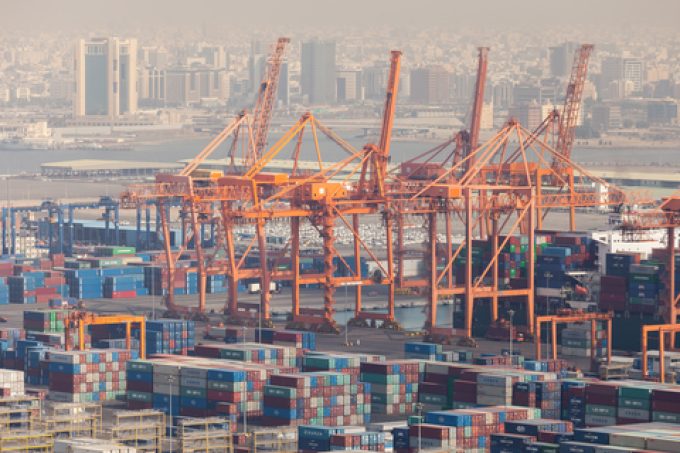
Saudi Arabia’s red Sea port of Jeddah is further cementing its new role as a key container gateway to the Persian Gulf countries whose supply chains have been severed by the closure of the Straits of Hormuz.
In addition, despite sporadic attacks on ports outside Hormuz, carriers are also offering the UAE ports of Khor Fakkan and Fujairah, as well as the Omani ports of Sohar, Duqm and Salalah as alternative gateways to markets within the Gulf.
French container shipping line CMA CGM today said it had drawn up three multimodal corridors to access Gulf Cooperation (GCC) countries.
“Located south of the Strait of Hormuz, Khor Fakkan, Fujairah, and Sohar serve as strategic entry points for Gulf-bound flows,” the carrier said today.
“From these ports, CMA CGM offers logistics corridors to serve the main hubs in the UAE – Khalifa, Jebel Ali and Sharjah,” it added.

Source: CMA CGM
According to Drewry’s senior associate of ports and terminals, Eirik Hooper, the entire Gulf region processes around 33m teu a year, with about two-thirds of that handled in Dubai and Abu Dhabi, and nearby Khor Fakkan remains the best placed port to handle Gulf-bound flows.
“Khor Fakkan is the only port where bypass utility is genuinely high – at 130km from Dubai via a good dual carriageway, it can absorb some additional Dubai-bound volume with limited additional infrastructure.
“UAE authorities have already implemented emergency customs clearance procedures allowing direct road transfer to Jebel Ali and Abu Dhabi free zones – a pragmatic measure that validates the corridor’s pre-existing role,” he said.
However, its location also means it is vulnerable to Iranian projectile attacks and vessels calling there are likely to do so under much higher insurance premiums, Ellis Morely, divisional director at marine insurer Howdens told a European Shippers Council webinar on Friday.
He said the Lloyd’s of London joint-war committee last week redrew the high-risk area after attacks on Oman and elsewhere outside the Gulf. “If we’re talking about Omani and UAE ports from Fujairah and Salalah – it’s well within targeting range and capability.
“Is it less of a risk than transiting through the Straits of Hormuz? Our view is yes, the straits are the highest risk part of this whole area, but these alternatives are by no means a safe option,” he said.
And Mr Hooper said that the huge distance between Salalah and the UAE – some 1,700km through the Empty Quarter and no rail connection – mean trucking costs would be enormous.
“A 40ft container trucked from Salalah to Dubai costs an estimated $3,000-$5,000, based on per-kilometre benchmarks, versus $200-$400 drayage from Jebel Ali.
“As a Gulf supply chain bypass, it is effectively disconnected,” he said, adding however, that it could “handle some of the transhipment cargo bound for the East African and South Asian markets traditionally handled in Jebel Ali”.

Source: Drewry Maritime Advisors
This inevitably makes supply chain planners look once more at Jeddah, which can be accessed by vessels performing southbound Suez Canal transits, and CMA CGM said it had “established road corridors, with or without maritime connections, for onward delivery to Saudi Arabia (Dammam), the UAE, Qatar, Bahrain, Kuwait, and Iraq.
“This setup also allows flows to connect to the Mediterranean and Asia without exposure to the strait.”
For Middle East countries further north, such as Iraq, the French line is also offering trucking services out of the Turkish port of Mersin, similar to MSC, and the Jordanian gateway of Aqaba.
Despite the relative safety of Jeddah, the distance remain huge, Mr Hooper said, but would have been substantially mitigated if Saudi Arabia had pressed ahead with its plans to build a rail freight line more urgently.
Jeddah, King Abdullah and Duba (NEOM) offer meaningful capacity for Saudi domestic consumption, but there is currently no rail connection between Jeddah and Riyadh.
“The Saudi Landbridge, the 950-km freight railway that would create this link, remains unbuilt, with construction tenders not expected until mid-2026 and completion targeted for the early 2030s.
“Without it, all Red Sea-Gulf hinterland container movement must go by road, approximately 950 km Jeddah-Riyadh and 1,400 km Jeddah-Dammam.
“For Qatar, Bahrain, Kuwait and Iraq, none of which have viable overland bypass routes that avoid either Hormuz or Saudi territorial transit, no adequate alternative exists,” he added.
For uninterrupted access, sign in or sign up to The Daily News, Premium or The Loadstar Enterprise Plan.
Comment on this article