AI cargo props up air cargo market amid warnings of an early peak
Booming AI-related shipments are offsetting weaker ecommerce demand in air cargo, with analysts warning geopolitical ...

PLD: PROPOSAL DETAILSPLD: FINAL OFFERDSV: ROAD CEO MATTERSDSV: VOLUME PROGRESSION IN SEA FREIGHT DSV: TIME TO INCREASE THE VOLUMES IN SEA FREIGHTDSV: HEADCOUNT DISCREPANCIESDSV: TRASHEDDSV: IT IS A MATTER OF TRUSTDSV: FREE CASH FLOW QUESTIONEDDSV: QUESTION TIMEDSV: CEO ON SCHENKER INTEGRATIONDSV: CFO PREPARED REMARKSDSV: CEO PREPARED REMARKSDSV: CONF CALL FWRD: SHOOTING UPKNX: TRADING UPDATE ON THE WAY GM: TRADING UPDATE OUTUPS: REMEMBER THE TAILWINDS
PLD: PROPOSAL DETAILSPLD: FINAL OFFERDSV: ROAD CEO MATTERSDSV: VOLUME PROGRESSION IN SEA FREIGHT DSV: TIME TO INCREASE THE VOLUMES IN SEA FREIGHTDSV: HEADCOUNT DISCREPANCIESDSV: TRASHEDDSV: IT IS A MATTER OF TRUSTDSV: FREE CASH FLOW QUESTIONEDDSV: QUESTION TIMEDSV: CEO ON SCHENKER INTEGRATIONDSV: CFO PREPARED REMARKSDSV: CEO PREPARED REMARKSDSV: CONF CALL FWRD: SHOOTING UPKNX: TRADING UPDATE ON THE WAY GM: TRADING UPDATE OUTUPS: REMEMBER THE TAILWINDS

Flexport is to ease the path for customers with an additional $250m in supply chain finance through a partnership with BlackRock.
Yesterday, Flexport announced that its Flexport Capital arm would have access to more funds “to enable its customers to access a broader range of working capital financing options”.
The company, which has provided more than $2bn in financing to customers since 2017, said it had achieved annualised growth rate of 71% over the past five years.
“Global trade runs on cash flow, and too many great businesses fall behind simply because they can’t fund the gap between when they buy inventory and when they sell it,” said Flexport CFO Stuart Leung.
“Together with BlackRock, Flexport Capital offers businesses more access to flexible capital to help them scale.”
It said its “flexible working capital” could help customers with challenges such as inventory and logistics finance, term loans, asset-based lines of credit and tariff finance.
“Flexport customers can also access funding at any stage of the product lifecycle, from supplier pick-up to final delivery and beyond, without the complex fees or documentation common in traditional lending,” the company added.
But Flexport hit the news for another reason yesterday: it was named, along with other unicorns, in a securities fraud case whereby scammers had attempted to abuse its shareholdings.
Two sales team leaders for a variety of fund management companies admitted mis-selling stock issued by private companies that were considering an IPO, including Flexport, Stripe and Instacart. The funds raised $70m from the scam, which falsely represented that the investment funds were registered with the SEC, made misleading promises, and used high-pressure sales tactics between July 2021 and April 2023.
Flexport neither knew about the scam, nor was involved.
Of the $70m, nearly $31m was secretly charged in mark-ups, according to the prosecution, (which did not reveal which of the companies in the list below was Flexport).
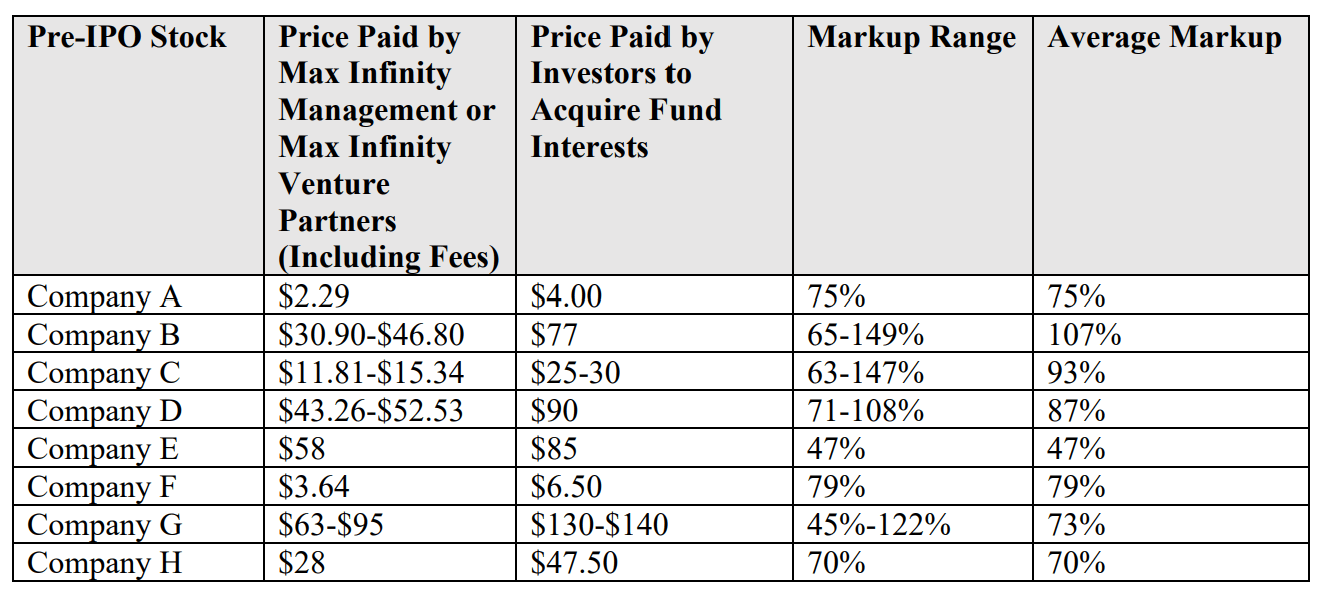
“Defendants engaged in a scheme to defraud investors and prospective investors using boiler room-style high-pressure sales tactics, false and misleading statements, and other means of trickery and deception to offer and sell investment fund interests purportedly representing shares of stock in private companies that had not yet held an initial public offering … Through the conduct of each defendant, which violated the antifraud, securities registration, and broker-dealer registration provisions of the federal securities laws, the scheme raised over $70m from more than 550 investors throughout the United States.”
Meanwhile, Flexport’s ambitions for an IPO have been delayed, and will likely be postponed until there is profit, expected to be this year.
CEO and founder Ryan Petersen told WSJ in March: “At the end of the year [2025], we can actually entertain that [IPO idea]. For now, it’s off the planning horizon.”
Nevertheless, yesterday AccessIPOs named the forwarder in a list of ‘Upcoming IPOS 2025, 70+ start-ups in the IPO pipeline’.
It suggests Flexport is worth $2.5bn to $3bn, and shows how to acquire shares, “usually a challenge … [for] a stock that [is] not yet trading on the public markets”.
“However, there are a few ways to own Flexport stock sooner than later. All US-based investors are now eligible to invest in the fund for a $500 minimum investment.
“You will only own a small portion of the company. The fund is a diversified way to own a pool of pre-IPO startups. You’ll gain access to several high-growth companies with one purchase. If you are an accredited investor, there may be additional options.
“Founders, early employees, and investors are often in a difficult predicament. They own valuable shares of a company that doesn’t trade publicly.
“These shareholders might have multi-million dollar net worths because of their stock holdings, but the stock is not liquid because it doesn’t trade on an exchange.
“Multiple platforms have evolved to allow these individuals to liquidate their holding before the IPO.”
One such platform is Hiive, which has traded stocks in Flexport since May 2022, “one of the most actively traded pre-IPO companies on Hiive, with prices frequently fluctuating”, explained Hiive spokesperson Nathan Pitzer earlier this year.
“A wide variety of investors are active on Hiive. The majority of our transaction volume comes from institutional investors, including VC firms, PE firms, and family offices. Any accredited investor can use the platform to submit transactions. Our minimum transaction size is $25K, while the average transaction size is approximately $400K.”
He added: “Hiive is a live market, meaning prices are set by the supply and demand of buyers and sellers.”
Flexport’s shares on Hiive have fallen since the May 2022, when they launched at $15. The price hit a low of $2.07 last December, rising to $3.27 now.
For uninterrupted access, sign in or sign up to The Daily News, Premium or The Loadstar Enterprise Plan.
Comment on this article
Alexander Kozij
October 07, 2025 at 4:24 amThe service of funding client inventory is one of the most valuable that can be offered.
It also enables the the transportation side of the business to charge reasonable rates, that still generate a profit.
When your transportation provider provides cash flow to fund an importers inventory. And that is something the importer needs.
Most of other value such shipment visibility, a couple hundred dollars savings per shipment, responsiveness etc. Is no longer a compelling enough, value proposition to get a importers to evaluate alternative Freight Forwarders.
UPS has provided this service for years (due in part to UPS’s immense financial leverage with institutions and cash position). UPS has gained and retained thousands of customers through this service for over a decade, in spite of being more expensive and having sub-par customer service.
That being said, this a high risk endeavor for all businesses to provide to their clients.