Middle East premium fades – but AI boom keeps air freight rates aloft
Air freight markets appear to be settling, with capacity largely returned to the Gulf, fuel ...


PLD: TRADING UPDATE ON THE WAY KNIN: UPSIDEJBHT: STRONG TRADING UPDATE DSV: EVERY LITTLE HELPSJBHT: CEO REMARKS WMT: VERTICAL INTEGRATION IN LOGISTICSJBHT: HERE WE GOPG: STEADYEXPD: NEW RECORD BA: DELIVERIESMAERSK: BEAR CAMP MUSINGS
PLD: TRADING UPDATE ON THE WAY KNIN: UPSIDEJBHT: STRONG TRADING UPDATE DSV: EVERY LITTLE HELPSJBHT: CEO REMARKS WMT: VERTICAL INTEGRATION IN LOGISTICSJBHT: HERE WE GOPG: STEADYEXPD: NEW RECORD BA: DELIVERIESMAERSK: BEAR CAMP MUSINGS
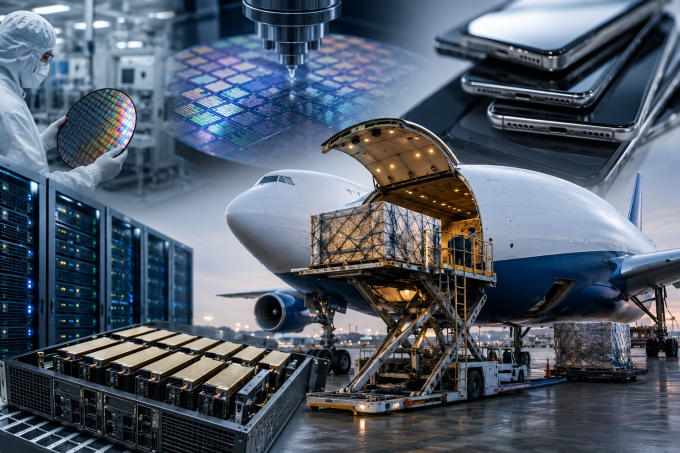
The AI infrastructure boom looks set to keep air cargo demand elevated for years, after the world’s largest contract chipmaker predicted demand would remain strong until the end of the decade.
There is now no doubt that semiconductors, servers, and data centre equipment have overtaken smartphones as the industry’s fastest-growing electronics market.
Taiwan Semiconductor Manufacturing Company (TSMC) today raised its full-year revenue forecast after reporting another record quarter, saying AI-related demand remained “extremely robust”, and customers continued to provide “very strong” demand signals.
Chief executive CC Wei said demand could remain robust through 2029 or 2030.
The comments closely mirror what air cargo operators are already seeing. According to Aevean, data centre-related air trade grew 42% last year, driven by a 65% jump in shipments of GPUs and AI accelerators and a 70% rise in networking equipment.
The consultancy estimates hi-tech cargo added around 170,000 tonnes to US air imports in the first quarter alone, equivalent to about 52 fully loaded widebody freighter flights every day.
TSMC reported Q2 revenue of NT$1.27trn ($40.2bn), up 36% year on year, while net profit jumped 77%, to NT$706.6bn. It also increased its 2026 revenue outlook, saying it now expected sales to grow “slightly above 40%” in US dollar terms.
“Our customers and customers’ customers, mainly the cloud service providers, continue to provide us with a very strong signal and positive outlook,” Mr Wei told analysts. “Thus, our conviction in the multi-year AI megatrend remains very high.”
Asked how long supply would remain constrained by AI demand, he replied: “I believe from this day on, all the way to probably 2029, 2030, demand is very strong.”
The company also raised planned capital expenditure this year to $60bn-$64bn, up significantly from $52-56bn, with Mr Wei saying investment would continue to increase.
“As long as there are business opportunities, we will not hesitate to invest,” he said, adding that capital expenditure over the next three years would be “significantly higher” than over the previous three.
Mr Wei said TSMC was independently verifying AI demand by tracking the construction and location of new data centres to ensure chips were being deployed rather than simply accumulating in inventory.
TSMC’s own figures illustrate how dramatically the semiconductor market has changed. High-performance computing, which includes AI processors, accounted for 66% of second-quarter revenue, while smartphones contributed just 22%, down from 26% in the previous quarter. North America represented 78% of sales, showing that the AI investment wave continues to be driven primarily by US hyperscalers and chip designers.
But while demand is concentrated in North America, the freight movements are increasingly global. TSMC said it was expanding advanced manufacturing capacity in Taiwan, Arizona, and Japan, while Germany will focus on mature-node automotive and industrial production.
TSMC will also invest in advanced packaging, creating additional flows of high-value semiconductor equipment, materials, and components across Asia and the Pacific.
The trend has already been evident to freight forwarders specialising in the sector.
Speaking to The Loadstar earlier this year, Morrison Express CEO Asok Kumar said manufacturers throughout the AI supply chain were reporting exceptionally full orderbooks.
“They’re talking about being booked out until end of next year, some even until end of ’28… and many are saying this will continue till 2030.”
He added that the growth extended well beyond semiconductor manufacturers themselves.
“It’s the one vertical market that’s just showing exceptional growth.”
Mr Kumar said the busiest freight corridors remained intra-Asia, followed by the transpacific, closely reflecting the geography of semiconductor manufacturing and AI investment.
The surge in AI infrastructure is also beginning to reshape the wider electronics market.
Counterpoint Research this week reported that global smartphone shipments fell 11% in the second quarter, to their lowest Q2 level in 13 years, attributed partly to higher handset prices, caused by rising memory chip costs as AI data centres absorb increasing volumes of supply.
For years, air cargo’s hi-tech vertical has been shaped by consumer product launches. But TSMC’s latest outlook suggests the industry’s growth is now increasingly tied to hyperscaler capital expenditure instead.
If today’s forecasts prove accurate, demand for semiconductor and AI infrastructure shipments could remain a structural feature of the market well into the next decade.
For uninterrupted access, sign in or sign up to The Daily News, Premium or The Loadstar Enterprise Plan.

Comment on this article