Box ship attacked, Hormuz shut again, Middle East rates sail past pandemic peak
Gulf importers and their forwarders are once more turning to Middle East landbridge routes after ...

VW: THE IMPACT VW: MASSIVE JOB CUTS CONFIRMEDEXPD: BULLISHCHRW: POSITIONING AHEAD OF EARNINGSAMZN: IN THE NUMBERSAMZN: PEOPLE MATTER UNTILVW: THE LAST CUT IS THE DEEPESTJBHT: GEARING UP VW: BUYING TIMER: BIG VOTE OF CONFIDENCEAAPL: BEARISH HEDGEYE AAPL: THE BEAR CASEFDX: LIFE SCIENCES ORG UNVEILEDWTC: UPS AND DOWNSWTC: ASX ANNOUNCEMENT REGARDING DSV PARTNERSHIP VW: D-DAY
VW: THE IMPACT VW: MASSIVE JOB CUTS CONFIRMEDEXPD: BULLISHCHRW: POSITIONING AHEAD OF EARNINGSAMZN: IN THE NUMBERSAMZN: PEOPLE MATTER UNTILVW: THE LAST CUT IS THE DEEPESTJBHT: GEARING UP VW: BUYING TIMER: BIG VOTE OF CONFIDENCEAAPL: BEARISH HEDGEYE AAPL: THE BEAR CASEFDX: LIFE SCIENCES ORG UNVEILEDWTC: UPS AND DOWNSWTC: ASX ANNOUNCEMENT REGARDING DSV PARTNERSHIP VW: D-DAY

2026 is emerging as the year of “peak liquidity stress” for freight forwarders, with operational disruption and increased buyer power translating into cash inflow and outflow disparity, according to recent report by logistics technology platform OntegosCloud.
“The Middle East escalation has exposed a structural weakness in the industry,” said Oliver Gritz, its founder and CEO.
“Forwarders are paying with certainty, but collecting with increasing unpredictability,” he explained. “This is not just disruption; it’s a cash flow breakdown.”
The report warned that the growing gap between cash in and cash out was reaching “critical levels” across the freight forwarding industry. Unchanged fixed-timing cash outflows include carrier payments, duties, and advances; but at the same time, inflows are becoming “increasingly unpredictable”.
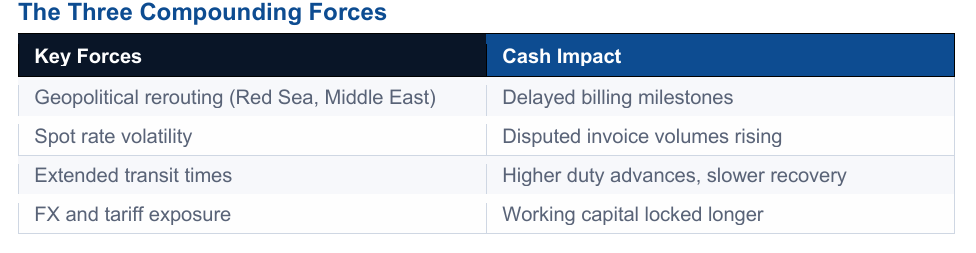
The main driver of this is attributed to disruption in the Red Sea and broader Middle East region, which have extended transit times and, in turn, shifted billing milestones.
OntegosCloud also identified a rise in invoice disputes, “directly delaying cash realisation”. The report said: “Freight costs and emergency surcharges are rising sharply, increasing working capital requirements, shipping risk premiums and insurance constraints are tightening, reducing operational flexibility, and route uncertainty is driving higher dispute volumes, slowing collections further.
“At the same time, shifting market dynamics, particularly increased buyer power, are extending payment terms and weakening payment discipline across the industry,” it added. “These developments are directly fracturing the cash conversion cycle of freight forwarders.”
Source: OntegosCloud (click to expand)
Further, the report warned, even if geopolitical tensions stabilised, the financial after-effects would persist “well into 2027”, continuing to stretch cash cycles and lock-up working capital.
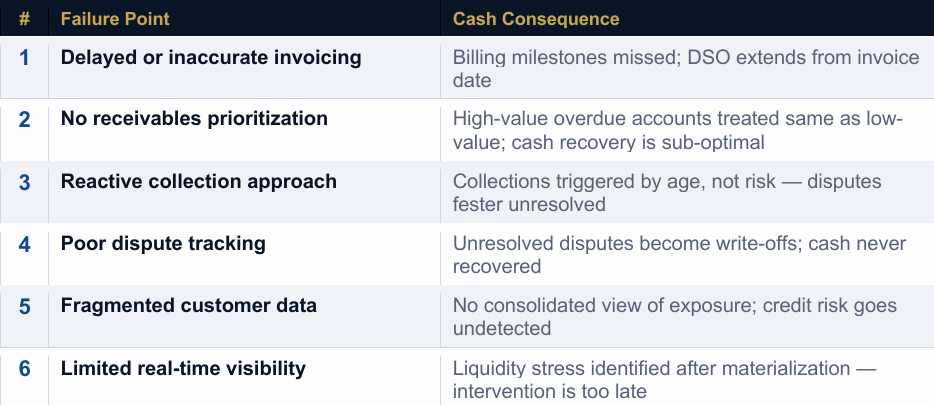
However, it added that cash flow tightening was not simply a “market-driven phenomenon” beyond control, but also a “management discipline failure”.
Mr Gritz explained: “Two forwarders operating under identical market conditions can experience materially different cash outcomes, driven not by external exposure alone, but by the discipline of their internal receivables processes.”
Source: OntegosCloud (click to expand)
He stressed that liquidity management was becoming a “competitive differentiator” this year.
“In this environment, maintaining cash liquidity becomes a critical lever of maintaining cash health for forwarders. The companies that build real-time visibility and discipline into receivables will outperform, while others will find themselves operationally active, but financially constrained,” he exxplained.
OntegosCloud stressed that the forwarders that can navigate 2026 successfully would be those that treat liquidity as an “actively managed capability”, not a “downstream outcome”.
Key priorities should include real-time visibility into receivables, risk-based collection strategies, faster dispute resolution, and integrated cash cycle monitoring.
“In 2026, the ability to convert operations into cash, with speed, precision, and visibility, will define industry leaders,” summed up the report.
Watch our recent Loadstar Snapshot on the financial fallout of the Middle East conflict on global shipping:
For uninterrupted access, sign in or sign up to The Daily News, Premium or The Loadstar Enterprise Plan.

Comment on this article