Cosco launches Incheon-North Africa used car shipping service
Cosco Shipping Specialised Carriers, the Chinese group’s multipurpose arm, yesterday launched a regular service to ...


HON: DEALS ON THE MENUEXPD: NEW RECORD XPO: THE REBOUNDCAT: PAYOUT UPDHL: LIGHTHOUSEMAERSK: ANOTHER UPGRADEFWRD: HEALTHY CORRECTION R: RYDER CEO SAYS R: AMAZON LTL ANNOUNCEMENTPLD: EV INFRASTRUCTURE PUSHDHL: RAMPING UP 'NEW ENERGY LOGISTICS' GXO: NEW WINAMZN: LTL SERVICE UPDATEGM: ENERGY PROVIDER MODEL
HON: DEALS ON THE MENUEXPD: NEW RECORD XPO: THE REBOUNDCAT: PAYOUT UPDHL: LIGHTHOUSEMAERSK: ANOTHER UPGRADEFWRD: HEALTHY CORRECTION R: RYDER CEO SAYS R: AMAZON LTL ANNOUNCEMENTPLD: EV INFRASTRUCTURE PUSHDHL: RAMPING UP 'NEW ENERGY LOGISTICS' GXO: NEW WINAMZN: LTL SERVICE UPDATEGM: ENERGY PROVIDER MODEL
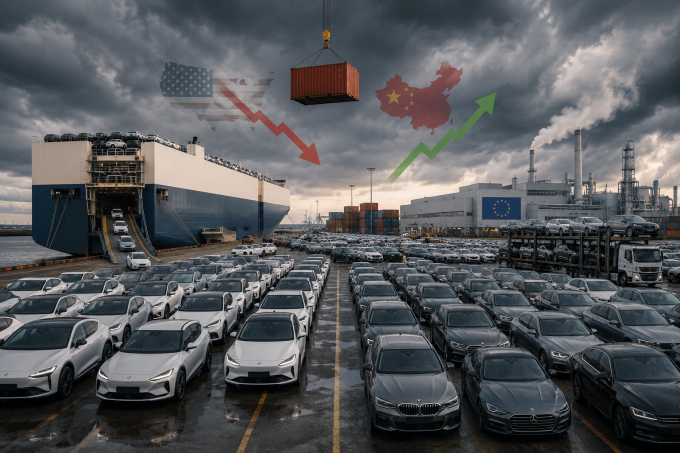
European automakers and their logistics services providers are navigating a period of upheaval and structural change, according to industry and research sources interviewed by The Loadstar.
Hit hard by US tariff hikes, a sizeable chunk of OEM premium export business has disappeared, while on the home front, Chinese rivals are not only shipping vehicles to the EU in ever-increasing numbers, but are accelerating plans to operate local production facilities in the bloc.
“The European automotive industry is facing a perfect storm of challenges. The market remains broadly flat, although there are notable exceptions. Spain and Poland continue to outperform most other European markets and are among the few countries still delivering meaningful growth,” said Frank Schnelle, executive director of the Association of European Vehicle Logistics (ECG).
“However, overall, the industry is having to deal with significant overcapacity. This is not only a European issue, but a global one. In China, the utilisation rate of production facilities is below 50%. In Europe, it is below 80%, we understand.”
Export markets have weakened considerably, with EU car shipments to the US falling approximately 13.5% last year, to around 668,000 vehicles, figures from the European Automobile Manufacturers’ Association reveal. And more recent data shows the pace of decline went up a couple of gears in January and February, year on year.
“The decline in EU exports to China has been even more notable, having been one of the most important markets for European vehicle manufacturers,” Mr Schnelle said. “Concurrently, Europe is experiencing a sizeable increase in vehicle imports from China, fundamentally changing the balance between export and import flows”
The arrival of Chinese brands “is definitely reshaping the market composition in automotive logistics”, noted Rico Luman, senior sector economist, transport & logistics, at Dutch bank ING.
“They are a driver of electrification, and this also has an impact on automotive logistics in terms of the weight of vehicles and the safety aspects,” he told The Loadstar.
“We know the incumbent European car industry has significant excess capacity, so collaboration with Chinese players could absorb some of it. At the same time, sales of new cars still hover 10% to 15% lower than pre-pandemic. Affordable EVs could push up new car sales, but we’re not there yet,” he added.
On exports, he said: “Emerging export markets, such as Latin America, are on the rise, while new EU trade agreements with India, Indonesia, and Australia offer new, longer-term growth opportunities.”
Returning to imports, having to handle these in greater quantities represents logistical challenges, as they typically require substantially more storage capacity than vehicles for export, explained Mr Schnelle. “As a rule of thumb, imported vehicles require roughly twice the storage space.
“They generally remain in compounds longer, require additional processing and distribution activities and create more complex inventory management challenges, he added.
.“Consequently, ports and inland compounds across Europe are expanding storage capacity. The strong increase in imports from China is again creating significant demand for storage space across the network.”
He also signalled growing concern that imported vehicle volumes may exceed the pace at which they could be sold on the European market – “congestion builds throughout the supply chain and pressure on available storage capacity increases further”, he said.
Mr Schnelle also highlighted the increasing number of vehicles being transported in containers.
“Generally not the ideal solution for finished vehicle logistics,” he noted. “Box terminals are typically not integrated into automotive logistics networks in the same way as dedicated vehicle terminals. They are disconnected from vehicle storage, technical processing, and distribution activities, creating inefficiencies and increasing the risk of transport damage.”
Turning to the impact of the conflict in the Middle East and the resulting surge in fuel prices, he noted: “Fortunately, most transport contracts today contain fuel adjustment mechanisms. However, many of these clauses only take effect after up to three months.
“For many smaller transport companies, this creates a significant cash flow challenge, as they must absorb the increased fuel costs before compensation mechanisms apply. ECG has therefore advocated for shorter adjustment cycles. Otherwise, there is a real risk that transport capacity will leave the market, which is clearly not in the interest of vehicle manufacturers.”
The trade body has been encouraged to see that a number of OEMs have recognised this challenge and adjusted their mechanisms accordingly. This has helped protect capacity and maintain stability across parts of the finished vehicle logistics sector.
More broadly, ECG members are also dealing with increasing sustainability requirements, investment needs related to digitalisation and decarbonisation, and a general lack of predictability in vehicle production and trade flows, “making planning and investment decisions increasingly difficult”.
Finally, have these difficult market conditions led to European automakers reducing spend on transport and logistics costs?
“That’s definitely what we’ve seen recently, but at the same time, reliable logistics and supply chains have become a boardroom theme,” Mr Luman said.
“Resilience is key, and this also comes with additional services, such as storage in ports. In any case, freight rates have gone up following the hostilities in the Gulf.”
For uninterrupted access, sign in or sign up to The Daily News, Premium or The Loadstar Enterprise Plan.

Comment on this article