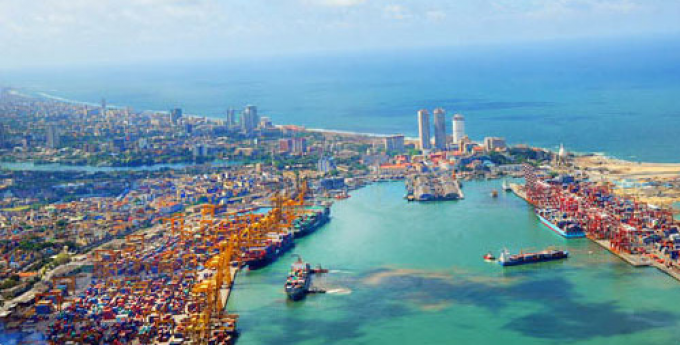
Colombo
Photo: Sri Lanka Ports Authority

Amid more supply chain disruption engulfing the Middle East, industry sources in Sri Lanka are reporting outreach signals from several major container lines seeking terminal slots for ad-hoc transhipment calls at Colombo Port.

Sources said the Sri Lanka Ports Authority (SLPA) had begun talks with carriers impacted by port closures and other security issues in the Persian Gulf.

Logistics voices in Colombo have also confirmed the trade development.

“Shipping lines are increasingly considering the p ort of Colombo as an alternative discharge hub,” said Rezvan Rasheed, CEO of Colombo-based Aries Global Logistics, in a LinkedIn post.

“As disruptions continue across key Gulf gateways, Colombo’s strategic position is again coming into focus as a critical transhipment node to maintain cargo flows and minimise delays and costs.”

The late-2023 Red Sea crisis delivered bumper hub dividends for Colombo from widespread vessel diversions, culminating in serious harbour congestion issues due to a shortage of capacity. Sources agree Colombo is now better equipped, having added significant capacity from the recent launch of two expansion projects — Adani Ports’ phase 1 operations of its Colombo West International Terminal (CWIT) and the addition of a third berth at the SLPA-owned East Container Terminal (ECT).

“With the third berth now brought into service, throughput volumes are expected to accelerate materially, strengthening Colombo’s standing as a principal transhipment centre serving the Indian subcontinent, the Bay of Bengal and east–west mainline services,” SLPA said, kicking off full-scale ECT operations.

The expanded capacity is already bearing fruit. According to new data, container handling at Colombo reached a new recent high of some 755,000 teu in January.  Of this, transhipment movement accounted for some 604,000 teu, data shows.

While any relay traffic gains could strengthen Colombo’s hub position, some concerns persist over the prospect of an overstretched capacity situation.  SLPA and other industry sources fear a prolonged Middle East crisis will complicate the evacuation of containers offloaded by carriers, thus choking supply chains for regular or settled vessel calls at the port.

With a ban on Pakistan cargo transiting Indian ports since last May, some of the mainline carriers in the past introduced shuttles to Colombo for those loads to move via transhipment, instead of direct calls to Karachi.  This diversion is already an incremental source of volumes for Colombo.

Comment on this article


You must be logged in to post a comment.