Ceva Vietnam-US air service a sign of global tech supply chain shift
Significant growth in Vietnam’s tech sector is seeing logistics operators boost capacity in the country ...


MAERSK: ANOTHER UPGRADE HITS THE WIRES MAERSK: FLATTISH MAERSK: REACTION TO GUIDANCE UPGRADEMAERSK: SHIPPING GURU INSIGHTGXO: ROLLOVER WINMAERSK: EVERY LITTLE HELPSHLAG: EUROGATE DEALAAPL: SUPPLY CHAIN HURDLESVW: DECISION TIME VW: UPDATE XOM: EARNING GROWTHWTC: REBOUND ON WEAKNESSCHRW: BENCHMARKINGDHL: UPGRADEDEXPD: QUOTE OF THE WEEKVW: MASSIVE JOB CUTS
MAERSK: ANOTHER UPGRADE HITS THE WIRES MAERSK: FLATTISH MAERSK: REACTION TO GUIDANCE UPGRADEMAERSK: SHIPPING GURU INSIGHTGXO: ROLLOVER WINMAERSK: EVERY LITTLE HELPSHLAG: EUROGATE DEALAAPL: SUPPLY CHAIN HURDLESVW: DECISION TIME VW: UPDATE XOM: EARNING GROWTHWTC: REBOUND ON WEAKNESSCHRW: BENCHMARKINGDHL: UPGRADEDEXPD: QUOTE OF THE WEEKVW: MASSIVE JOB CUTS

Remember the old days, when mid-September in airfreight was characterised by Apple bagging all the freighter capacity? The iPhone5, in 2012, the iPhone6 in 2013 – as PC Mag wrote at the time: “Apple may have booked every cargo flight from China to the US on three major freight carriers for two weeks to deliver enough iPhone 6 units to fulfil demand when the phone launches on Sept 19.”
Well, yesterday Apple launched its new model, the first in years: the lightweight $999 Air, as well as the iPhone17, available on 19 September.
So far, it’s been hard to see whether that has impacted the airfreight market, which has already seen capacity spurned on China-US as ecommerce volumes falter following the end of the de minimis exemption.
But according to Rotate, there is a “very small bump” on the transpacific but “nothing crazy” – a far cry from the capacity-busting shipments seen in previous years.
Apple has also diversified its manufacturing in recent years, with the majority of iPhones assembled in India, rather than China. However, according to the Wall Street Journal, “Indian suppliers aren’t yet capable of delivering as many of the Pro models that US consumers demand, and so most of these still come from China”.
Geraint John, VP research at Zero100, told The Loadstar: “The iPhone supply chain was built around an incredibly integrated Chinese ecosystem, not just Foxconn, but chemicals, materials, metals, robotics, all the way down to co-developed manufacturing systems. That’s hard to replicate anywhere else.
“That said, Apple has started to diversify. You’re seeing more production in India, some in Vietnam, and across Asia. They’ve been slower than some competitors, but the long-term trend is clear: every big tech company is trying to reduce reliance on China.”
Aevean data shows a shift from the sourcing country in smartphones:
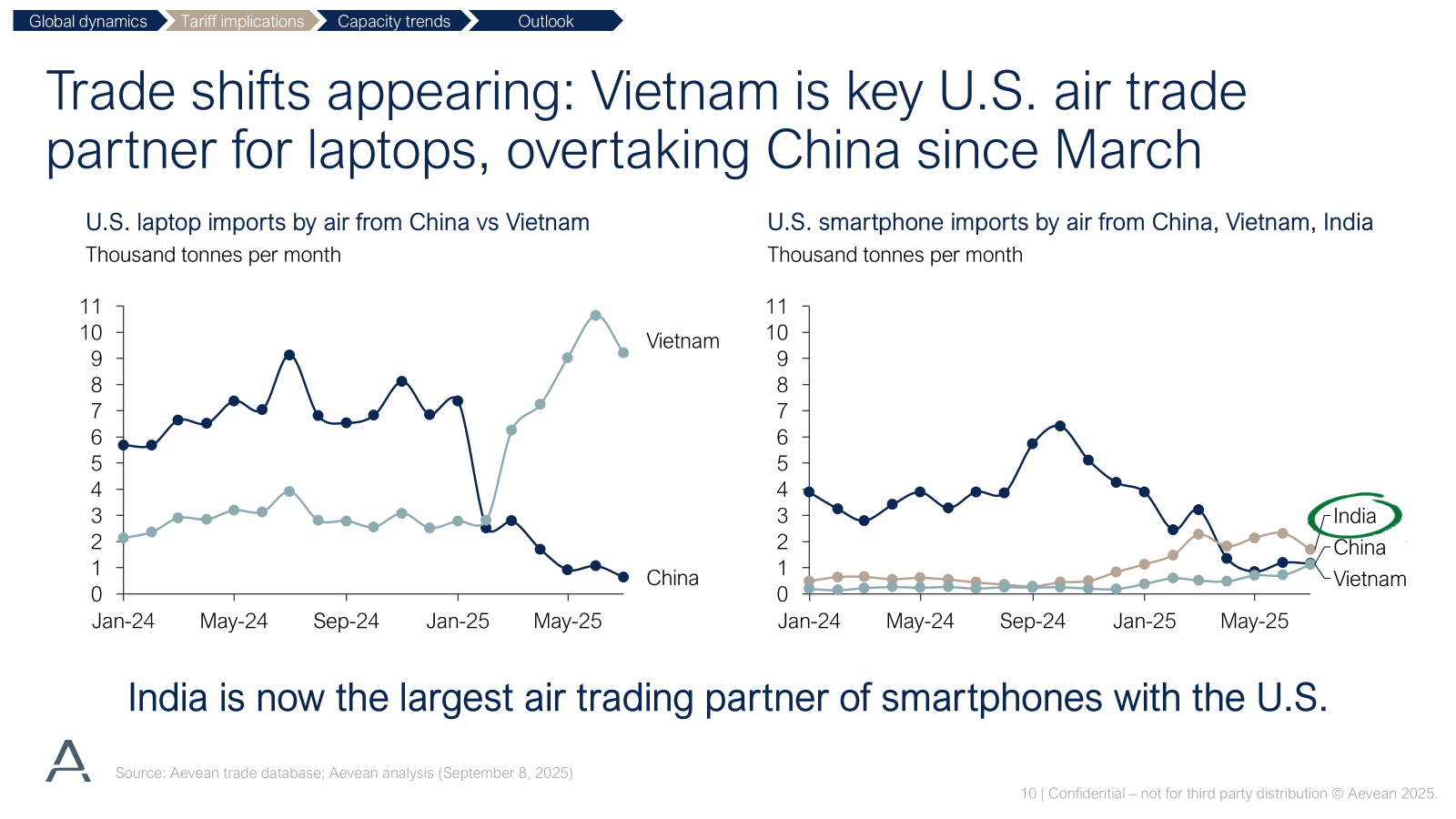
Aevean
Meanwhile, Apple has been lucky with tariffs, which could have hit sales figures hard. Currently, smartphones are enjoying “temporary” relief from tariffs, although they do face a 20% IEEPA baseline tariff.
According to WSJ: “Touting new models and phone capabilities as a reason for price increases will allow Apple to avoid blaming President Trump’s tariffs, continuing chief executive Tim Cook’s pattern of deftly handling the president’s seesawing trade policies.”
The White House has threatened a further 25% tariff if companies don’t move production to the US, while potential semi-conductor tariffs could also raise prices.
Mr John said it was “hard to pin down” whether Apple was absorbing the tariffs, or passing them on.
“Apple’s model is built on scale. They sell so many units that suppliers are willing to cut costs to the bone, knowing Apple will move millions of devices. That dynamic cushions them against tariffs and allows them to maintain pricing power. Whether the tariffs show up in retail prices or are absorbed inside that supply chain isn’t obvious, but Apple’s brand strength gives it more flexibility than most to manage those shocks.”
In April, media outlets reported that Apple had chartered freighters to carry 600 tonnes of iPhones to the US from India before threatened tariffs kicked in. Reuters noted Apple had added 20% capacity to its three plants in India.
Mr John said: “India is a really interesting case. Apple went there originally as a hedge against China, especially during the Trump years. But it’s also about India being a giant market in its own right. The challenge is, India has high tariffs, so it’s not a straightforward swap for China. Apple gains from tapping into the local market, but those tariffs definitely raise the costs of doing business there. It’s a balance between market opportunity and manufacturing challenge.”
Chennai is the site of Apple’s main Indian Foxconn plant, but according to Rotate’s capacity database, neither in the past week or month has capacity blossomed: in fact, last week over the previous four, freighter capacity from the city fell 6.3%, while in the past month over the previous month, freighter capacity out of Chennai fell 3.9%.
The dearth of capacity is unlikely to be related to front-loading: freighter charters in April were said to have carried 1.5m iPhones, less than 1% of Apple’s 2024 iPhone sales.
And Apple, which is famously secretive over its supply chain and logistics, is unlikely to send high volumes by sea: the speed of delivery supports Apple’s working capital, and can negate the extra costs of shipping by air.
But, with the threat of further tariffs for smartphones not made in the US, will airfreight feel the hit of domestic production?
Probably not, said Mr John.
“You can’t just lift and shift an iPhone factory. To make iPhones in the US, you’d need to redesign the device from the ground up to take human labour out of the process and replace it with automation and robotics. That’s a massive undertaking – we’re talking close to a decade, not a year or two.
“So, yes, Apple could do more in the US, but only if they see it as part of a long-term global shift toward regional supply chains, not just a short-term political swing.”
Analysts warned that moving production to the US would be prohibitively expensive, leading to prices of some $3,500 for an iPhone, significantly damping demand.
Apple acknowledged the risks in its third-quarter report.
“Various modifications to the US tariffs have been announced and further changes could be made in the future, which may include additional sector-based tariffs or other measures. For example, the US Department of Commerce has initiated an investigation under Section 232 of the Trade Expansion Act of 1962, as amended, into, among other things, imports of semiconductors, semiconductor manufacturing equipment, and their derivative products, including downstream products that contain semiconductors.
“Tariffs and other measures that are applied to the company’s products or their components can have a material adverse impact on the company’s business, results of operations and financial condition, including impacting the company’s supply chain, the availability of rare earths and other raw materials and components, pricing and gross margin.
“The ultimate impact remains uncertain…”
For uninterrupted access, sign in or sign up to The Daily News, Premium or The Loadstar Enterprise Plan.
Comment on this article