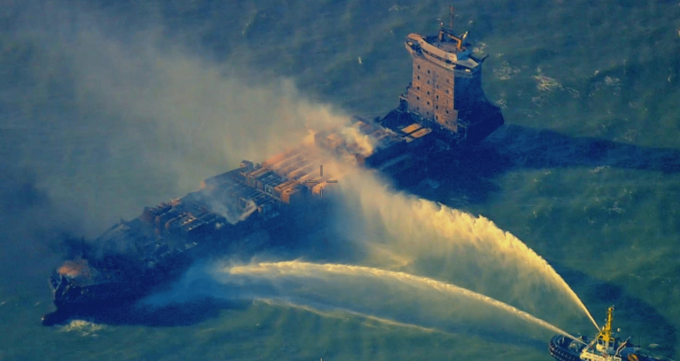
'No lookouts on either ship' says MAIB report on box ship-tanker collision
The UK’s Marine Accident Investigation Bureau (MAIB) today released its interim report into the recent ...


KNX: TIME TO SAY GOODBYEODFL: SET THE BAR HIGHBA: PIPELINEBA: SUPPLY CHAIN TESTAMZN: AI WAVESDHL: THE FRENCH CONNECTIONJBHT: MIND THE SPREADMAERSK: GAUGE THE UPSIDE DSV: UP AND DOWNCHRW: FIRST OF ITS KINDMFT: TAKING PROFIT
KNX: TIME TO SAY GOODBYEODFL: SET THE BAR HIGHBA: PIPELINEBA: SUPPLY CHAIN TESTAMZN: AI WAVESDHL: THE FRENCH CONNECTIONJBHT: MIND THE SPREADMAERSK: GAUGE THE UPSIDE DSV: UP AND DOWNCHRW: FIRST OF ITS KINDMFT: TAKING PROFIT
On 22 May, NCL Salten ran aground within metres of a sleeping Norwegian’s house; fortunately, no one was hurt. Cue Twitter jokes about next-day delivery.
But less of a laughing matter, this was the vessel’s third grounding in as many years, its owner said.
“During questioning, the [officer on watch] stated that he fell asleep while on duty alone, which led to the vessel running aground,” a local prosecutor told press, at the time of the grounding. NCL Salten Globe 6, BBC Marmara, Kaami, and recently Solong on a long list of vessels which got into distress from the officer on watch either absent or asleep.
The problem issues from the fact that this job is so tortuously dull as to be a recognised safety hazard. In the Tiktok age of contracting attention spans, when literature students can’t read a whole book, seafarers are fully expected to stare out of the window at the featureless line where grey sea meets grey sky, remaining vigilant and mindful, hour after hour. No doubt, there are a growing list of tasks to attend to thereafter; but for now, even a glance at a clock is discouraged.
Helpfully, some vessels have devices fitted to torment the OOW into staying awake. The bridge navigation watch alarm system (BNWAS) requires a button to be pressed every so often, or it sounds a siren. As is often the case, NCL Salten had its BNWAS silenced before the grounding, inspections confirmed – but, had the system been operated as intended, the grounding might never have happened.
But this is not a given. ‘Alarm fatigue’ is a separate but recognised issue in the maritime industry, which happens when alarm systems are operating as designed. To avoid liability, OEMs over-zealously programme ECDIS navigation systems to sound a barrage of alarms at the most minor provocation. Crews will disable them, ignore them, or reflexively silence them without looking to see what the problem is. Sometimes, a vessel approaches risky shallows, or even suffers serious engine problems, because crews are not paying attention to alarms.
Mounting incidences of crew inattention, then, combined with advancing technology, set the stage for a reduction of onboard responsibilities. In one attempt, Israeli startup Orca AI is seeing adoption with its SeaPod ‘automated watchkeeper’, a podded array with multi-directional cameras and thermal imaging.
Installed on 800 vessels, the company claims, with 300 more to come, the software combines its interpreted optical data with output from GPS and other shipboard sensors. By replacing human eyes with AI-driven surveillance, these systems promise continuous vigilance without fatigue.
Conscientiously implemented, digitalising the ship’s watch could leave crews some respite, and more time to perform other critical shipboard tasks. On the other hand, Jevons Paradox – which generally hits the mark when applied to the last century of technological advancements — suggests this will lead to crew head count reductions, increased workloads, and some version of the same problem crews had to begin with.
The offshore segment, whose vessels are less answerable to IMO frameworks than mainhaul container ships, are already seeing entry from the thin end of the crewless wedge. Instead of a bridge, the diminutive Reach Remote 1, now operational,features arrays of sensors and cameras to relay information to its shore.
Notwithstanding the aggro that aircraft traffic control has suffered this year, it is the model shipping now seeks to adapt. One ship management expert told your correspondent his company is borrowing expertise from the airline industry to build its shoreside monitoring bases.
“This is optimisation and control on a whole different level, without taking away the responsibility of the master and those other officers on the spot,” he said. “We can digitally zoom in, monitor every light bulb, every valve, every vibration, every dollar that is being wasted, or not.
“We will frequently telephone the master and say, ‘you’ve got three auxiliaries running, why?’ or, ‘we see cylinder one is overheating, you probably wanna have a look at that when you get to the next port’. From an efficiency point of view, that’s not dangerous, it’s just helping. [But] I think if one tries to intervene too much from a navigational or operational point of view, then it’s dangerous.”
Digital watchkeeping proffers the possibility of leveraging un-human technology for an inhuman task, potentially increasing the safety of vessels. But even if that fails, the normalisation of shore monitoring and traffic control will increase the chances that at least one person overseeing the vessel’s progress will be operating on a proper night’s sleep.

For uninterrupted access, sign in or sign up to The Daily News, Premium or The Loadstar Enterprise Plan.
Comment on this article