CNBC: Amazon layoffs take their toll in saturated job market
CNBC reports: On an early morning in January, Jake Linsley woke up to a text from ...

VW: THE IMPACT VW: MASSIVE JOB CUTS CONFIRMEDEXPD: BULLISHCHRW: POSITIONING AHEAD OF EARNINGSAMZN: IN THE NUMBERSAMZN: PEOPLE MATTER UNTILVW: THE LAST CUT IS THE DEEPESTJBHT: GEARING UP VW: BUYING TIMER: BIG VOTE OF CONFIDENCEAAPL: BEARISH HEDGEYE AAPL: THE BEAR CASEFDX: LIFE SCIENCES ORG UNVEILEDWTC: UPS AND DOWNSWTC: ASX ANNOUNCEMENT REGARDING DSV PARTNERSHIP VW: D-DAY
VW: THE IMPACT VW: MASSIVE JOB CUTS CONFIRMEDEXPD: BULLISHCHRW: POSITIONING AHEAD OF EARNINGSAMZN: IN THE NUMBERSAMZN: PEOPLE MATTER UNTILVW: THE LAST CUT IS THE DEEPESTJBHT: GEARING UP VW: BUYING TIMER: BIG VOTE OF CONFIDENCEAAPL: BEARISH HEDGEYE AAPL: THE BEAR CASEFDX: LIFE SCIENCES ORG UNVEILEDWTC: UPS AND DOWNSWTC: ASX ANNOUNCEMENT REGARDING DSV PARTNERSHIP VW: D-DAY

“But the emperor has no clothes!”… Hans Christian Andersen’s “The Emperor’s New Clothes”
Introducing the Lemming Index
The UN and WHO need to overhaul their human potential and wellbeing measures.
It’s time to add a more targeted but crucial metric like the infamous “Darwin Awards” but this time for entire cohorts not just individuals.
The new measures once in place, could be aggregated into a dashboard because dashboards are good. And this could be the “Gullibility Index” or better yet “Lemming Index”.
Nowhere in all eternity would such an index be more applicable, than to the US financial markets with their AI fantasy, at precisely this moment.
Big bubbles no troubles
Some of us – (whether unfortunately or not) – were alive in the ‘80s and remember Wrigley’s iconic adds for that chewable Blu Tack® predecessor called “Hubba-Bubba”.
The coolest kids were the ones who’d mastered the art of repeatedly spouting bubbles like basket balls. But there was always a catch. Sooner or later, it had to burst. About as predictable as gravity or night following day.
For the Techno Utopianists, sorry, truly, look away now.
This column isn’t for you.
For the rest, whilst not investment advice, give some thought to your 401k’s and retirement savings before it’s too late…
Born in the USA
Three of the five or six greatest bubbles and busts in history have been US masterpieces and all of these within the last century.
It’s a wildly impressive scorecard of value destruction.
The 1929 crash – wiped out $70–80bn which was almost all of the NYSE at the time, (~$90bn).
The Dot-com crash of 2000–02 – wiped out ~$5trn with spill over into the wider economy and global markets.
The Sub-prime and GFC crash of 2008-09, takes the cake (so far), wiping out a whopping estimated $14trn, resulting in a US recession and major impacts for years, across the global economy.
At some point in the not-so-distant past, the robber barons of Wall Street and Silicon Valley must have both realised, they can make way more money from hype than they ever could from actual legit business. And so, the bubble game was born.
Mix in a little mass amnesia, lots of “but this time it’s different, No! It really is different”, keep chanting the mantra and soon enough the fever spreads and the obedient herd follow along. Et voilà! Hubba-Bubba on steroids. This is a mass hypnosis sport but, unfortunately, it’s no game.
With each cycle there’s an almost predictable incentive to make the numbers stupendously bigger than ever before. Out but now back, Open AI CEO, Sam Altman wants $7trn alone, just for his AI build out. Why not? In fact, why stop at 7? Round it up to 10! But just note in the real world, we could buy a couple of decent countries for that sort of money.
The numbers with the current AI Bubble are not at all out-of-range to GFC level impacts. In recent months the feted MAG7 alone have incinerated 3 trillion already. Reminder, it’s February.
Of course, bubbles of this order of magnitude are only possible in a country whose currency enjoys global reserve status, whose economy is drowning in central bank stimulus, with successive administrations steeped in hegemonic intent and a strongman leader facing midterms just around the corner.
Perceived US Tech supremacy and perceived US economic strength are vital. At least for the next few months…
This would be “Too big to fail 2.0”. As American as apple pie.
The Sun rises in the East
In China, (the country we’re suddenly supposed to despise), there’s another inconvenient contradiction emerging.
With a much larger population and user or market concentration than the US or any leading Western economy, the multiples are radically different.
US tech is breaching the 100 times forward earnings (estimate) while in China the big names trade at roughly 30 times. For the record, not so long ago a 30x valuation was often considered stretched…
When we enquire as to why this is the case, we get a very heroic (and very deluded) answer. It’s basically, “because our tech is so much better”.
Really? Who to trust? The Wall St and Silicon Valley barons and “bros” or Chinese Tech?
At these stretched multiples and even more stretched narratives it’s an increasingly difficult choice. And it’s a choice we shouldn’t have to make.
What’s under the hood?
The breathless frothing and panting about AI keep missing the same thing. Over and over.
In fact, it’s becoming nauseating to have to go there again but go there we must in order to get to the guts of where we’re at with this omniscient, everything, everywhere, all-at-once miracle, loosely referred to as “AI”.
For the record. We’re at the stage of pattern recognition only. We’re nowhere near AGI. Further, it’s beyond insanity to even hint at sentience. Whether you talk agentic, anthropic or more correctly, myopic. We’re nowhere near the automation of everything that keeps being bandied about. That means we’re nowhere near sustainable, profitable business. (A conspicuously absent prerequisite for 100x forward earnings multiples one would think…)
And we’ve already spent trillions, essentially scaled to the moon, wasted billions of litres of water, untold megawatts of power and hijacked the real-world economy for a techno fantasy, (but very, very lucrative bubble).
Something’s got to give. And it’s starting already.
We can debate endlessly the techno obscurantist details but I’ll let the heavyweights carry this part of my argument for me.
You can easily move past the hype and delve into the real science of current AI, here, here, here, and here. Sadly, the business media echo chamber overlooks all this. Can’t let the facts get in the way of a good story. For those who have ears to hear…
As impressive as the current crop of text, image and music generators may be, along with all the other toys, (and as much as they might streamline a sprinkling of admin tasks), we are not even in the ballpark of a “civilisational shift” or anything particularly transformational. Not in our wildest dreams would any of this carry the burden of valuation currently being applied.
And that’s precisely the point. That’s how bubbles work. It’s a mania and groupthink thing not a multiples thing.
Don’t be fooled.
The world is not enough
NYU Stern School’s Aswarth Damodaran, among others, has released very sound analysis on the core valuation problems with AI.
And there’s an embarrassingly obvious flaw which takes a lot of effort to ignore. Even if a small select few of these market darlings, were able to make it to viability, the market itself is not big enough. And it never will be.
(Click to expand the table below.)
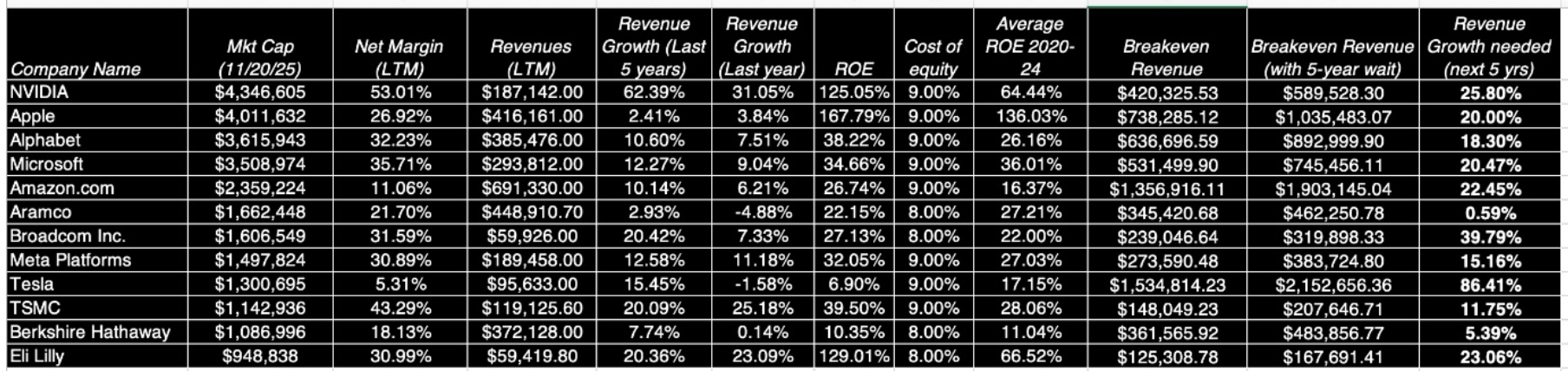
Some of them might achieve an approximation to the total break-even growth required, but not all.
No amount of circular funding, Svengalian arithmetic or wishful thinking can magic this one away.
That means a cull. And that means a bloodbath.
The emperor has no clothes. Your nagging suspicions were correct. You were right all along. If you need therapy or intervention to help with this, don’t delay. Cope. Get away from the hype echo chamber, the silent majority, the all-pervasive groupthink.
You’re staring at a bubble.
Calling all Luddites
The Luddites of history are an interesting lot. Much maligned and in modern parlance greatly misunderstood.
They knew the actual barons of their era were obsoleting them with machines and took matters into their own hands.
There’s a curious paradox afoot in our time though. We talk constantly about the imminent civilisational displacement that really existing AI will bring, (not to mention other emergent harms), but we do absolutely nothing about it.
Is it because deep down we already sense it’s mostly bullshit?
How is it that the Tech bros and robber barons are the ones who’ve suddenly seen the light and are proposing Universal Basic Income (UBI) among other measures? Perhaps that’s also another grandiose, all-encompassing spectre that conveniently distracts and keeps the charade going.
If we want the real-word economy to function, democracy to endure and the real-world existential threats facing global humanity to be addressed, we need to “lance the boil” right now and set the fantasy aside.
Supply Chain – the poor cousin still
In the current milieu, Supply Chain continues to be the poor cousin or worse, the ugly duckling.
Supply Chain is at the very coal face of the real-world economy and takes the hit with every rise and fall. It bears the brunt of the disruption and distortion. One would think we’d have learnt the lessons from the recent Covid upheaval, but alas we haven’t.
Supply Chain is in the crosshairs again on at least two obvious fronts.
Firstly, the promised automation for our function has never materialised, even at this juncture. We’re not sexy enough. Just in the last decade we’ve been bombarded with Blockchain, 3D Printing, IoT, AR, VR, Big Data and finally the ultimate AI hype cycle.
Where’s the transformation? It’s mostly in the Wall Street and Silicon Valley bank accounts.
Secondly, quite rapidly from this point, expect further disruption and turbulence across the global value chain.
As the train wreck unfolds, many of those massive grid, data centre and “chip fab” build outs will evaporate. There’ll be the usual chaos and scrambling to stem the bleeding. Supply Chain, Shipping and Logistics will be the last link where the pain is concentrated the most.
An orderly correction and re-alignment would be preferable but that’s highly unlikely because the bubble is still too seductive and the illusion just too strong.
(Russell Wood is a senior columnist for Loadstar Premium. Russell doesn’t invest in the companies he covers and reports to Alessandro Pasetti, global head of Premium. You can contact Ale at [email protected])
For uninterrupted access, sign in or sign up to The Daily News, Premium or The Loadstar Enterprise Plan.
Comment on this article