Capacity injection for east-west trades as more ULCVs are delivered
East-west tradelanes saw some capacity injected over the past two weeks as several large containerships ...

F: NEW PROFIT STREAMCHRW: HEALTHY CORRECTIONDSV: TIME TO BUY INWTC: NO LUCKCHRW: 'NUCLEAR VERDICT'DSV: DEEP CUTKNIN: UPGRADEDKNIN: AI BENEFITSKNIN: NOT WORTH ITPLD: DEAL TIMEKNIN: CONF CALL CLOSING KNIN: PRICING POWER KNIN: MARKET SHARE GAINS IN ROAD KNIN: AI-RELATED COST INFLATION OUTLOOK
F: NEW PROFIT STREAMCHRW: HEALTHY CORRECTIONDSV: TIME TO BUY INWTC: NO LUCKCHRW: 'NUCLEAR VERDICT'DSV: DEEP CUTKNIN: UPGRADEDKNIN: AI BENEFITSKNIN: NOT WORTH ITPLD: DEAL TIMEKNIN: CONF CALL CLOSING KNIN: PRICING POWER KNIN: MARKET SHARE GAINS IN ROAD KNIN: AI-RELATED COST INFLATION OUTLOOK
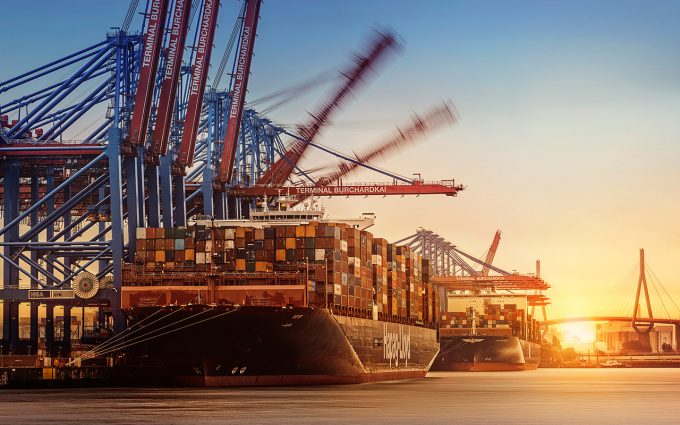
German container shipping line Hapag-Lloyd appears to have slightly lost market share last year, today reporting its 2024 annual results.
The carrier carried a total of 12.4m teu, a 4.7% increase over the 11.9m teu it lifted in 2023, while the global market, according to Container Trade Statistics (CTS), grew 6.2% during the same period.
However, the company said its results “significantly exceeded expectations at the beginning of the year”, reporting a 6.6% increase in group revenues, to $20.7bn last year, compared with $19.4bn in 2023, on the back of strong demand for both liner and terminal activities.
Group EBITDA was up marginally, at $5bn, and group EBIT came in at $2.8bn, $100m above 2023.
“The increase in revenue was partially offset by higher transport and terminal expenses,” the company noted, reporting “a disproportionate increase in transport expenses” of 7.4%, to $13.8bn, due to the “rerouting of ships around the Cape of Good Hope”.
Its accounts revealed it spent $2.86bn on 4.7m tonnes of bunkers in 2024, a 17.6% increase over 2023’s 4m tonnes, while expenditure on haulage and terminals rose 12%, to $6.83bn.
Meanwhile, M&A boosted its burgeoning port arm, Hanseatic Global Terminals, where EBITDA was up threefold, to reach $151m, compared with 2023’s $50m, and EBIT reached $72m, compared with $18m in 2023, when the division was still being formed.
“In a challenging market environment, we achieved solid results and further increased customer satisfaction,” said chief executive Rolf Habben Jansen.
“We have further consolidated and expanded our terminal business under the Hanseatic Global Terminals brand. We have worked hard to further improve processes which will yield results in the years to come and stepped up our investments in digitalisation and training of our people.
“Finally, we launched the largest newbuild programme in our company’s history, which will enable us to further modernise and decarbonise our fleet,” he added.
That fleet, at the end of 2024, stood at 299 vessels – 131 of which are owned and 168 chartered – for a combined capacity of 2.35m teu. This compares with 266 ships at the end of 2023, for a combined capacity of 1.97m teu, and last year it ordered 24 new ships, with a total capacity of 312,000 teu, for delivery between 2027 and 2029.
As with many of its peers, its 2025 guidance is broad, with group EBITDA forecast at between $2.5bn and $4bn, and group EBIT between break-even and $1.5bn, which is said was due to “considerable uncertainty due to the highly volatile development of freight rates and major geopolitical challenges”.
“In 2025, we are off to a very good start with Gemini, but the economic and geopolitical environment remains fragile. We anticipate earnings in 2025 to be lower than in 2024,” Mr Habben Jansen said.
“In the first half of the current year, we will implement our Gemini network and expect to set new standards in terms of schedule reliability.
“We will continue to develop Hanseatic Global Terminals and wait to further grow our inland business.
“At the same time, we will keep a very close eye on our unit costs and focus on becoming even more efficient and climate-friendly,” he added.

For uninterrupted access, sign in or sign up to The Daily News, Premium or The Loadstar Enterprise Plan.
Comment on this article