Nuclear power the future for box ships – but China may get there first
As the IMO debates today on how to power the future of shipping, China is ...
GXO: NEW WINAMZN: LTL SERVICE UPDATEGM: ENERGY PROVIDER MODELEXPD: LAYOFFS CONFIRMED DHL: DOWNSIDE RISKDHL: OVERVIEWDHL: DATE CENTRE PUSH IN APACMAERSK: HAVE A LOOKTSLA: TAILWINDS FDX: PAYOUT ADJUSTMENT UPDATEKNIN: AIR FREIGHT NETWORK EXPANSION
This week, classification society Lloyd’s Register announced a collaboration with ship designer Seatransport on a floating nuclear reactor vessel to provide emergency power for coastal communities.
A workboat, then – but LR’s Mark Tipping told The Loadstar that a nuclear-powered containership, merchant shipping’s most obvious business case, would not be far behind.
No need for bunkering would mean independence from OPEC posturing, and no need to slow down to save money or cut CO2 emissions. In fact, the first nuclear-powered box ships will be incentivised to race to grab market share, leading to a two-tier market where slow, conventional vessels will be forced to cut rates.
“When looking at faster speed, there are a couple of things that can challenge you,” Mr Tipping said. “You need to be aware of noise in the marine environment, which can be mitigated through hull form and propeller. You need, in some locations, to be careful of things like whales in the marine environment. However, you still have plenty of opportunity to go fast.”
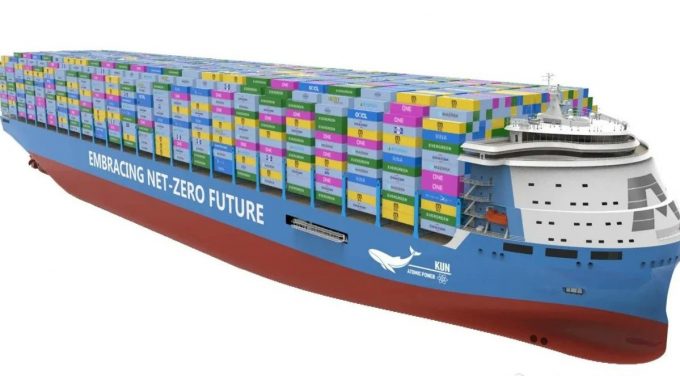
The recent CSSC KUN-24AP concept (pictured above) made this implicit, with a vision of a vast, fast Chinese powerhouse which would smash the competition. But the tech is still some years away, Mr Tipping said.
“I absolutely think we are going to see containerships with molten salt reactors… however, we’re unlikely to see them available before 2035. That technology is likely to be in the second mover tranche, not the first.”
Since the KUN-24AP reveal, the US has suddenly taken an interest in building and operating its own fleet. A protectionist bent; a proven contempt for shipping’s regulators; and competence at building nuclear-powered naval vessels – perhaps a sector-disrupting nuclear box ship is closer than we think.
“The recent US moves are certainly enabling for any US ship considering nuclear,” said Mr Tipping.
However, a stable investment landscape would also be needed.
“Yes – fixed trade routes for a long period of time,” agreed Mr Tipping. “But this is what you need anyway, with any of the other alternative fuels, confidence of being able to refuel at either end. It requires political stability to do that.”
Technically, much hinges on the small modular reactor (SMR), supposedly much more self-sufficient than those of the past. SMR is an umbrella term for any number of reactor types, but the key is simplification. Instead of the outrageously expensive, built-to-order reactors of today, SMRs would be built on production lines, in standardised sizes.
Pressurised water reactors (PWRs) are tried and tested by navies, generating steam to drive a turbine and propeller shaft, but they require significant manpower to operate.
“Our precedent for nuclear is submarines, aircraft carriers, Russian icebreakers… they use technologies which are not current,” explained Mr Tipping. “It’s a bit like flying across the ocean in a biplane.”
The story of why navies are willing to put up with this has to do with the missed opportunities of the 1970s, when N/S Savannah was tragically decommissioned two years before an oil crisis which would have made it queen of the ocean. This was compounded by the 1980s’ Chernobyl disaster, which put a swift end to any excitement – and, critically, investment – in development of new nuclear reactor technology.
However, this is changing due to climate change. Mr Tipping alluded to Project Pele, a US initiative to provide miniature reactors, transportable by truck or plane, for powering military bases. These, he said, would be operable by people with just six months’ training.
“But we won’t see that in the marine industry – no marine regulator is going to accept that kind of an approach. But it does give you a feel for the trajectory.
“Obviously, in the marine commercial market, there is no way we’re going to have 20 or so crew looking after a reactor,” he added. “So the design basis around these reactors is that they require minimal attendance to them.
“Yes, competent people, appropriately trained – but they don’t need to be an army, and they’re not going to need to be PhDs either.”
For uninterrupted access, sign in or sign up to The Daily News, Premium or The Loadstar Enterprise Plan.
Comment on this article