155 hospitalised as toxic gas leak forces Antwerp box terminals to close
European shippers and forwarders have been warned to expect significant disruption to operations after a ...


PLD: TRADING UPDATE ON THE WAY KNIN: UPSIDEJBHT: STRONG TRADING UPDATE DSV: EVERY LITTLE HELPSJBHT: CEO REMARKS WMT: VERTICAL INTEGRATION IN LOGISTICSJBHT: HERE WE GOPG: STEADYEXPD: NEW RECORD BA: DELIVERIESMAERSK: BEAR CAMP MUSINGSCHRW: HIGHER HIGHS ON THE RADAR
PLD: TRADING UPDATE ON THE WAY KNIN: UPSIDEJBHT: STRONG TRADING UPDATE DSV: EVERY LITTLE HELPSJBHT: CEO REMARKS WMT: VERTICAL INTEGRATION IN LOGISTICSJBHT: HERE WE GOPG: STEADYEXPD: NEW RECORD BA: DELIVERIESMAERSK: BEAR CAMP MUSINGSCHRW: HIGHER HIGHS ON THE RADAR
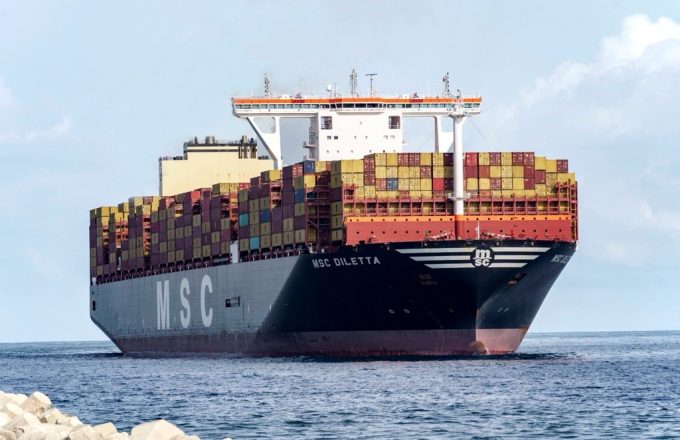
Following a sustained period of investment in port infrastructure and container handling equipment, ultra-large container vessels (ULCVs) have found a new trading area, West Africa.
MSC confirmed this week that it had begun to deploy ULCVs of up to 24,000 teu capacity, previously confined to the Asia-Europe trades, on its Asia-West Africa AFL service.
The first arrival, at the end of April, was the 2021-built 24,000 MSC Diletta, owned by Chinese non-operating shipowner SPDB Financial Leasing, at the port of Tema in Ghana.
“This event marked a turning point, ushering in an era of unprecedented shipping capacity for the region,” the Geneva-headquartered carrier said.
“The arrival of MSC Diletta in Ghana illustrates the extraordinary expansion of West African container ports in the past decade, where not that long ago vessels of 4,000-5,000 teu were regarded as the absolute maximum allowable in this region,” said Alphaliner recently.
The ship was followed by the similar-sized MSC Turkiye, and according to the eeSea liner database, of the 14 ships deployed on the service, eight are ULCVs and all, ironically, previously served on the now extinct 2M Lion service MSC operated with Maersk.
“The volume of business and trade between Asia and Africa, particularly West Africa, is experiencing rapid growth,” the carrier said. “MSC is directly responding to the growing needs of its customers for increased capacity and more efficient shipping solutions on this vital trade route.”
According to Container Trade Statistics, volumes on the Asia-Sub Saharan Africa trade in April amounted to 391,100 teu, a 29.1% year-on-year increase. West African ports account for the largest share of shipments on the trade, with just 160,000 teu shipped from Asia to West Africa in April.
Meanwhile, freight rates on CTS’s Far East-Sub Saharan Africa price index in April was up 23.9% year-on-year, while spot rates have doubled over the past three months, from just over to $2,000 per 40ft to $4,060, according to the latest reading of the Shanghai Containerised Freight Index’s (SCFI) Shanghai-Lagos leg.
The AFL service has a port rotation of Qingdao-Busan-Gwangyang-Ningbo-Shanghai-Nansha-Shekou-Cai Mep-Singapore-Vizhinjam-Tema-Lome-Abidjan-Kribi-Singapore.
Crucially, the four West African ports on the service rotation all have terminals that are in part controlled by either MSC’s terminal operating subsidiary TiL, or Africa Global Logistics, the port operator it acquired from Bollore (click to expand table below).

Source: The Loadstar
During the worst of the prolonged period of Mediterranean port congestion in the middle of last year, as carriers continued to grapple with the fallout from the Red Sea crisis, MSC trialled using Lome has a temporary transhipment hub for its Asia-US east coast and India/Middle East-US east coast services, and it may be that this experience persuaded its network planners that the region was ready to serve ULCVs on a regular basis.
In any case, their introduction follows an established economic principle of liner shipping: larger ships equal lower unit costs, which allows carriers to reduce prices and, hopefully, create additional demand. This is likely be accentuated by efficient port operations with higher reliability – the latest Sea Intelligence Consulting monthly Liner Reliability Report notes that MSC’s AFL service has a 75% on-time arrival rate on its headhaul voyages, which is high by global standards. However, the data only goes up to the end of April, so it will be interesting to see how it fares after MSC’s West Africa terminals have a full month of handling ULCVs.
Follow my leader?
Will other carriers follow MSC’s lead? It is important to emphasise how long-term these developments are, as explained by Tema’s Meridian Port Services chief executive Mohamed Samara, speaking on the inaugural visit of the MSC Turkiye to the Ghanaian port at the end of April.
“In 2015, under the leadership of President John Dramani Mahama, we envisioned infrastructure capable of handling ultra-large vessels. Today, that vision is alive as we welcome one of the world’s largest containerships…. Our design criteria focused on durability and scalability for 100 years.”
Meanwhile, it is also here that we could see the ripple effect from the US Trade Representative’s proposed fees on Chinese-built and Chinese-operated vessels, under the 301 legislation.
Unlike President Trump’s legally dubious tariffs, the USTR 301 action has been confirmed, and some form of fees on Chinese ships will come into force on 14 October – their levels and which are ships will be included are still under review, although the current proposal would see every ship built in China calling at a US port hit with a $120 per teu fee, and/or a $50 per ton fee for Chinese operators.
The chart below, from Alphaliner, shows the number of vessels of more than 7,500 teu (what it terms very large container carriers) currently operated and on order.

Source: Alphaliner
The headline number is 582 vessels over 7,500 teu are under construction.
And this chart shows where previous VLCCs were built and where current units are under construction:

Source: Alphaliner
And the key takeaway is, that while South Korean and Japanese shipbuilders account for the majority of ULCVs currently operating, Chinese shipbuilders account for the majority of those under construction – and while carriers are expected to do everything they can to keep these ships away from the US, it is shippers in regions like West Africa that can expect to enjoy the benefits of expanded capacity.
For uninterrupted access, sign in or sign up to The Daily News, Premium or The Loadstar Enterprise Plan.
Comment on this article