Carriers keep the price pressure on – a 'shock and awe' PSS the standout
Container spot freight rates on the transpacific and Asia-Europe trades rose for the sixth consecutive ...


HON: DEALS ON THE MENUEXPD: NEW RECORD XPO: THE REBOUNDCAT: PAYOUT UPDHL: LIGHTHOUSEMAERSK: ANOTHER UPGRADEFWRD: HEALTHY CORRECTION R: RYDER CEO SAYS R: AMAZON LTL ANNOUNCEMENTPLD: EV INFRASTRUCTURE PUSHDHL: RAMPING UP 'NEW ENERGY LOGISTICS' GXO: NEW WINAMZN: LTL SERVICE UPDATEGM: ENERGY PROVIDER MODEL
HON: DEALS ON THE MENUEXPD: NEW RECORD XPO: THE REBOUNDCAT: PAYOUT UPDHL: LIGHTHOUSEMAERSK: ANOTHER UPGRADEFWRD: HEALTHY CORRECTION R: RYDER CEO SAYS R: AMAZON LTL ANNOUNCEMENTPLD: EV INFRASTRUCTURE PUSHDHL: RAMPING UP 'NEW ENERGY LOGISTICS' GXO: NEW WINAMZN: LTL SERVICE UPDATEGM: ENERGY PROVIDER MODEL
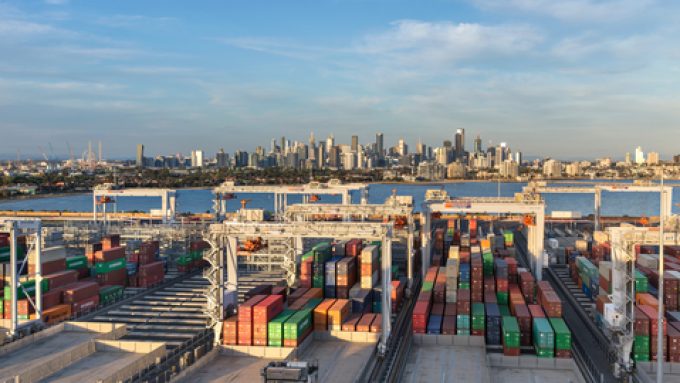
Capacity on the Far East-Oceania trade expanded sharply over the past year, significantly outpacing global fleet growth, according to new analysis from Alphaliner.
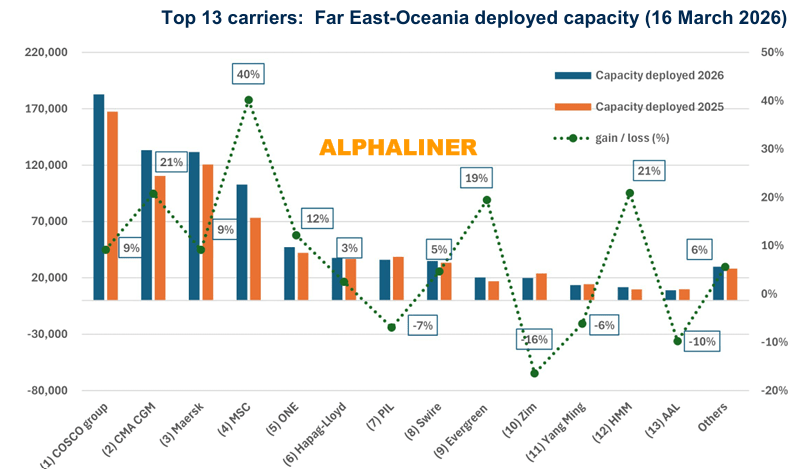
As of 16 March, total deployed capacity on the route had reached 811,141 teu, an increase of around 84,000 teu, or 12% year on year. This is double the approximate 6% growth recorded across the global liner fleet over the same period.
MSC emerged as the standout contributor to this expansion, posting the largest absolute and proportional gains.
The carrier added 29,478 teu, a 40% increase on its 2025 capacity, bringing its total deployed slots on the trade to 102,837 teu – growth driven largely by the launch of its China-Australia Kangaroo service and the extension of the China-Indonesia-Australia Koala loop.
This expansion cements MSC’s fourth-place ranking on the trade, with more than double the capacity of fifth-placed ONE.
MSC also announced recently it was enhancing its Eagle Service, which offers direct connectivity between Oceania and the Americas, claiming “market leading transit times” on a rotation of Philadelphia-Savannah-Freeport-Rodman-Papeete-Auckland-Sydney-Melbourne-Brisbane-Wellington-Tauranga-Rodman-Cristobal-Philadelphia.
According to Alphaliner data, CMA CGM also recorded strong growth, increasing capacity by 23,000 teu, or 21%, allowing it to overtake Maersk and move into second place. The French carrier now deploys 133,383 teu, just ahead of Maersk’s 131,693 teu. Its gains were partly supported by the introduction of the North Asia-PNG-Australia APR2 service via its ANL brand.
Maersk, by contrast, posted more modest growth, around 11,000 teu, or 9%, while Cosco retained its leading position with more than 182,000 teu, following a 9% year-on-year increase.
Source: Alphaliner
At the other end of the spectrum, regional specialist Swire Shipping maintained a relatively stable capacity of 34,984 teu. Its smaller, geared vessels, averaging just 1,666 teu, highlight the operational requirements of ports across the region, where infrastructure constraints favour such tonnage.
Despite a 16% capacity decline, Zim’s reduction amounted to the removal of a single 3,000 teu vessel from a joint service with MSC.
Overall, the trade remains highly concentrated, with the top four carriers, Cosco, CMA CGM, Maersk and MSC, controlling 68% of the capacity, up from 65% a year ago, and mainline operators accounting for roughly 91% of deployed slots.
Alphaliner also noted that the fleet deployed on the route was relatively older, with an average vessel age of around 15 years, compared with just under 12 years globally.
According to the Freightos Terminal, ocean freight spot rates from China to Australia rose sharply towards the end of March and now sit at an average $1,372.09 per teu.

Source: Freightos FBX
Hapag-Lloyd announced today it was increasing ocean rates from North Europe and Mediterranean Sea to Australia from 1 May. For those shipping on the North Europe to Australia route, this includes a jump on the current base level from $162 per teu to $362 per teu.
Meanwhile, on the airfreight side, Australia has had warnings of critical fuel supplies, linked to the shortage resulting from the Middle East conflict.
China is the world’s top oil importer and has implemented a ban on exports of diesel, gasoline, and jet fuel to protect domestic availability as global energy markets tighten.
Australia, Bangladesh, and the Philippines are particularly reliant on Chinese fuel supplies and will have to cover their needs elsewhere. Scan Global Logistics warned that Australia faced “mounting exposure” in its jet fuel supply chain.
“Stockpiles are critically low, holding only 29-32 days of jet fuel, far below the International Energy Agency’s 90-day requirement, and some airlines have cancelled flights due to the shortage,” it said.
However, one major airline in the region told The Loadstar that currently their freight operations “continue to operate as normal”.
Watch our recent Loadstar Snapshot on the financial fallout of the Middle East conflict on global shipping:

For uninterrupted access, sign in or sign up to The Daily News, Premium or The Loadstar Enterprise Plan.

Comment on this article