Asia and Africa soak up new shipping capacity as US trades tread water
More than half of the new containership capacity added to global markets in the past ...


KNX: TIME TO SAY GOODBYEODFL: SET THE BAR HIGHBA: PIPELINEBA: SUPPLY CHAIN TESTAMZN: AI WAVESDHL: THE FRENCH CONNECTIONJBHT: MIND THE SPREADMAERSK: GAUGE THE UPSIDE DSV: UP AND DOWNCHRW: FIRST OF ITS KINDMFT: TAKING PROFIT
KNX: TIME TO SAY GOODBYEODFL: SET THE BAR HIGHBA: PIPELINEBA: SUPPLY CHAIN TESTAMZN: AI WAVESDHL: THE FRENCH CONNECTIONJBHT: MIND THE SPREADMAERSK: GAUGE THE UPSIDE DSV: UP AND DOWNCHRW: FIRST OF ITS KINDMFT: TAKING PROFIT
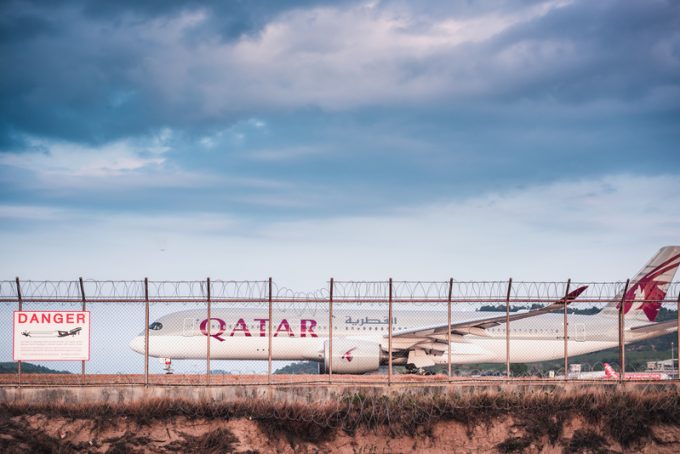
The escalating Middle East crisis is rapidly turning into a global airfreight shock, as disruption to Gulf hub operations tightens capacity, sends rates soaring on key Asia-Europe lanes and forces forwarders to devise unconventional routing solutions.
Flexport CEO Ryan Petersen said the impact on air cargo could be even greater than on ocean freight, because of the central role Gulf airlines play in the global air logistics system.
“We’ve talked mostly about ocean freight so far, but actually air freight is probably even more impacted here,” he told CNBC.
“About 15% of the world’s air cargo capacity – between Emirates, Etihad, and Qatar Airways – comes from the Gulf. That’s just the air cargo capacity, and says nothing about the importance of the airports.”
Dubai is among the world’s largest cargo airports and is a critical hub for Asia-Europe freight flows, he noted.
“A huge amount of Asia-to-Europe cargo naturally goes through the Middle East, geographically,” he said, adding that the price of shipping from Asia to Europe by air had already doubled in the past two weeks.
“And that’s even before what we’re going to be feeling very soon – these heavily escalated jet fuel prices.”
Market data suggests the disruption is already feeding through into the air cargo market.
According to WorldACD Market Data, global airfreight traffic in the week ending 8 March fell 4% week on week and was 12% lower year on year. Origin Middle East and South Asia (MESA) saw the steepest decline, with tonnage down 36% against a 42% drop in capacity.
The Gulf region was hit particularly hard, with outbound volumes falling 62% week on week, on a 70% capacity reduction.
As capacity disappeared, rates quickly moved higher. WorldACD said the average global airfreight rate rose 6% week on week, to $2.40 per kg, with spot rates jumping 10%.
From MESA to Europe, rates surged 57% week on week, while pricing from MESA to the US climbed 22%.
Spot market data suggests the squeeze is even sharper on Asia-Europe lanes. Freightos FAX terminal figures show rates from southern Asia to Europe rising from $2.57 per kg on 3 March to $4.37 by 12 March, a jump of roughly 70% in nine days. South-east Asia-Europe prices also climbed sharply, increasing from $3.14 per kg to $4.46 over the same period.
Forwarders say the disruption is now spreading across the global network as cargo is forced onto alternative routings.
DSV said overall airfreight capacity remained “very limited”, although Gulf carriers had gradually begun operating limited freighter services as authorities approved select repositioning, cargo and repatriation flights.
But it warned that cargo from South-east Asia, the Indian subcontinent and Oceania was increasingly being routed via China and Hong Kong, tightening capacity on corridors that had initially escaped the worst of the disruption.
“The impact is now spreading across multiple tradelanes,” DSV said, warning customers to expect delays, space shortages, and short-notice rate adjustments.
India’s Ligi Logistics said: “Air freight markets have tightened further compared to Week 11, with capacity decreasing across key ISC gateways including India, Bangladesh, and Southeast Asia.
“Key developments include airlines continuing to reroute flights due to restricted airspace; reduced capacity through Middle East hubs, which traditionally serve as key transshipment points; air freight rates increasing steadily week over week; carriers offering very short rate validity, often on a flight-by-flight basis; priority cargo receiving preference, while standard cargo may face delays.
“As a result, many forwarders are now securing space earlier and exploring alternative routings via Europe and Asia-Pacific hubs. Customers are strongly advised to plan shipments 7–10 days in advance wherever possible.”
The pattern is also reflected in capacity figures. Rotate data, comparing the period from 28 February to 16 March with the previous two weeks, shows global capacity down 11% – although the past 72 hours have seen a 4% increase versus the previous week, suggesting airlines are gradually restoring some services or deploying alternative routings.
Faced with the disruption, forwarders are experimenting with hybrid transport solutions.
Mr Petersen said Flexport had created a new Asia-Europe routing combining ocean and air freight. The service uses fast containerships across the Pacific, with cargo then transloaded in Los Angeles before flying to Europe from LAX.
“It’s about half the cost of air freight and much faster than ocean freight,” he said, describing it as “a nice middle ground between air and ocean”.
The approach also reflects concern that shippers may have fewer alternatives than usual.
According to supply chain platform FourKites, global ocean networks had been recovering before the conflict interrupted the trend. Asia-US east coast transit times had fallen from around 64 days in mid-December to 56 days by late February, but that improvement is expected to reverse as vessels reroute and congestion spreads.
Stephen Dyke, director of strategic solutions at FourKites, said temperature-controlled supply chains could be among the first to shift cargo back to air.
“Temperature-controlled supply chains have the least margin for error,” he said. “When carriers start restricting reefer bookings and transit times extend by 10 or more days, you can’t just absorb that. Shelf life doesn’t pause.”
Meanwhile, the cost impact is beginning to ripple through the market.
Oman Air Cargo said it would introduce both a fuel surcharge and a war-risk surcharge across its cargo network from 18 March, citing volatile jet fuel prices, and rising insurance costs tied to operations in conflict-affected regions.
Maersk has also warned of higher air freight costs, saying fuel surcharges will be reviewed weekly while a new transit disruption surcharge will cover additional costs linked to rerouting and tight capacity.
Taken together, the signals from market data providers, airlines, and forwarders point to a rapidly tightening market. With Gulf hubs still operating below normal levels and fuel costs surging, the Middle East crisis is increasingly reshaping global air cargo flows, forcing shippers to pay more, reroute freight, and search for creative ways to move time-critical goods.
Catch up with the latest in today’s News in Brief podcast, with Xeneta’s Peter Sand and Marco Forgione, director general of the UK’s Chartered Institute of Export & International Trade

For uninterrupted access, sign in or sign up to The Daily News, Premium or The Loadstar Enterprise Plan.
Comment on this article