A wave of container spot rate rises amid peak season and tight capacity
Peak season is now fully under way, after a week in which spot rates on ...


KNX: TIME TO SAY GOODBYEODFL: SET THE BAR HIGHBA: PIPELINEBA: SUPPLY CHAIN TESTAMZN: AI WAVESDHL: THE FRENCH CONNECTIONJBHT: MIND THE SPREADMAERSK: GAUGE THE UPSIDE DSV: UP AND DOWNCHRW: FIRST OF ITS KINDMFT: TAKING PROFIT
KNX: TIME TO SAY GOODBYEODFL: SET THE BAR HIGHBA: PIPELINEBA: SUPPLY CHAIN TESTAMZN: AI WAVESDHL: THE FRENCH CONNECTIONJBHT: MIND THE SPREADMAERSK: GAUGE THE UPSIDE DSV: UP AND DOWNCHRW: FIRST OF ITS KINDMFT: TAKING PROFIT
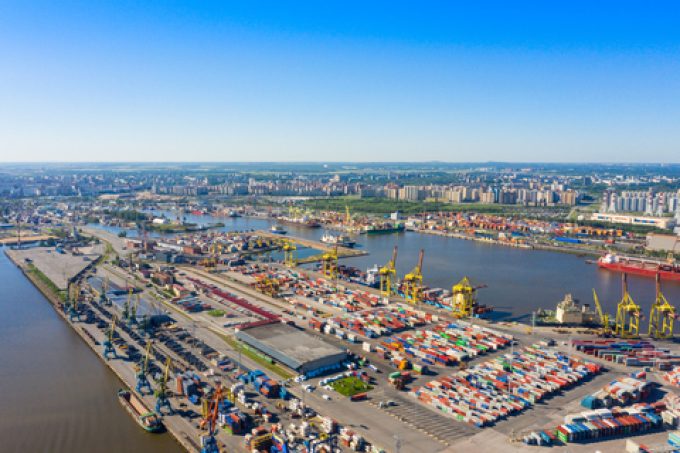
French carrier CMA CGM is set to resume container services to the Russian Baltic gateway of St Petersburg, according to this week’s Alphaliner.
The report noted that a fortnightly call at St Petersburg has been inserted into the forward schedule of the carrier’s Finland Express FLX service, which currently runs on a port rotation of: Bremerhaven-Hamburg-Kotka-Helsinki-Tallinn-Gdansk-Bremerhaven.
“Forward schedules of the Marseille-headquartered line suggest that the 1,436 teu North will make the first appearance at the Russian Baltic Sea port on 17 November.
“The addition of St Petersburg to the FLX means that CMA CGM will resume regular services to Russia, for the first time since early March 2022,” Alphaliner noted in its weekly report.
However, according to the eeSea liner database – which has yet to include a St Petersburg call on the pro forma schedule – the service was upsized in the past few weeks and now deploys two 2,100 teu vessels, the CMA CGM Tivoli and CMA CGM Mermaid, and certainly indicates the French carrier is expecting increased demand.
In addition, French news outlet Mediapart, reported last week that two CMA CGM executives travelled to St Petersburg in mid-September to “to organise the return of the French group to Russia”.
Russia’s invasion of Ukraine saw most global shipping lines end their services to Russia – with the sole exception of MSC, which at the time said it would “continue to accept and screen bookings for delivery of essential goods”, a position that allowed it to has maintain two Baltic feeder services, BAL02 and BAL04, as well as the reefer-dominated Ecuador-NWC-US string.
Prior to the war, the chief avenue for Russian importers of containerised goods was via North European ports, principally Rotterdam and Hamburg, where boxes were transhipped onto feeder vessels. Following the Russian invasion, container throughput through Russia’s Baltic gateway crashed over the course of 2022, while Rotterdam and Hamburg’s declined by around 10%.
As this this Premium analysis showed, during 2022 and 2023 Russia’s Pacific ports of Vladivostok and Vostochny supplanted St Petersburg as the country’s main container gateway after a range of smaller Chinese carriers launched services from China to there.
However, last year the cargo flows reversed once more as several Russian-linked container carriers launched Asia-Europe services – mostly via the Suez Canal – directly connecting China and India with St Petersburg, typically deploying vessels small enough to call at St Peterburg’s draught-restricted terminals directly.
The eeSea liner database lists five direct Asia-St Petersburg services, operated independently by Fesco, Mline (two), OVP and Saftrans, while Reel Shipping continues to run a Damietta-St Petersburg shuttle service, with Russia-bound cargo transhipped in Egypt and Moroccan port of Casablanca.
Meanwhile, according to Russian terminal operator Global Ports – in which APM Terminals held a 30% stake which it was forced to sell once war broke out – growth in St Petersburg has continued at the expense of Russia’s other ports.
The operator, by far Russia’s largest, published its third-quarter 2025 results this week, which showed its St Petersburg terminals handling 571,000 teu in the first nine months, up 18.5% year on year, while throughput at its Far East facilities was down 28.8% year on year, to 264,000 teu.
Global Ports also published volumes for the total Russian market, which showed the country’s total container volumes for the first nine months of this year down 3.2% year on year, to 3.97m teu, which management said was due to a “reduction in consumer demand”. Total volumes through St Petersburg, including terminals not under Global Ports’ control, grew 5.2%.

For uninterrupted access, sign in or sign up to The Daily News, Premium or The Loadstar Enterprise Plan.
Comment on this article