Forwarders face profitability test as freight markets look set to stabilise
As global freight markets begin to show signs of stabilisation after months of disruption, the industry’s largest forwarders have shown ...


CHRW: DEAL TIMEDHL: GO GREENDSV: BULLISH DSV: NOTE TO INVESTORSKO: TAX FIGHTDSV: STILL 'OVERWEIGHT'WTC: HAMMEREDWTC: MOUNTING TROUBLEWTC: ANOTHER DIFFICULT WEEK CHRW: NEW PRODUCT LAUNCHDSV: LEADING THE DROP
CHRW: DEAL TIMEDHL: GO GREENDSV: BULLISH DSV: NOTE TO INVESTORSKO: TAX FIGHTDSV: STILL 'OVERWEIGHT'WTC: HAMMEREDWTC: MOUNTING TROUBLEWTC: ANOTHER DIFFICULT WEEK CHRW: NEW PRODUCT LAUNCHDSV: LEADING THE DROP

Fluctuating weekly capacity sailing into North European ports could be exacerbating their congestion problems, according to Sea-Intelligence data.
Since 2020, the variation in capacity offered on transpacific services has “increased sharply”, but there has been “much more” deployed on the Asia-Europe trade, according to the maritime analyst.
It noted that between 2011 and 2019, the average volatility in vessel capacity offered in a specific week on the Asia-North Europe trade was 12.3%, and mainly fluctuated within 10% and 15%.
However, this saw a “very high increase”, to an average of 29.6%, in the years from 2021 to today.
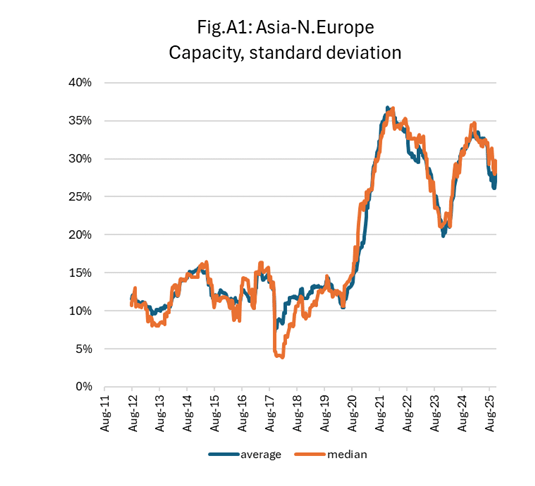
Source: Sea-Intelligence
“The data shows cargo capacity is becoming more volatile from week to week. This, in turn, also means that the arrival of cargo in destination ports becomes ‘lumpier’ – ie, ports will more frequently see cargo does not arrive in a smooth flow but is more stop-and-start,” it said.
“This creates problems for port operations, as a port is designed to handle smooth flows.”
And while the persistent port congestion in Europe has been the unfortunate product of a host of factors, including low water levels, labour shortages, alliance changes, construction projects, and so on, Sea-Intelligence deduced that “the increased ‘lumpiness’ of cargo flows” was also contributing to the problem.
According to Ocean Network Express’s recent Vessel Schedule Status Report, Algeciras, Antwerp, Bremerhaven, Genoa,and Le Harve are all suffering delays, citing holiday labour shortages as the principal reason.
Kuehne+Nagel has warned that waiting times for Antwerp had extended to two days, while Genoa could see up to 3.5 days’ delay.
In Rotterdam, rail restrictions have been in place for a few days due to construction, which has resulted in trains being unable to call at terminals, delaying operations. At the RWG terminal, there have been carrier reports of an average 10-day wait and “yard utilisation remains critical due to high import volumes”, according to K+N.
Sea-Intelligence found that the trend of increased capacity volatility was also true for the Asia-Mediterranean trade, which saw average weekly capacity deviation increase to 29.1% over the past four years, from 13.9% between 2011 and 2019.
Listen to the recent News in Brief Podcast for a round-up of last week’s supply chain news!

For uninterrupted access, sign in or sign up to The Daily News, Premium or The Loadstar Enterprise Plan.

Comment on this article