Monsoon storms bring added disruption to India's west coast ports
Monsoon storms along India’s west coast have exacerbated supply chain disruption for containerised freight moving ...


WTC: 'ONE RECORD'HLAG: EARNINGS GUIDANCE UPGRADE AAPL: GLOBAL SMARTPHONE SHIPMENTS VW: THE IMPACT VW: MASSIVE JOB CUTS CONFIRMEDEXPD: BULLISHCHRW: POSITIONING AHEAD OF EARNINGSAMZN: IN THE NUMBERSAMZN: PEOPLE MATTER UNTILVW: THE LAST CUT IS THE DEEPESTJBHT: GEARING UP VW: BUYING TIMER: BIG VOTE OF CONFIDENCEAAPL: BEARISH HEDGEYE
WTC: 'ONE RECORD'HLAG: EARNINGS GUIDANCE UPGRADE AAPL: GLOBAL SMARTPHONE SHIPMENTS VW: THE IMPACT VW: MASSIVE JOB CUTS CONFIRMEDEXPD: BULLISHCHRW: POSITIONING AHEAD OF EARNINGSAMZN: IN THE NUMBERSAMZN: PEOPLE MATTER UNTILVW: THE LAST CUT IS THE DEEPESTJBHT: GEARING UP VW: BUYING TIMER: BIG VOTE OF CONFIDENCEAAPL: BEARISH HEDGEYE
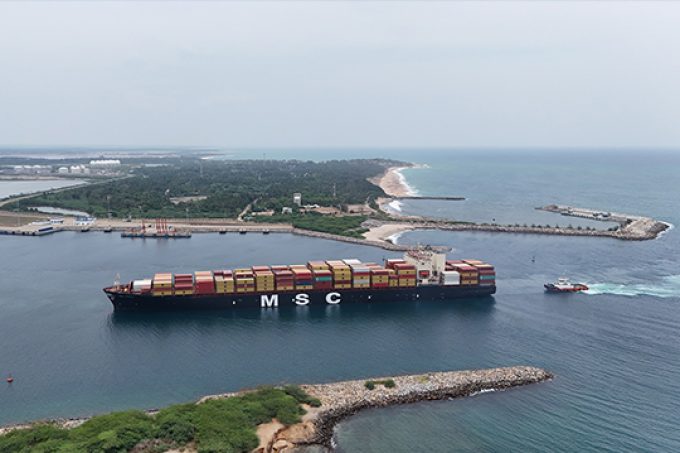
Intra-regional port competition in South Asia, especially across Sri Lanka and India, is intensifying as back-to-back supply chain disruptions keep ocean carriers searching for transhipment options.
Hambantota International Port (HIP), an emerging alternative to Sri Lanka’s Colombo, is rapidly augmenting its container-handling prowess to capitalise on this growing transhipment demand.
Having launched container operations in 2024, Hambantota has already made major liner customer gains at the expense of capacity strains in Colombo. And port owner China Merchants Port Holdings (CMPort) is to invest a further $108m in container equipment upgrades at the port amid a surge in ad-hoc calls, in some part due to a spillover effect out of Colombo.
That capital spending involves six quay cranes, 16 rubber-tyred gantry cranes and 40 trailers from Shanghai Zhenhua Heavy Industries as part of Hambantota’s phase 2 container terminal development.
“The new quay cranes, with a 72-metre outreach, 55-metre lifting height and 65-ton lifting capacity, will enable HIP to handle the world’s largest container vessels, while the RTGs will enhance yard efficiency and support more environmentally sustainable operations through a transition towards electrification,” CMPort said.
The Chinese conglomerate claims the expansion will nearly double Hambantota’s annual box capacity, to 2m teu. The market outlook for the port is encouraging, as it reported a seven-fold increase in box volumes last year.
“The investment comes amid growing demand for alternative logistics hubs as global shipping patterns continue to shift, particularly due to geopolitical tensions in the Middle East,” it said. “HIP’s location, just 10 nautical miles from the main east–west shipping route, positions it as a reliable and efficient option for shipping lines seeking minimal deviation and operational stability.”
Those green shoots of port capacity demand are also evident along the Indian coast.
With altered capacity equations, the battle for market share between Nhava Sheva (JNPA) and Mundra is heating up. JNPA is now on a stronger capacity footing because of the recent capacity expansions, primarily involving operations at PSA Mumbai (BMCT).
As a result, JNPA has boosted volumes 12% year on year in fiscal year 2025-26, to 8.2m teu, significantly higher than the growth rate reported by Mundra, up to just 8.6m teu from 8.5m teu, provisional data shows. That’s a sign that JNPA was able to wrest back some portion of the northern hinterland shipper support it had lost to its rival .
That shift is expected to accelerate in the coming months, as BMCT, JNPA’s largest box facility, is now ready to handle container trains through a dedicated freight corridor (DFC), according to industry sources, the launch of which at full scale will be a game-changing experience for hinterland shippers using JNPA, they believe.
In contrast, Mundra has a tightening capacity situation, impacting its landside productivity, with trains taking longer to turn around.
There are also reports that container storage yards at Vizhinjam Port in South India are now at their maximum handling capacity, with the Middle East crisis adding to the container relaying activity by MSC, according to sources.
Vizhinjam handled about 1.3m teu in fiscal 2025-26, data shows.
For uninterrupted access, sign in or sign up to The Daily News, Premium or The Loadstar Enterprise Plan.

Comment on this article