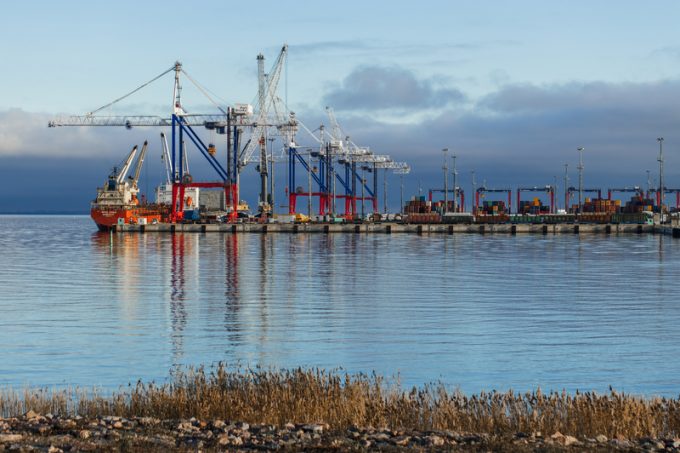
St Petersburg Bronka terminal
Photo 209132437 © Andrey Zayats | Dreamstime.com

Russian Railways’ (RZD) container activity saw notable decline over the first nine months of this year, but with Russian exports still riding high, the downturn on the tracks could be indicative of a return to ocean freight.

Between January and October, the state railway carried 6.3m teu, 3.9% down on the same period 12 months earlier, with loaded container volumes dropping 6.5% to 4.5m teu, with the operator moving close to its worst performance, by volumes, since 2009.

And there was a divergence between import and export volumes, the former down 4%, to 2.5m teu, but export volumes rose 8% year on year, to 1.5m teu.

What this means more broadly is hard to determine, with numerous commentators claiming the Russian economy is “cooked”, and that an effort to reduce management headcount by RZD is not only down to the weakening domestic demand, but “shrinking export markets”.

One other possibility, however, is that after a sanctions-induced high, RZD is again competing with ocean freight and facing what appears to be an upswing in containership capacity coming into Russia following nearly four years of war.

Per Global Ports Q3 25 results, while total Russian maritime box volumes have declined 7.3% year on year for the quarter, its Baltic operations showed significant upturns, the Baltic Basin up 9.8%, to 404,000 teu, and St Petersburg up 7%, to 327,000 teu.

Over the nine months to October, the Baltic Basin experienced a 6.2% bump, to 1.3m teu, with St Peterburg growing 5.2% yoy, to a little over 1m teu, despite overall Russian box volumes for the operator dropping 3.2%, to a little under 4m teu.

Per Lloyd’s List, St Petersburg has begun regaining some of its pre-war volumes, after having struggled until last year’s 31% bounce, up to almost 1.4m teu, with that theme continuing this year, up 5% year on year by October.

Much of this growth has been driven by an influx of new operators, but it now seems there is an increased willingness among mainline operators to add the Russian gateway to rotations, with CMA CGM’s Finland Express (FLX) service due to call at St Petersburg on 17 November.

Alphaliner indicated that the service would call using the 1,436 North vessel, however, eeSea liner database suggests that the FLX had since been upgraded to two 2,100 teu ships, CMA CGM Tivoli and CMA CGM Mermaid.

Should the service call at St Petersburg as expected, it would mark the first return of a major mainline operator, which the exception of MSC, to a Russian gateway since the invasion of Ukraine in February 2022.

And, in bringing that much capacity amid what is a cheap rate environment, it may also explain why RZD has found itself struggling for import market share on goods not subject to sanctions, while still making use of the rail operator for sanctioned exports.

Comment on this article


You must be logged in to post a comment.