Adani pushes to complete Mundra's fifth terminal as competition looms
Adani Ports (APSEZ) is pushing hard to open of its under-construction fifth container terminal (CT5) ...

EXPD: AIRCRAFT ON GROUND SERVICESTSLA: JUST AS VW STRUGGLESBA: NEW BIG ORDERBA: THE ORDERBOOK GROWSPLD: PUSHING FOR A DEAL PLD: TIME TO DEALEXPD: ANOTHER ALL-TIME HIGH CHRW: NEW RECORD DSV: AHEAD OF EARNINGS RELEASE JBHT: NEW HIGHS EVERYWHEREPLD: STRONG DELIVERYJBHT: FAIR-VALUE CONSENSUS ESTIMATE AT ALL-TIME HIGH KNIN: AI TECH ADVANTAGEPLD: TRADING UPDATE ON THE WAY
EXPD: AIRCRAFT ON GROUND SERVICESTSLA: JUST AS VW STRUGGLESBA: NEW BIG ORDERBA: THE ORDERBOOK GROWSPLD: PUSHING FOR A DEAL PLD: TIME TO DEALEXPD: ANOTHER ALL-TIME HIGH CHRW: NEW RECORD DSV: AHEAD OF EARNINGS RELEASE JBHT: NEW HIGHS EVERYWHEREPLD: STRONG DELIVERYJBHT: FAIR-VALUE CONSENSUS ESTIMATE AT ALL-TIME HIGH KNIN: AI TECH ADVANTAGEPLD: TRADING UPDATE ON THE WAY
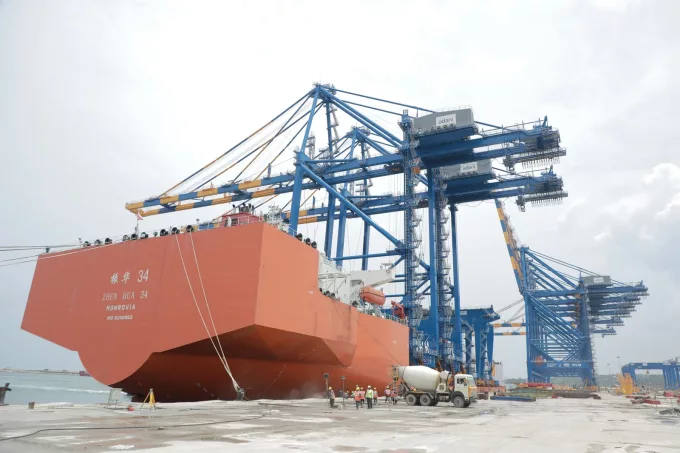
Container lines seem to be driving significant supply chain efficiency gains from India’s rapid port infrastructure improvements, a catalyst for the country’s healthy economic indicators.
Reflecting that turnaround, Vizhinjam, a deepwater container transhipment hub in southern India, continues to set new industry benchmarks in operations, heating up competition among regional trade gateways.
The Adani Group-managed box terminal has hosted some of the largest containerships since it began commercial operations in December, and has handled 1m teu – its designed annual capacity – in just nine months.
The milestone came from some 460 ship calls, making it the busiest harbour in south-east India.
“With world-class infrastructure, a strategic location and a vision to drive India’s maritime future, Vizhinjam continues to set records and redefine global shipping standards,” the port authority said.
Most of MSC’s regional transhipment operations are now through Vizhinjam, with calls growing at a brisk pace; up to four scheduled arrivals a day, data shows. While they are mostly feeder calls, the carrier is also focusing on direct mainline connectivity, with a weekly service to Europe as one example.
Vizhinjam already features the most advanced harbour equipment, including eight ship-to-shore cranes and some 24 automated rail-mounted gantry cranes, to turnaround containers faster.
Vizhinjam is proving to be a challenge not only to Sri Lanka’s Colombo port, but also other Indian ports in the region, particularly DP World’s Vallarpadam terminal in Cochin.
Although Colombo has benefited from recent Pakistani cargo diversions due to Indian port restrictions, the pace of box volumes moving via Vallarpadam has tapered off in the current fiscal year, new data suggests. Vallarpadam saw April-July volumes drop to 261,000 teu from 286,000 teu, year on year.
India’s port transformation is widespread, aided by private investments for concession rights at government-controlled landlord ports and policy reforms, with the government having just yesterday announced plans to pump some $1trn into maritime investment.
With the development of additional terminal capacity and equipment upgrades, mainline carriers now have greater flexibility for berthing windows at Nhava Sheva port (JNPA) with better economies of scale.
For example, CMA CGM has begun consolidating its operations at its own terminal at JNPA, operated jointly with Mumbai-based JM Baxi in a 50:50 partnership, following recent infrastructure enhancements.
Nhava Sheva Freeport Terminal (NSFT) is a refurbished operation of JNPA’s oldest box terminal, with concession rights awarded to CMA Terminals/JM Baxi in 2022.
CMA CGM has finalised plans to move Europe calls on its Epic service from PSA Mumbai (BMCT) to NSFT, beginning next month.
While this shift is not entirely unexpected, it means a significant cut in volumes handled by BMCT as the new PSA terminal has just commissioned phase 2 development, doubling capacity to 4.8m teu.
Dedicated terminal operations have, admittedly, become an integral part of carrier supply chain strategies, due to schedule flexibility pressures under ever-challenging volatile market conditions.
Indian policymakers also claim domestic port productivity rates are now on par with global standards, highlighting an 87% boost in overall capacity over the past decade, with the average time taken by a ship to turn around halving to 48 hours.
Additionally, a new port law for implementation this year promises greater autonomy to government port authorities, and is believed to be another game-changer for the sector.
For uninterrupted access, sign in or sign up to The Daily News, Premium or The Loadstar Enterprise Plan.
Comment on this article