Kuehne+Nagel expands air freight network in volume-hungry Europe
Kuehne+Nagel (K+N) is eyeing greater connectivity with Europe via Frankfurt, while Central Europe’s air cargo ...

JBHT: STRONG TRADING UPDATE JBHT: CEO REMARKS WMT: VERTICAL INTEGRATION IN LOGISTICSJBHT: HERE WE GOPG: STEADYEXPD: NEW RECORD BA: DELIVERIESMAERSK: BEAR CAMP MUSINGSCHRW: HIGHER HIGHS ON THE RADARWTC: 'ONE RECORD'
JBHT: STRONG TRADING UPDATE JBHT: CEO REMARKS WMT: VERTICAL INTEGRATION IN LOGISTICSJBHT: HERE WE GOPG: STEADYEXPD: NEW RECORD BA: DELIVERIESMAERSK: BEAR CAMP MUSINGSCHRW: HIGHER HIGHS ON THE RADARWTC: 'ONE RECORD'
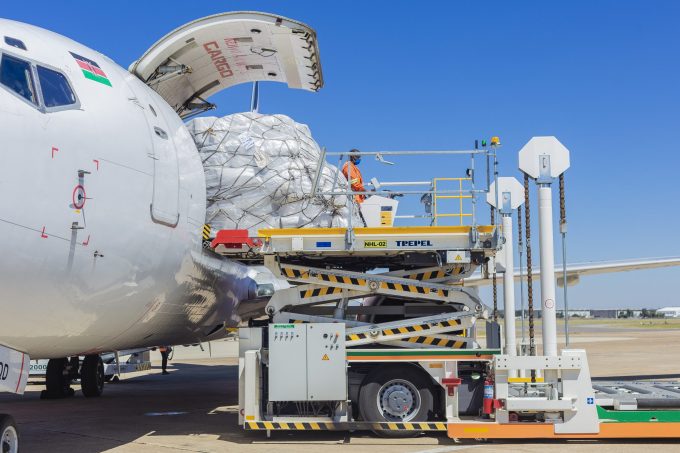
Africa’s long-underperforming air cargo market is finally gaining momentum, with operators and handlers quietly building: one warehouse, partnership, and forklift at a time.
Supporting this is news is that African airlines saw a 4.7% year-on-year increase in air cargo demand in April, along with a 9.7% rise in cargo capacity, according to the latest IATA data.
And companies like Menzies Aviation, Magma Aviation, and Kale Logistics Solutions are betting on cargo handling efficiencies as key drivers to capitalise on that growth.
For Peter Kerins, CEO of Magma Aviation, the African cargo story begins – and often ends – with strong local relationships.
“Our focus is primarily on strengthening partnerships with trusted local ground handling agents across Africa to ensure efficient and reliable operations,” said Mr Kerins. “Africa remains a strategic focus for our growth, and we are actively investing in expanding our footprint across key markets by building strong partnerships.”
Magma, which specialises in airport-to-airport cargo movement, operates in some politically sensitive and logistically fragmented markets. In high-risk areas, the company has contingency plans that include rerouting flights and working with alternative airports.
According to Mr Kerins, air cargo pricing in Africa is influenced by several factors, notably limited capacity on some lanes, costly operations, poor infrastructure, and uneven trade flows – all made worse by complex regulations and inconsistent tariffs across borders.
Charles Wyley, EVP Middle East, Africa, and Asia at Menzies Aviation, said his strategy for Africa was focused on building cargo infrastructure, growing networks, and fine-tuning operations tailored to the unique needs of each location.
Infrastructure at many airports across the continent still falls short of the standards needed for efficient cargo operations, but change is under way.
Nowhere is this more evident than in Mozambique, where Menzies recently opened a new state-of-the-art, hi-tech cargo facility at Maputo International Airport, and is also deploying a ‘people-centric model’ with strategic leadership appointments in Central and East Africa helping the company “align closely with operational realities and cultural differences”.
The partnership with Siginon Aviation in Nairobi, for example, said Mr Wyley, “enhances Menzies’ ability to serve the East African corridor in a way that resonates with how business is done locally”.
According to Mr Kerins at Magma, e-commerce is a key growth driver for air cargo on the continent, fuelled by the rise of cross-border digital platforms and consumer demand for faster deliveries, “an area we are actively exploring, and we look forward to increasing our involvement as opportunities develop”, he said.
That said, Mr Kerins noted that infrastructure in some markets was still developing. While major cities and regional hubs were becoming better equipped, there was still a need for greater investment in road-to-air logistics, customs digitisation, and warehousing, he explained.
Meanwhile, Vineet Malhotra, co-founder and director at Kale Logistics Solutions, emphasised that supply chain visibility remained a major blind spot for handlers, particularly in Mozambique.
“Often, once cargo enters the airport cargo precinct, landside stakeholders lose sight of its movement,” he said. “In cases where cargo is misplaced or left idle in a warehouse, there is little to no visibility.”
Kale is responding with Africa’s first airport cargo community system, across eight airports in Mozambique.
“It’s Africa-centric by design,” Mr Malhotra explained. “There is potential to deliver by leveraging the uniqueness of the region and the untapped potential of the African market.”
Check out our interview with Amazon Air Cargo’s Tom Bradley
For uninterrupted access, sign in or sign up to The Daily News, Premium or The Loadstar Enterprise Plan.

Comment on this article