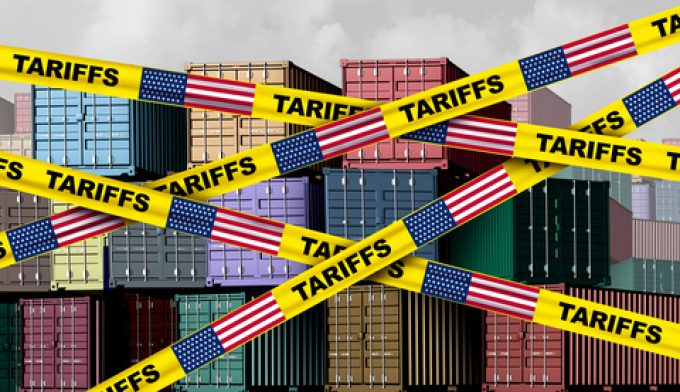
Trump Tariff
Photo: © Skypixel | Dreamstime.com

The barrage of tariffs unleashed by the US government, and the gyrations around legal challenges to impose them, have created disruption and uncertainty that remains an existential threat to small and mid-sized businesses.

They are also causing a transformation of supply chain strategies that calls for new priorities and capabilities, according to Infios, a provider of intelligent supply chain execution solutions.

A survey of 500 US SMEs, conducted by digital forwarder-cum-marketplace Ship4wd in April, concludes that “tariffs have become the defining challenge of the current trade environment for US small businesses”.

Nearly all (96%) of those surveyed said tariffs had a direct negative impact on their shipping, sourcing or supply chain last year, and identified tariffs as their primary concern for 2026 – 31% of them expecting a “significant-to-devastating impact”.

Don Mabry, SVP global trade at Infios, noted that in many cases importers were faced with stacked tariffs, many at elevated levels not seen before. Effective duty rates have risen 25% to 80%, which magnifies the impact of any mistake in entry filings, especially the HTS classification.

A study of more than a million aggregated US customs entry data led Infios to the conclusion that, beyond their impact on businesses and supply chains, tariffs have morphed into a factor in procurement and supply chain strategy and in transport choices.

One aspect of this is the prominence of bonded warehousing in importers’ strategies. Warehouse and withdrawal entries jumped from around 10% of observed entries in 2024, to 16% right after tariffs hit, Infios found.

Washington’s tariff offensive also triggered changes in the use of transport modes. Use of airfreight rose 12%, whereas ocean transport slid 10%-12%. While some other shifts triggered by the tariffs proved transient (such as new trade corridors or a brief push to boost USMCA sourcing), the modal shift and the use of bonded warehousing have not been reversed and remain in the ascent, signalling that mode choice is now used as policy-risk insurance, not just cost optimisation, Infios noted.

And the change wrought by tariffs goes beyond individual elements of supply chain management, Mr Mabry stressed.

“What we’re seeing isn’t just a shift in sourcing or supplier mix, it’s a fundamental change in how trade is executed,” he explained. “Tariffs have introduced a level of volatility that companies can no longer manage with periodic adjustments or manual processes.”

One stark illustration of this is the complexity of HTS classification, which has doubled, from six to 12 elements, and amplified by the magnitude of tariffs – especially if they are stacked.

“Manual processes start to break down,” he said, adding that legacy systems were ill-suited to deal with the complexities now involved. He pointed to transport management systems, which had no handle on tariffs

According to Infios, tariffs have transformed supply chain execution from a linear process into an adaptive system. This requires greater flexibility in order to respond more effectively as complexity increases, and it calls for optionality, where companies have multiple options in the event of a looming tariff change or other disruption.

“Optionality is the new efficiency,” Mr Mabry said.

To make the transformation, six capabilities are essential, according to Infios: companies must be able to perform dynamic tariff modelling; they need intelligent classification and origin management; multimodal execution decisioning; warehouse entry and withdrawal optimisation; route and corridor intelligence; and automated compliance orchestration.

To begin with, Mr Mabry named three aspects on which to focus: classification; bonded warehousing; and scenario modelling.

Some elements, notably route and corridor intelligence, call for collaboration with supply chain providers. In the main, though, Mr Mabry does see a growing need for AI – both generative and agentic variants.

“This is not a trend, it is a necessity,” he said.


Listen now for a data-rich deep dive into the volatility redefining global shipping in 2026

Comment on this article


You must be logged in to post a comment.