Carriers keep the price pressure on – a 'shock and awe' PSS the standout
Container spot freight rates on the transpacific and Asia-Europe trades rose for the sixth consecutive ...
HON: DEALS ON THE MENUEXPD: NEW RECORD XPO: THE REBOUNDCAT: PAYOUT UPDHL: LIGHTHOUSEMAERSK: ANOTHER UPGRADEFWRD: HEALTHY CORRECTION R: RYDER CEO SAYS R: AMAZON LTL ANNOUNCEMENTPLD: EV INFRASTRUCTURE PUSHDHL: RAMPING UP 'NEW ENERGY LOGISTICS' GXO: NEW WINAMZN: LTL SERVICE UPDATEGM: ENERGY PROVIDER MODEL
As container lines try to manage capacity in the face of wild swings in short-term demand on transpacific trades, there appears to be a split in strategy among the carrier groupings.
According to new analysis by liner database eeSea, MSC has spent the past fortnight redesigning its east-west network.
“MSC has orchestrated substantial modifications across five distinct services, yielding significant capacity implications,” said eeSea operations manager John Kingori.
“Beyond straightforward suspensions and selective blank sailings, MSC has exhibited sophistication through service consolidations and strategic bifurcations,” he added.
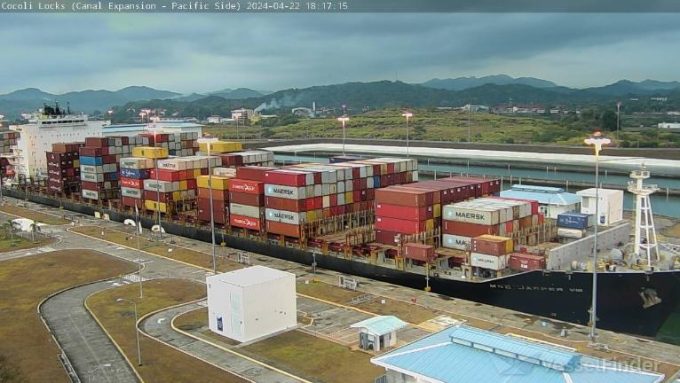
The Loadstar reported last week that MSC’s Asia-Mediterranean Phoenix service had been effectively closed, while today’s eeSea analysis shows its Asia-US east coast Empire service will be discontinued following the 27 April departure of the 8,400 teu MSC Jasper VIII from Shanghai.
The vessel is en route to the Panama Canal and is due to arrive in New York on 31 May and at its final US east coast call at Baltimore on 6 June.
The service has Israeli carrier Zim as a slot-charterer, which “will presumably need to identify alternative capacity solutions or potentially suspend their corresponding offering altogether”.
Meanwhile, MSC’s transpacific Orient service appears also set to be discontinued. The final sailing in the service was the 11,000 teu Cape Kortia, which departed Ningbo on 15 April and is currently due to arrive at Long Beach on 14 May, with its last west coast all at Portland on 24 May.
However, the most drastic action has been reserved for its Swan-Sentosa Asia-Europe-North America pendulum service, which is set to be split in two, with the newly independent Swan service deploying 10 vessels of 15,000 teu on a purely Asia-North Europe route, on which the Premier Allaince partners – ONE, Yang Ming and HMM – are chartering slots.
Meanwhile, the Sentosa service will now operates as a transpacific Asia-US west coast service, operated independently by MSC with 10 ships, also of 15,000 teu average capacity. And at the same time MSC has decided to merge its Asia-Middle East/India Shikra service with its Asia-US west coast Pearl, leading to a “modest reduction” in capacity.
“The Pearl-Shikra integration will feature 8,000 teu vessels, representing a reduction from the 10,000 and 11,000 teu vessels previously employed in the standalone Shikra and Pearl services, respectively. Additional capacity reduction will be achieved through fleet reduction, with the pendulum service operating 13 vessel slots, three fewer than the 16 vessels previously allocated to the individual standalone services,” Mr Kingori added.
Meanwhile, the Ocean Alliance of CMA CGM, Cosco, OOCL and Evergreen, is set to lead the way in short-term capacity cuts through an aggressive blank sailing programme, according to new data from Sea-Intelligence Consulting.
Of the 58 blanked sailings announced on the Asia-North America west coast trade during April and May, some 30 were by Ocean carriers, representing a year-on-year capacity reduction in the two months of 26%.
In contrast, the Gemini Cooperation – Maersk and Hapag-Lloyd – has not announced a single blanked sailing during the period, but has reduced capacity 8% year on year by deploying smaller vessels.
Sea-Intelligence noted that, in response to the trade war, overall container capacity on the Asia-North America east coast trade had retreated by some 15 percentage points, giving industry observers the clearest indication yet of how US tariffs have hit demand.
“Prior to the trade war, the carriers planned to increase trade capacity by 10.9% year on year, but this has now changed to a capacity reduction of 4.9%.
“We have yet to see solid market demand data out of Asia in the wake of the trade war, but indications from carriers and forwarders have been of a Chinese booking downfall in the -30% to -50% range.
“Of course, this is partially offset by uptake elsewhere in Asia, but it presently does not seem likely that gains in the rest of Asia can almost offset all of the loss in China,” Sea-Intelligence’s weekly analysis noted.
Listen to the recent episode of The Loadstar’s News in Brief Podcast for a round up of last week’s supply chain news!
For uninterrupted access, sign in or sign up to The Daily News, Premium or The Loadstar Enterprise Plan.
Comment on this article