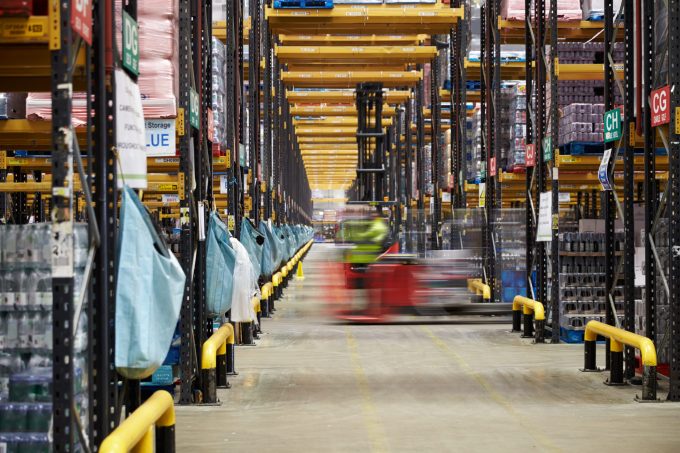
Forklift,Driving,Across,An,Aisle,In,A,Warehouse,,Motion,Blur

Faster fulfilment is bringing fundamental change to warehousing, requiring new concepts and metrics.

During the second half of last year, US inventory levels dwindled like snow on a warm day: on the Logistics Managers Index they were down to a reading of 35.1 in December, with warehouse utilisation slumped to a value of 42.9.

Continuing uncertainty about trade relations and predictions of economic slowdown pushed firms to sell inventory and adopt a cautious stance, but low inventories also reflect a massive push to localised fulfilment, which is showing no sign of abating.

John Kirkman, supply chain leader at industrial real estate giant CBRE, noted that the huge centralised warehouses built in the middle of nowhere had become behemoths of a past era. Seven days to get a product to a consumer is no longer deemed acceptable, so more and more firms have been establishing warehouses closer to population centres, in order to shorten delivery windows to three days or fewer.

Home Depot has added nearly 200 facilities to its warehouse network over the past eight years, and today the giant retailer delivers 55% of its in-stock SKUs on the same, or next, day.

A few years ago, the company achieved rapid delivery times for goods shipped directly from stores, but products dispatched from other locations dragged down average delivery speed. The company is now stocking more branded goods at fulfilment centres, which has improved speed.

Inevitably, technology has also played a part: the company is employing an algorithm examining factors to determine which location holding a product can achieve the fastest delivery.

Scott MacRae, CEO of Landmark Global, stressed the importance of having “a single source of truth”. Without this, complexity can become overwhelming and companies risked reacting to problems when goods are already in motion, he said, resulting in breakdowns they can ill afford.

Regional demand forecasting capabilities are also crucial to avoid inventory levels going to inadequate and costly levels.

While the gains in fulfilment speed associated with localised warehousing are impressive, and seen very much as de rigueur, the concept increases operational risk and complexity, warned Mr MacRae, and returns and compliance become more complicated.

Arguably, returns do not really match the concept, noted Mr Kirkman. Distribution centres are built to ship outward and handling returns can take up 10%-15% of warehouse space.

This is a bigger issue than in the traditional centralised giant warehouses. Localised fulfilment facilities are geared to handling lower volumes at higher velocity, and the available space at the new urban centres is significantly smaller and more expensive, he pointed out, adding that this called for a change in focus from square footage to volume, in order to get more efficiency out of a warehouse.

Higher velocity and lower inventory mean cargo owners rely more on their transport providers and need the capacity to monitor and manage the full system. Mr MacRae emphasised that it was important to treat localised fulfilment as a network strategy, not a real estate decision.

As such, localised fulfilment is not opposed to global sourcing. It is more about agility, he added.

Comment on this article


You must be logged in to post a comment.