Ex-Schenker/DSV leader rumoured to join DHL Group
Watch out


WTC: 'ONE RECORD'HLAG: EARNINGS GUIDANCE UPGRADE AAPL: GLOBAL SMARTPHONE SHIPMENTS VW: THE IMPACT VW: MASSIVE JOB CUTS CONFIRMEDEXPD: BULLISHCHRW: POSITIONING AHEAD OF EARNINGSAMZN: IN THE NUMBERSAMZN: PEOPLE MATTER UNTILVW: THE LAST CUT IS THE DEEPESTJBHT: GEARING UP VW: BUYING TIMER: BIG VOTE OF CONFIDENCEAAPL: BEARISH HEDGEYE
WTC: 'ONE RECORD'HLAG: EARNINGS GUIDANCE UPGRADE AAPL: GLOBAL SMARTPHONE SHIPMENTS VW: THE IMPACT VW: MASSIVE JOB CUTS CONFIRMEDEXPD: BULLISHCHRW: POSITIONING AHEAD OF EARNINGSAMZN: IN THE NUMBERSAMZN: PEOPLE MATTER UNTILVW: THE LAST CUT IS THE DEEPESTJBHT: GEARING UP VW: BUYING TIMER: BIG VOTE OF CONFIDENCEAAPL: BEARISH HEDGEYE

DSV has now confirmed TMS changes revealed by The Loadstar in February: the world’s largest freight forwarder is moving away from CargoWise toward Schenker’s in-house Tango and Star platforms as part of a broader AI and systems consolidation strategy.
At DSV’s Capital Markets Day today, the company laid out a “count-to-one” technology strategy, built around reducing third-party software dependency and consolidating onto internally controlled systems.
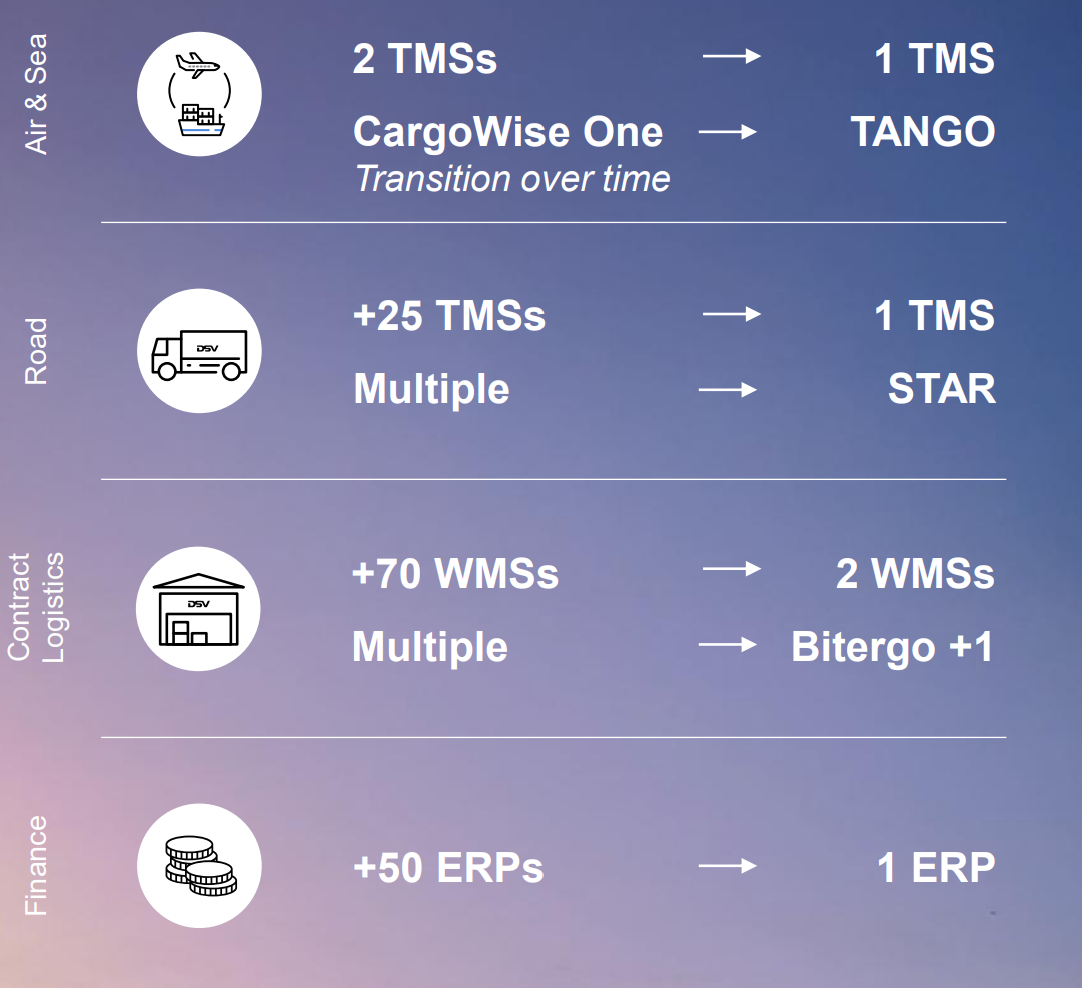
Most notably, DSV presented a target systems architecture slide showing its Air & Sea division transitioning from “2 TMSs” to “1 TMS”, with “CargoWise One → Tango” shown on the slide.
For Road, DSV confirmed Star would become the division’s single transport management system, consolidating more than 25 systems into one.
The presentation went considerably further than DSV’s carefully worded responses following The Loadstar’s February exclusive, which reported that the company had already begun gradually shifting operations away from CargoWise.
At the time, industry sources described a “phased migration strategy” rather than a “rip-and-replace” event, with DSV using APIs and modular integration layers to allow systems to coexist during transition.
DSV disclosed that approximately 25% of Air & Sea volumes were already running on Tango, with the broader rollout beginning in 2027, after further upgrades this year.
The company also tied the migration directly to future productivity gains, forecasting around Dkr6bn ($870m) in annual AI and technology-related improvements by 2030, specifically linked to “leveraging AI and migrating to Tango and Star”. The company said transitioning to Tango would deliver “substantial savings” and “significant cost improvement”.
Perhaps most strikingly, DSV openly framed the shift as a move away from dependence on third-party enterprise software. In one of the clearest statements yet from a major global forwarder, the company said it was “moving from off-the-shelf to owned core systems”, adding that long-term ownership was “cheaper, faster, and more resilient than off-the-shelf solutions – and reducing dependencies on third-party providers”.
That will inevitably be interpreted as a direct challenge to WiseTech Global’s long-standing dominance in forwarding software.
Elsewhere in the presentation, DSV repeatedly stressed ‘simplification and consolidation’.
“One process, one system, count to one,” the group said, outlining a strategy that has already seen more than 6,000 business applications and around 50 data centres closed since 2016.
The broader strategy also appears increasingly aligned with what several industry technology executives suggested to The Loadstar earlier this year: that DSV was building not simply a replacement TMS, but a consolidated enterprise data and AI platform underpinning all divisions.
DSV also unveiled a new “Enterprise Data Platform” and “AI Factory”, designed to centralise operational data across Air & Sea, Road, and Contract Logistics, while enabling reusable AI services at enterprise scale.
The company also confirmed that it intended to continue investing in Tango, “to enhance long-term productivity and savings”.
For WiseTech, the implications could be significant. For years, CargoWise has been regarded as effectively irreplaceable at the top tier of global forwarding. But if DSV – historically one of CargoWise’s most important enterprise customers – ultimately migrates substantial volumes to internally owned systems, it may encourage other large forwarders to reassess their long-term platform dependence – particularly as AI reshapes enterprise software economics.
One technology executive told The Loadstar today that it might not be just WiseTech that could face customer losses.
“People are running for the exits from other systems too…it’s madness.”
For uninterrupted access, sign in or sign up to The Daily News, Premium or The Loadstar Enterprise Plan.

Comment on this article
Andrew C
May 12, 2026 at 3:36 pmIf they can get all their branches on the same page, the predictive power for their lane-level forecasting is going to be incredibly hard for smaller players to compete with.