EXCLUSIVE: The MSC-Bolloré-Clasquin tightrope in forwarding
Key changes in APAC betray tension (as a big party in Paris beckons)


VW: D-DAYPLD: KEEP PUSHINGDHL: NEW AIR SERVICEDHL: GUIDANCE UPGRADE REACTIONDHL: NEW HIGH TARGET ON THE STREET DSV: EXPECTATIONS RUN HIGH KNIN: DHL GUIDANCE UPGRADE READ-ACROSSKNIN: NEW OPENINGGM: TECH UPSIDEAMZN: BIG DEBT FUNDING ON ITS WAYDHL: 'STELLAR EXPRESS'DHL: UPDATEDHL: STRONG PRELIMINARY UPDATE CHRW: STILL VERY BEARISH
VW: D-DAYPLD: KEEP PUSHINGDHL: NEW AIR SERVICEDHL: GUIDANCE UPGRADE REACTIONDHL: NEW HIGH TARGET ON THE STREET DSV: EXPECTATIONS RUN HIGH KNIN: DHL GUIDANCE UPGRADE READ-ACROSSKNIN: NEW OPENINGGM: TECH UPSIDEAMZN: BIG DEBT FUNDING ON ITS WAYDHL: 'STELLAR EXPRESS'DHL: UPDATEDHL: STRONG PRELIMINARY UPDATE CHRW: STILL VERY BEARISH
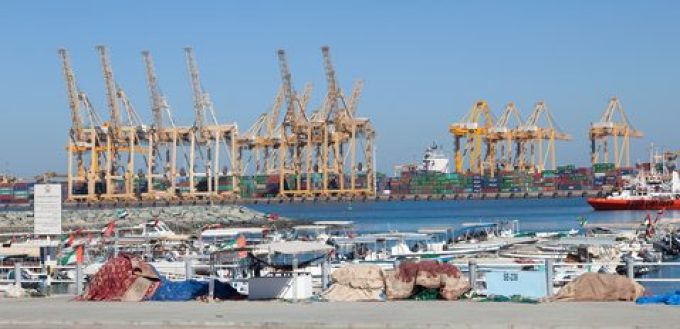
The Emirati owner of the port of Khor Fakkan has unveiled a massive capacity expansion project to coincide with its transformation from common-user terminal operator to one-stop shop logistics service provider.
At the same time as the fragile US-Iran “ceasefire” was collapsing, Gulftainer chief executive Farid Belbouab held a press conference in nearby Sharjah to outline the creation of four new business groups – GT Ports, GT Logistics, GT Parks, and GT Maritime.

Farid Belbouab (Photo: Gulftainer)
“This is more than an expansion of our business – it is the launch of a new chapter in Gulftainer’s history,” Mr Belbouab said.
“For nearly 50 years, Gulftainer connected ports. The next 50 years will be about connecting economies,” he added.
At the centre of its plans is the expansion of Khorfakkan Commercial Terminal (KCT) from 3.5m teu to 5m teu, “with a long-term masterplan exceeding 10m teu”, expected to be integrated into the UAE’s Etihad Rail, which “will further strengthen KCT as a fully multimodal gateway connecting sea, road, and rail”.
This will be complemented by the Al Dhaid Logistics and Sajaa Logistics parks, which together will provide 2.3m teu of annual inland logistics capacity.
“Collectively, these developments are creating one of the Middle East’s largest integrated logistics ecosystems, combining warehousing, bonded and non-bonded storage, cold chain, contract logistics, container freight stations, distribution centres, ecommerce fulfilment, cross-docking, value-added logistics, light industrial activities, and multimodal transport solutions within a single connected platform,” the company said.
Prior to the outbreak of the latest conflict and closure of Hormuz, Khor Fakkan was the forgotten transhipment hub in the region, losing its previous role as the main competitor to Jebel Ali, as Abu Dhabi’s Khalifa was developed, largely via joint-venture terminal deals with MSC, CMA CGM, and Cosco.
When the conflict began, designed purely as a transhipment hub and being located outside Hormuz meant shippers began using Khor Fakkan as the Gulf’s landbridge entry point, so the first thing Gulftainer had to do was to build truck gates at its landside boundaries – previously every container leaving had done so on a ship.
The launch of its new business lines this week has turned that improvised supply chain into long-term strategy.
According to Xeneta’s eeSea liner database, annual volumes at Khor Fakkan peaked at around 3.8m in 2017, dropping steeply to 2.2m the following year – throughput figures have not been made publicly available since.
“The port was basically dead, and the operator was on the ropes – to be honest, I was expecting it to close down entirely,” one former Gulftainer executive told The Loadstar recently.
“It might sound insensitive, but the war was like a winning lottery ticket,” he added.
Vessel traffic at the port was similarly pedestrian: in January it saw seven containership calls, while in February that was down to just four.
However, it received 14 ships in March, 21 in April, 23 in May, and 26 in June, and has handled 12 already this month.
And from three scheduled services a month at the beginning of the year, today it hosts eight.
One example is MSC’s India/Middle East-West Africa IAS service, deploying 11 vessels with an average capacity of 9,200 teu, which traditionally included two Gulf calls, at Jebel Ali and Abu Dhabi’s Khalifa, where MSC operates a joint-venture terminal.
Within days of the closure of Hormuz, MSC dropped the Khalifa and Jebel Ali calls and replaced them with one at Khor Fakkan.
In terms of monthly slot capacity offered to shippers, KCT has grown from 54,000 teu in January, to 123,000 teu in June.
The war also acted as catalyst for the rapid growth of Gulftainer’s fleet of feeder ships, now rebranded as GT Lines.
“Together with GT Lines, which currently operates 10 chartered vessels and is expanding through owned vessels, Gulftainer is creating integrated trade corridors that seamlessly connect ports, shipping and inland logistics across the region,” the company added.
GT Lines launched two shuttle services from KCT to India in early March to ferry Gulf-bound containers unloaded in Mundra and Nhava Sheva, and a similar service to Karachi in April. Also in April, it launched two Far East-Middle East strings, with Chinese carrier CU Lines as a vessel provider.
In a related development, DP World announced this morning it had acquired 700 trucks “to expand its road freight network in the GCC, providing customers greater certainty, reliability and efficiency when moving cargo across the region”.
DP World GCC chief executive Ahmad Yousef Al-Hassan said: “This is a long-term investment in our multimodal network and the customers that trade in the GCC. As regional demand grows, we are scaling our capabilities to provide customers with an integrated network they can depend on at every stage.”
The fleet is capable of undertaking up to 35,000 truck trips a month, “supporting both domestic and cross-border trucking for DP World’s customer base in the GCC”, the company added.
This article is © The Loadstar. Reproduction, rewriting, or derivative use requires a license. Contact [email protected] for licensing enquiries.

For uninterrupted access, sign in or sign up to The Daily News, Premium or The Loadstar Enterprise Plan.
Comment on this article