MSC, Mærsk & CMA CGM – where rivalry doesn't matter (and where it does)
Behind closed doors


GXO: CONTRACT RENEWALFDX: SELL-SIDE REACTION TO INTERIMSFDX: CONF CALL FDX: EARNINGS BEAT FDX: FREIGHT SPIN-OFF UPSIDEPLD: 'OPPORTUNISTIC DEAL-MAKING'PLD: REJECTED BY SEGROPLD: HUNTINGKNIN: BOND FINANCINGWTC: UP WE GODHL: NEW CFO APPOINTMENTFDX: TRADING UPDATE ON THE WAY TSLA: ON THE MENDGM: TECH STARTUP LISTINGDSV: NEW HIGH TARGET CHRW: BOLT-ON DEAL TIMEDHL: GO GREEN
GXO: CONTRACT RENEWALFDX: SELL-SIDE REACTION TO INTERIMSFDX: CONF CALL FDX: EARNINGS BEAT FDX: FREIGHT SPIN-OFF UPSIDEPLD: 'OPPORTUNISTIC DEAL-MAKING'PLD: REJECTED BY SEGROPLD: HUNTINGKNIN: BOND FINANCINGWTC: UP WE GODHL: NEW CFO APPOINTMENTFDX: TRADING UPDATE ON THE WAY TSLA: ON THE MENDGM: TECH STARTUP LISTINGDSV: NEW HIGH TARGET CHRW: BOLT-ON DEAL TIMEDHL: GO GREEN
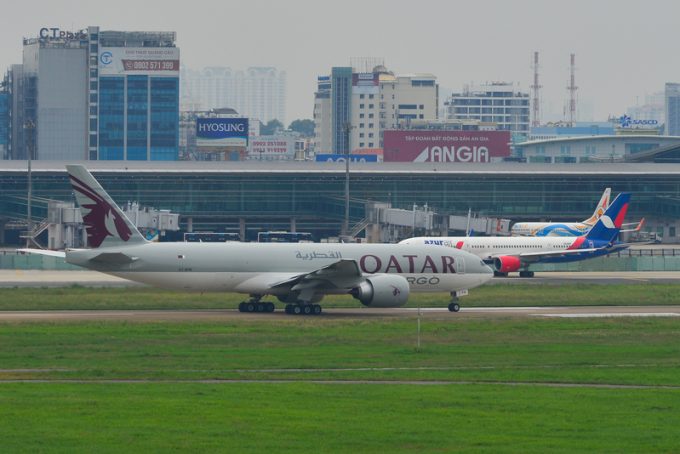
Significant growth in Vietnam’s tech sector is seeing logistics operators boost capacity in the country to take advantage of potentially high yields.
Ceva Logistics has launched a three-times-weekly 777F Hanoi-Chicago service, citing growing demand from manufacturers in Vietnam’s technology and industrial sectors for a “dependable long-haul solution into the US”.
Ceva provides pickup and cargo consolidation across multiple Vietnamese gateways, including Hanoi (HAN), Danang (DAD), and Ho Chi Minh City (SGN), supported by domestic operations teams coordinating multimodal flows, customs brokerage and transhipment activities.
Sister airline CMA CGM Air Cargo reportedly recently launched a twice-weekly nonstop widebody freighter route connecting the French and Vietnamese capitals.
The moves come amid mounting evidence that Vietnam is evolving into one of the world’s fastest-growing hubs for hi-tech manufacturing – and logistics providers are moving quickly to position themselves for the shift.
For years, Vietnam was viewed primarily as a beneficiary of the “China-plus-one” strategy, attracting manufacturers seeking to diversify production from China. But growing investments suggest the country is moving beyond a role as a low-cost assembly base to becoming an increasingly important part of global tech supply chains.
Taiwan’s Well Shin said yesterday it was shifting production of AI server power cords to Vietnam after securing cloud-related orders, and China’s Huawei has expanded partnerships in the country, spanning AI, energy and 5G infrastructure.
According to Vietnam’s National Statistics Office, the country attracted $24.8bn in foreign investment commitments in the first five months of 2026, up 34.9% year on year, with around 65% of this directed towards manufacturing and processing.
Among the largest projects announced this year are Samsung’s second facility in Thai Nguyen province, Posco Future M’s battery materials investment, and automaker BYD’s expansion of its electronics production.
Vietnam is also seeing increased investment in digital infrastructure. Industry forecasts point to rapid growth in AI-ready data centres, cloud infrastructure, and edge computing facilities. Hyperscale facilities are expected to account for the largest share of this expansion, driven by cloud growth and AI-related computing demand.
And the shift is increasingly visible in freight markets.
According to consultancy Aevean, Vietnam’s AI-related air cargo exports increased 110% year on year in the first four months of 2026, while forwarders reported airfreight capacity out of both Hanoi and Ho Chi Minh City had tightened significantly, with exports to the US facing critical space constraints and elevated rates.
According to Rotate, freighter capacity year to date into Vietnam from Europe has gone up 190%, and +50% from North America. Overall freighter capacity growth out of Vietnam has risen 32% over last year.
Operators, including Atlas Air, UPS, China Cargo Airlines, Kalitta Air, Turkish Cargo, and AeroLogic have all added capacity– the strongest growth has been recorded on routes linking Vietnam with major manufacturing centres in South Korea, mainland China, and Hong Kong.
That pattern suggests Vietnam is becoming more deeply integrated into regional technology production networks rather than simply replacing China as a manufacturing location.
Ceva’s latest announcement reflects that. Alongside the Hanoi-Chicago launch, the company also renewed its Wuxi-Chicago freighter operation in China, arguing that both routes support customers seeking resilient transpacific supply chains.
It’s not just air cargo: in April, Ceva parent CMA CGM announced the second phase of expansion at the Gemalink terminal in Cai Mep, southern Vietnam. The project will increase annual capacity from 1.7m teu to approximately 3m teu by 2027.
The carrier said the terminal, which opened in 2021 and in which it holds a 25% stake alongside Gemadept, is already operating at full capacity. CMA CGM described the expansion as part of its long-term strategy in Vietnam, where it also operates extensive logistics services through Ceva.
And Vietnam’s attraction is no longer based solely on labour costs. Increasingly, investment is flowing into electronics, battery materials, telecommunications equipment, digital infrastructure, and other higher-value sectors that generate demand for sophisticated logistics services.

For uninterrupted access, sign in or sign up to The Daily News, Premium or The Loadstar Enterprise Plan.
Comment on this article