Carriers keep the price pressure on – a 'shock and awe' PSS the standout
Container spot freight rates on the transpacific and Asia-Europe trades rose for the sixth consecutive ...


WTC: EBL DEAL DETAILSWTC: EBL DEALEXPD: 'READ MY LIPS' HON: DEALS ON THE MENUEXPD: NEW RECORD XPO: THE REBOUNDCAT: PAYOUT UPDHL: LIGHTHOUSEMAERSK: ANOTHER UPGRADEFWRD: HEALTHY CORRECTION R: RYDER CEO SAYS R: AMAZON LTL ANNOUNCEMENTPLD: EV INFRASTRUCTURE PUSH
WTC: EBL DEAL DETAILSWTC: EBL DEALEXPD: 'READ MY LIPS' HON: DEALS ON THE MENUEXPD: NEW RECORD XPO: THE REBOUNDCAT: PAYOUT UPDHL: LIGHTHOUSEMAERSK: ANOTHER UPGRADEFWRD: HEALTHY CORRECTION R: RYDER CEO SAYS R: AMAZON LTL ANNOUNCEMENTPLD: EV INFRASTRUCTURE PUSH
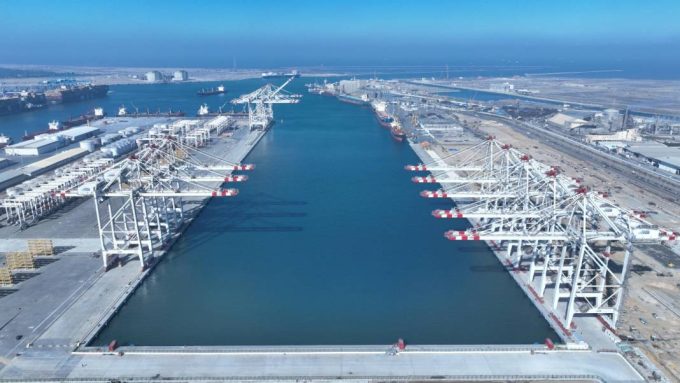
The opening of a new container terminal in Egypt today could provide a crucial pressure-release valve for Europe’s container supply chains, should carriers resume Suez Canal transits in earnest.
A sudden restoration of Asia–Europe services via the canal risks unleashing a wall of cargo on Mediterranean gateways already operating with limited slack. If boxes begin to stack up in Valencia, Genoa or Piraeus, carriers will need somewhere to put them.
Egypt’s new Damietta Alliance Container Terminals (DACT) is betting it can be that somewhere.
The terminal launched commercial operations with the maiden call of Hapag-Lloyd’s 13,117 teu Essen Express, formally bringing into play a facility designed primarily as an east Mediterranean transhipment hub. Once fully built out, it will offer up to 3.3m teu of annual capacity – entering a regional market that has just absorbed another major capacity injection.
5.5m teu of new capacity
In November, APM Terminals opened the latest expansion of its Suez Canal Container Terminal (SCCT) at Port Said, adding 2.2m teu of annual capacity. The project delivered just under 1km of quay and 510,000 sq metres of yard space, supported by 12 quay cranes, 30 electric RTGs and more than 90 trucks. SCCT’s capacity now stands at 7m teu, taking total capacity at Port Said to 8m teu.
Combined with DACT’s planned 3.3m teu, around 5.5m teu of additional annual capacity is being layered into the Egyptian east Mediterranean market within a short space of time.
On current demand levels, that looks like structural overcapacity.
SCCT handled 4.5m teu in 2021, 4.2m teu in 2022, 3.95m teu in 2023 and 3.9m teu in 2024 – resilient figures given the Red Sea crisis, but well below its expanded design ceiling. Gemini Cooperation partners Maersk and Hapag-Lloyd maintained calls through the disruption, supported by Asia–Mediterranean loops, an India–Europe service and regional shuttle networks.
DACT now enters the arena as a purpose-built transhipment platform: 93ha with 1,670 metres of quay at 18 metres depth, and equipped with 12 fully electric ship-to-shore cranes with 25-row outreach and 40 hybrid RTGs. The planned cargo mix is 80% transhipment and 20% import-export.
Hapag-Lloyd, via Hanseatic Global Terminals, holds a 39% stake, making the facility central to its long-term terminal strategy within the Gemini framework.
From surplus to safety valve?
At present, Gemini does not need two major Egyptian hubs running at scale. SCCT already provides dedicated, alliance-aligned capacity.
But that calculus changes rapidly if Suez transits resume and dozens of Asia–Europe sailings simultaneously revert to the shorter route creating an effect that analysts at Sea-Intelligence described as the “Double Influx” problem.
“As faster Suez-routing vessels catch up to the tail-end of the slower Cape-routing fleet, there is a port congestion risk specific to the destination region.
“As carriers redirect services back to Suez (saving roughly 14 days), these vessels will arrive in North Europe at the same time as the final wave of vessels that were committed to the long Cape route weeks prior,” Sea-Intelligence said.
Months of Cape diversions have distorted sailing schedules, transit times and equipment positioning. A wholesale return to Suez could compress arrival windows into European ports, increasing peak intensity even if underlying demand growth remains modest.
Mediterranean hubs are not immune to congestion. Yard density, labour constraints and hinterland bottlenecks can quickly erode fluidity. If discharge ports begin slowing vessels, carriers will look to restructure rotations, skip calls or tranship cargo elsewhere.
That is where Damietta’s spare headroom becomes strategically interesting.
Rather than flooding west Med and Adriatic ports, lines could peel off relay cargo in the east Med, deploy shuttle services, or temporarily buffer containers at a deepwater transhipment hub with available berth windows and yard space. In effect, surplus capacity becomes shock absorption.
Egypt’s three-way contest
The competitive backdrop is equally fluid.
Port Said remains Gemini’s established stronghold. Damietta has historically served other alliance configurations, while CMA CGM’s Terminal 55 in Alexandria anchors Ocean Alliance activity, with Piraeus acting as a key regional node.
DACT complicates that balance. It gives Gemini optionality: consolidate at Port Said, pivot to Damietta, or distribute flows between the two to manage risk and utilisation. For rivals, it intensifies competition in a market already facing pricing pressure.
In the near term, the east Mediterranean appears oversupplied. But shipping markets have repeatedly shown how quickly excess capacity can become scarce when networks are disrupted.
If Suez reopens and Europe struggles to absorb the returning tide, Damietta may find demand arriving faster than forecast.
In calm conditions, 5.5m teu of new capacity looks bold. In a congestion scenario, it may look essential.
For uninterrupted access, sign in or sign up to The Daily News, Premium or The Loadstar Enterprise Plan.
Comment on this article