Near-record transpac spot rate surge a 'harbinger of instability', says Sea-Intelligence
A sharp increase in container spot rates on the major east-west trades has propelled freight ...


MAERSK: NEARING ONE-YEAR HIGHFDX: FEDEX FREIGHT UPSIDEBA: TIME TO DELIVERFDX: EARNINGS RISKDSV: UPSIDEKNX: TIME TO SAY GOODBYEODFL: SET THE BAR HIGHBA: PIPELINEBA: SUPPLY CHAIN TESTAMZN: AI WAVESDHL: THE FRENCH CONNECTIONJBHT: MIND THE SPREADMAERSK: GAUGE THE UPSIDE
MAERSK: NEARING ONE-YEAR HIGHFDX: FEDEX FREIGHT UPSIDEBA: TIME TO DELIVERFDX: EARNINGS RISKDSV: UPSIDEKNX: TIME TO SAY GOODBYEODFL: SET THE BAR HIGHBA: PIPELINEBA: SUPPLY CHAIN TESTAMZN: AI WAVESDHL: THE FRENCH CONNECTIONJBHT: MIND THE SPREADMAERSK: GAUGE THE UPSIDE

Global container freight rate movements are driven by the world’s largest tradelanes, with smaller routes impacted months later, according to new analysis from Sea-Intelligence, based on Container Trade Statistics (CTS) data.
By analysing CTS rate indices from January 2018 to November 2025, covering global averages and 49 individual sub-trades across seven regions, the maritime intelligence company found “a clear relationship” between trade size and influence on rates.
This is largely unsurprising, as the larger trades account for a significant share of global container volumes, and therefore will always exhibit a strong correlation with global rate movements.
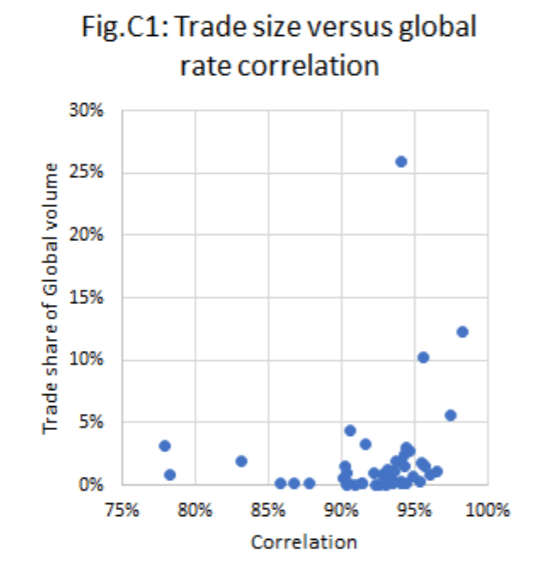
Source: Sea-Intelligence
Sea-Intelligence also isolated smaller lanes for closer inspection but found that even among trades representing less than 5% of global volumes, correlation with the global index remains high.
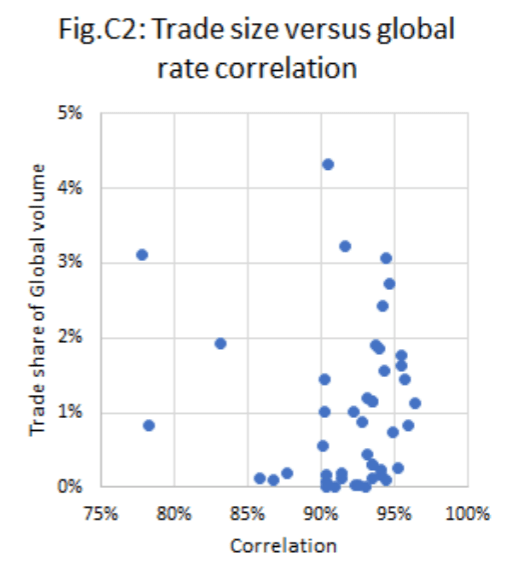
Source: Sea-Intelligence
But this doesn’t tell the whole story, the analyst said: “The question is then, what is the lead time for this correlation?.”
It found that while large trades tended to move in advance of the global average, thus becoming the “drivers”, smaller trades typically lag behind global rate developments by up to seven months.
“The smaller a trade is, the longer the lead time,” noted Sea-Intelligence.
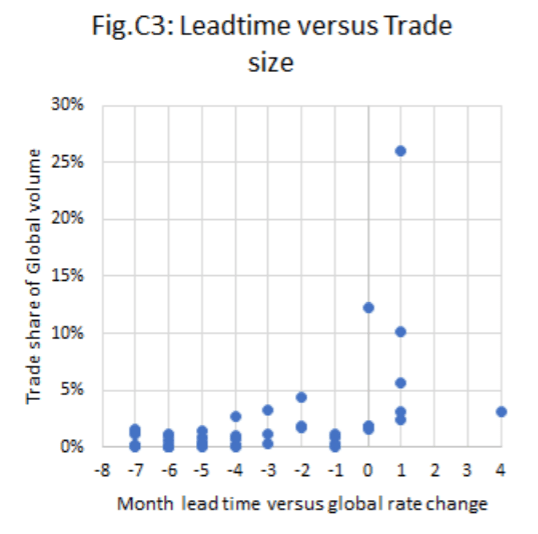
Source: Sea-Intelligence
It explained: “If rates suddenly increase sharply on the large trades, this will tend to pull capacity out of smaller trades, subsequently leading to comparable rate increases in smaller trades. And if the global rate declines due to overcapacity in the major trades, this would in turn lead to a cascading of capacity into smaller trades, causing rates there to drop.
“We do indeed see a pattern consistent with a trade dynamic, wherein the large trades are the drivers of freight rates, and smaller trades are subsequently subjugated to this development, with a lead time of up to seven months,” it concluded.
“In turn, this is an indication of cascading of supply in the global supply chains, and with an indication of the timeline such cascading operates under.”
Watch the latest News in Brief Podcast on YouTube!
For uninterrupted access, sign in or sign up to The Daily News, Premium or The Loadstar Enterprise Plan.

Comment on this article