US state legal chiefs in late bid to steer UP-NS rail merger into the buffers
Six of the nine Republican attorneys general that objected to the looming Union Pacific-Norfolk Southern ...

GM: TRADING UPDATE OUTUPS: REMEMBER THE TAILWINDS PLD: NEW RELEASEPLD: OUCHVW: NEW PARTNERS SOUGHTEXPD: AIRCRAFT ON GROUND SERVICESTSLA: JUST AS VW STRUGGLESBA: NEW BIG ORDERBA: THE ORDERBOOK GROWSPLD: PUSHING FOR A DEAL PLD: TIME TO DEALEXPD: ANOTHER ALL-TIME HIGH CHRW: NEW RECORD DSV: AHEAD OF EARNINGS RELEASE JBHT: NEW HIGHS EVERYWHERE
GM: TRADING UPDATE OUTUPS: REMEMBER THE TAILWINDS PLD: NEW RELEASEPLD: OUCHVW: NEW PARTNERS SOUGHTEXPD: AIRCRAFT ON GROUND SERVICESTSLA: JUST AS VW STRUGGLESBA: NEW BIG ORDERBA: THE ORDERBOOK GROWSPLD: PUSHING FOR A DEAL PLD: TIME TO DEALEXPD: ANOTHER ALL-TIME HIGH CHRW: NEW RECORD DSV: AHEAD OF EARNINGS RELEASE JBHT: NEW HIGHS EVERYWHERE
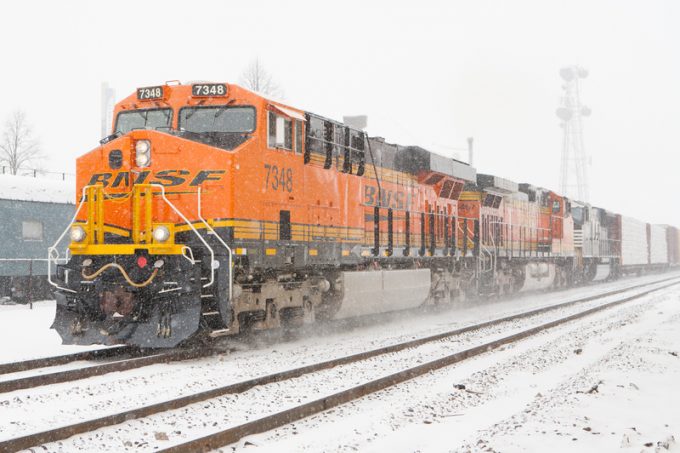
Once again this year BNSF is facing obstacles from rival railroad Union Pacific (UP) over planned services using part of the latter’s track infrastructure, this time jeopardising a new intermodal service.
And, in a separate development, a federal court has thrown out the ‘reciprocal switching’ rule the Surface Transportation Board (STB) issued last year to give shippers options for alternative service.
BNSF is chomping at the bit to start a new double-stack intermodal service from southern California to Salt Lake City, but has hit an obstacle as the route includes a section of track that belonged to Western Pacific, acquired by UP in 1996.
UP has argued that it did not receive sufficient notice to hire and train crews to manage the five weekly trains BNSF wants to run on the route.
In addition, it argues that BNSF has to follow its directional routing pattern. This would require eastbound trains to take the former Southern Pacific route through Donner Pass, which UP cleared for double-stack service in 2009, and obliging BNSF to pay a portion of that cost.
It is not the first time the pair have been at odds over BNSF using UP track. They have been unable to agree on charges for passage through the Tehachapi mountains in southern California, as this involves the use of the former Southern Pacific track. To guarantee a competitive landscape after the 1996 UP-SP merger, the STB had imposed conditions including trackage rights agreements that allow both UP and BNSF to move on thousands of miles of their respective tracks.
UP argues that the fees BNSF pays for use of the Techahapi Pass are so low it is actually subsidising its rival’s operations, whereas BNSF says the proposed increase would raise its costs drastically and stifle competition.
The pair brought their argument to the STB. And now BNSF has approached the regulator again, this time asking for an emergency order to UP to permit the planned intermodal service.
CMA CGM, reportedly the largest customer of the new operation, has also approached the STB, asking for a speedy move to allow the service to go ahead.
BNSF has described UP’s stance as “|a spoiling tactic”, after it lost the CMA CGM business and argues that the 1996 trackage rights agreement allows it to chose the lines it wants to operate on.
A recent attempt by BNSF to target two new customers over UP trackage was rejected by the STB last month.
Meanwhile, the regulator itself is facing headwinds over its stance on allowing shippers to use alternative carriers to the ones that own trackage near them. A federal court has ruled that the STB exceeded its authority when it introduced the reciprocal switching rule last year.
The rule, which allows shippers, served by just one Class I rail carrier and receive substandard service, to seek access to another railway was the result of STB hearings on railway performance issues that began to cascade in 2022.
Three Class I carriers – UP, CSX and Canadian National – challenged the rule in a lawsuit and the court found the rule contravened legislation that had deregulated the rail industry. It did uphold the requirement for the STB to produce weekly reports on service performance metrics.
Recent statistics indicate an improvement in intermodal operations, showing faster average train speeds than a year ago and fewer disruptions – despite higher volumes.
Many shippers remain unimpressed, though. At the recent meeting of the Midwest Association of Rail Shippers, one participant expressed no confidence in being able to keep operations going “when something goes wrong”, while another flatly declared rail was not viable.
For uninterrupted access, sign in or sign up to The Daily News, Premium or The Loadstar Enterprise Plan.
Comment on this article