HMM eyes hub-and spoke model as it expands feeder fleet
South Korean flagship carrier HMM wants to rebuild its intra-Asia shipping business, and is expanding ...


HON: DEALS ON THE MENUEXPD: NEW RECORD XPO: THE REBOUNDCAT: PAYOUT UPDHL: LIGHTHOUSEMAERSK: ANOTHER UPGRADEFWRD: HEALTHY CORRECTION R: RYDER CEO SAYS R: AMAZON LTL ANNOUNCEMENTPLD: EV INFRASTRUCTURE PUSHDHL: RAMPING UP 'NEW ENERGY LOGISTICS' GXO: NEW WINAMZN: LTL SERVICE UPDATEGM: ENERGY PROVIDER MODEL
HON: DEALS ON THE MENUEXPD: NEW RECORD XPO: THE REBOUNDCAT: PAYOUT UPDHL: LIGHTHOUSEMAERSK: ANOTHER UPGRADEFWRD: HEALTHY CORRECTION R: RYDER CEO SAYS R: AMAZON LTL ANNOUNCEMENTPLD: EV INFRASTRUCTURE PUSHDHL: RAMPING UP 'NEW ENERGY LOGISTICS' GXO: NEW WINAMZN: LTL SERVICE UPDATEGM: ENERGY PROVIDER MODEL
Following years of underinvestment, intra-Asia carriers are renewing their feeder and sub-panamax box ship fleets.
The past fortnight has seen orders for 13 newbuildings from Chinese intra-Asia operators Jiangsu Ocean Shipping Co (Josco) and Ningbo Ocean Shipping, as well as Vietnamese feeder operator Hai An Transport & Stevedoring.
Last month, brokers reported that Josco had ordered four 3,000 teu ships at Jiangsu Soho Chuangke Shipbuilding (also known as Jiangsu Soho Innovation & Technology) – subsequently confirmed as orders for three vessels, with a fourth as an option.
Josco, which operates intra-Asia services through subsidiary Jiangsu Ocean TCLC Container Lines also disclosed it had ordered four 1,900 teu ships at CSSC Huangpu Wenchong Shipbuilding, with options for two more.
The newbuildings are expected to be delivered in 2027, the 3,000 teu ships estimated to cost $45m each and those of 1,900 teu vessels around $32m each.
Josco said the newbuildings would add around 20,000 teu to its current fleet of around 15,600 teu, adding: “We want to enhance Jiangsu province’s shipping capability to support its export-oriented economy.”
NBOSCO announced that Wenchong had been chosen to build four 2,700 teu ships for delivery in 2027.
Clarksons’ latest Container Intelligence Monthly report says that last year, just 82 ships in the 100-2,999 teu range had been ordered, compared with 264 in 2021, 237 in 2022 and 100 in 2023, and suggested an uptick was imminent, with 23 commissioned in April, compared with just four feeder vessels ordered in the same month in 2024.
In addition, the declining availability of feeder ships is driving up charter rates, with daily prices ranging from $9,188 to $43,000 in the 725 teu to 2,750 teu vessel class, up 5% on early April.
And the intra-Asia carriers’ newbuilding orders coincide with trade volumes that have stayed resilient, despite headwinds on the long-haul routes.
Container Trade Statistics’ volumes data shows that in April, the intra-Asia trade stood at 3.78m teu, a 3% year-on-year dip, but exceeding the combined 3.09m teu for Asia-Europe and transpacific volumes.
Meanwhile, Drewry’s Intra-Asia Container Index was stable, as of 30 May, at $655 per 40ft, 11% higher year on year.

Source: Drewry Supply Chain Advisors
However, Hai An’s motivations appear to differ from its Chinese competitors. Linerlytica analyst Tan Hua Joo told The Loadstar the Vietnamese operator was chartering its newbuildings to an Asian operator
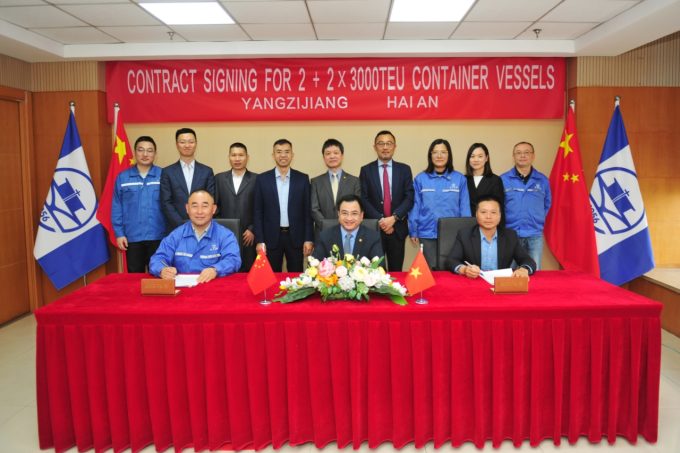
Hai An ordered two 3,000 teu ships at Yangzijiang Shipbuilding, with options for two more, and upon delivery, in 2027/28, they will be the largest vessels in Hai An’s fleet – currently, the biggest are 1,900 teu.
Hai An said: “Having large ships gives us opportunities to cooperate with major shipping lines, as we look to expand to Europe and the US west coast”
This would follow other traditional intra-Asia carriers that have dipped their toes into the transpacific market to take advantage of soaring spot rates, redeploying intra-Asia vessels to service US importers.
Analysis by Sea-Intelligence published yesterday shows the rapid expansion of transpacific capacity offered by what it terms niche carriers – principally outside the main east-west deepsea alliances.

Source: Sea-Intelligence Consulting
“We see a sharp ramp-up in capacity deployed by these new entrants in recent months, to 4.5% of the weekly deployed capacity on Asia-North America west coast,” it notes.
“This means that the current market conditions are such that these new entrants feel that there is an opportunity reminiscent of the global pandemic; and if history is anything to go by, we will see these carriers remove capacity as quickly as it was introduced, once the market conditions start to normalise,” it adds.
For uninterrupted access, sign in or sign up to The Daily News, Premium or The Loadstar Enterprise Plan.

Comment on this article
J D BALAJI
June 09, 2025 at 12:10 pmGood Article