Battery-powered 850 teu box ships herald 'second wave' of electrification
To operate on electrical power, the cliché goes, a ship would need to tow a ...


KNX: TIME TO SAY GOODBYEODFL: SET THE BAR HIGHBA: PIPELINEBA: SUPPLY CHAIN TESTAMZN: AI WAVESDHL: THE FRENCH CONNECTIONJBHT: MIND THE SPREADMAERSK: GAUGE THE UPSIDE DSV: UP AND DOWNCHRW: FIRST OF ITS KINDMFT: TAKING PROFIT
KNX: TIME TO SAY GOODBYEODFL: SET THE BAR HIGHBA: PIPELINEBA: SUPPLY CHAIN TESTAMZN: AI WAVESDHL: THE FRENCH CONNECTIONJBHT: MIND THE SPREADMAERSK: GAUGE THE UPSIDE DSV: UP AND DOWNCHRW: FIRST OF ITS KINDMFT: TAKING PROFIT
Despite five years of market disruption in which feeder-size vessels have been a saving grace – sometimes eliciting absurdly high demand – the shortsea market is still populated with aging, costly vessels. Regulation, too, has done little to help.
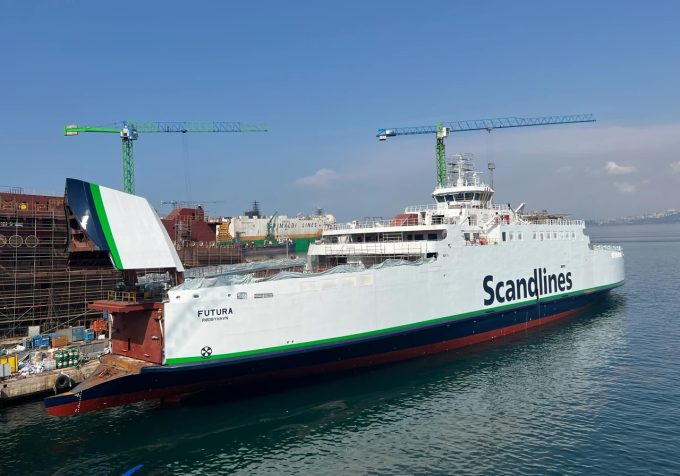
But where the container segment has failed to address the problem, the ferry segment just might, with the arrival of new electric vessels like Futura, the 1,200-lane-metre battery-hybrid Scandlines vessel now on sea trials in Turkey.
When it is delivered, Futura will ply a short route between Puttgarden, Germany, and Rødbyhavn in Denmark, using a 10MWh battery pack, fully recharging itself within 12 minutes.
“We cannot wait to put it into operation,” said Michael Guldmann Petersen, COO of Scandlines. “With our first emission-free ferry, we’re taking a huge step toward meeting our goal of operating with zero direct emissions on the Puttgarden-Rødby route by 2030.”
In a fossil-fuelled vessel, almost two-thirds of the fuel is wasted. The situation is even worse in a theoretical vessel powered by green e-fuel where, at best, 10% of the output of the wind turbine or solar panel actually makes it to the propeller.
Contrast this with a battery-electric vessel, which puts virtually all of the energy it intakes during charging to good use, either propelling the vessel or supporting the passengers.
This is the most exciting aspect of electrification – that it can drastically reduce the energy requirement of doing things, transportation included.
In shipping, it is often joked that for a ship to be battery-powered, it would have to tow a ship-sized battery with it. But this elides the fact that a ship powered by electric motors could consume as little as a quarter of the power.
This illustrates better the case for modal shift made by battery-electric vessels. Rather than finding enough green ammonia to power a network of coastal feeders, battery-electric equivalents could perform the same task using one-ninth of the energy. Meanwhile, instead of 100 trucks, the amount of diesel – and cost – saved by transporting 100 trailers on a battery-electric ro-ro vessel would be profound.
Norway is trying to figure out how to make tiny container feeders work, the all-electric Yara Birkeland now making regular trips along the coast. In the time since the vessel’s delivery in 2020, with 6.7MWh of lithium-ion batteries installed, battery energy density has improved by over 20%; but despite this, the vessel’s captain, Svend Ødegård, told The Loadstar it was using far less electric power than expected, with a quarter of the power left over at the end of each trip.
The 10 nautical miles between Puttgarden and Rødbyhavn might not be an operating range to shock the world. But, at a time where shipping is haggling over non-existent fuels like green ammonia and green methanol, Futura may serve as a proof-of-concept for battery-powered vessels, and, hopefully, lead to more ambitious investments.

For uninterrupted access, sign in or sign up to The Daily News, Premium or The Loadstar Enterprise Plan.
Comment on this article