Gulftainer unveils major logistics ambitions for Khor Fakkan expansion
The Emirati owner of the port of Khor Fakkan has unveiled a massive capacity expansion ...


VW: D-DAYPLD: KEEP PUSHINGDHL: NEW AIR SERVICEDHL: GUIDANCE UPGRADE REACTIONDHL: NEW HIGH TARGET ON THE STREET DSV: EXPECTATIONS RUN HIGH KNIN: DHL GUIDANCE UPGRADE READ-ACROSSKNIN: NEW OPENINGGM: TECH UPSIDEAMZN: BIG DEBT FUNDING ON ITS WAYDHL: 'STELLAR EXPRESS'DHL: UPDATEDHL: STRONG PRELIMINARY UPDATE CHRW: STILL VERY BEARISH
VW: D-DAYPLD: KEEP PUSHINGDHL: NEW AIR SERVICEDHL: GUIDANCE UPGRADE REACTIONDHL: NEW HIGH TARGET ON THE STREET DSV: EXPECTATIONS RUN HIGH KNIN: DHL GUIDANCE UPGRADE READ-ACROSSKNIN: NEW OPENINGGM: TECH UPSIDEAMZN: BIG DEBT FUNDING ON ITS WAYDHL: 'STELLAR EXPRESS'DHL: UPDATEDHL: STRONG PRELIMINARY UPDATE CHRW: STILL VERY BEARISH
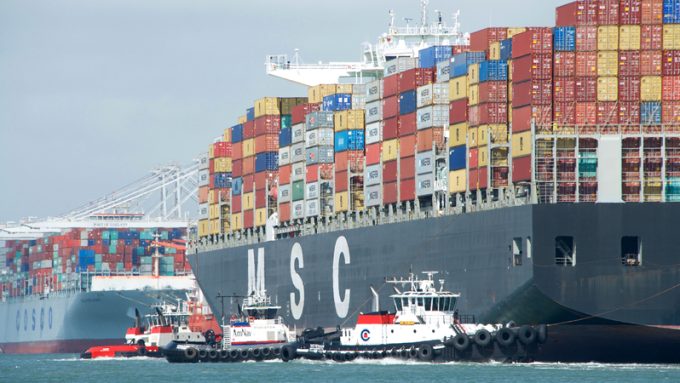
MSC’s fleet-expansion initiative has been driven by a “strategic desire to reduce exposure to one volatile market”, according to analysts, but “impossible to avoid” overcapacity next year could dampen its spirits.
Analysts at Braemar have dubbed MSC’s continuous fleet expansion as “buying power redefined”.
They estimate that between the start of 2020 and today, MSC’s operated fleet has expanded by around 3.2m teu, on a net basis, accounting for demolitions and the off-hire of chartered vessels.
Most of this capacity comes from newbuildings and second-hand buys – Alphaliner data shows MSC’s fleet has the lowest proportion of chartered tonnage among the world’s five largest carriers, about 37.8%.
“Regional and intra-regional liner services typically rely heavily on chartered tonnage,” said Braemar. “MSC’s decision to purchase significant amounts of second-hand capacity may therefore reflect a strategic desire to reduce exposure to what has been a volatile and often illiquid charter market.
“In such an environment, purchasing tonnage rather than chartering may have been an attractive and pragmatic approach,” it added.
This additional tonnage had given MSC the ability to “deploy vessels rapidly where cargo demand is strongest”, added Braemer, likely a key motivation behind the carrier’s “extensive second-hand purchasing activity in recent years”.
Nearly 90% of the second-hand ships MSC has bought since 2020 have been deployed on north–south or regional services, the remaining 11% on east–west trades, according to Braemar.
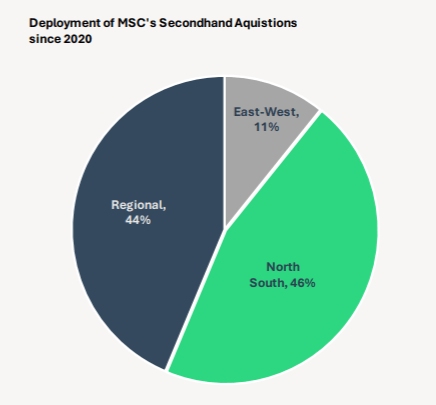
Graph: Braemar
This hunger for non-chartered tonnage, however, will contribute to the overcapacity that is expected to materialise on the major box trades next year – set to be exacerbated should vessels begin to re-route back to the Suez Canal.
Lars Jensen, CEO of Vespucci Maritime, explained: “In Q4 23, it was beyond doubt that there was overcapacity. That’s also why the carriers were loss-making and rates went back to pre-pandemic levels.
“Since then, we have had more capacity delivered than there has been demand. Pure and simple. So, however you choose to measure the overcapacity at the end of 2023, when the Red Sea re-opens, the situation is going to be slightly worse than back then.”
And Mr Jensen underscored that this supply and demand imbalance would be “impossible to avoid”.
“Container shipping has been cyclical for centuries, and you would often find that in an industry where it takes years to get capacity physically delivered from your order, it’s just impossible to avoid,” he said.
“In Q4 23, carriers were losing money fourth quarter because they had ordered too many ships… They were the butt of jokes at that point and people asked, ‘don’t the carriers ever learn?’.
“Then the Red Sea crisis rolls around and suddenly that overcapacity was needed to divert around Africa – had we not had that level of overcapacity that would have been impossible,” he said.
Mr Jensen asked: “Should we learn only to order what we think we’re going to need, and therefore not be resilient?
“But of course, I also realise that when you don’t need that resilience, it’s called overcapacity and then it becomes loss-making.
“That’s the nature of the industry.”

For uninterrupted access, sign in or sign up to The Daily News, Premium or The Loadstar Enterprise Plan.
Comment on this article