
As Norway’s NuProShip II project wraps up, nuclear power threatens to upend the over-tonnaged container market with new zero-emission super-ships, with cheaper lifetime costs and faster operating speeds.
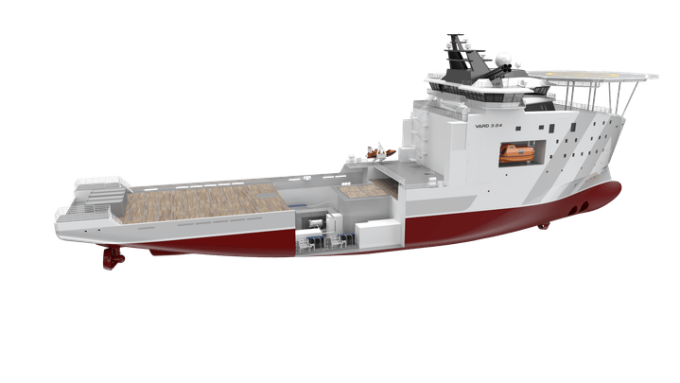
Norway’s NuProShip sequence of projects, helmed by Norwegian University of Science and Technology (NTNU) aims to use offshore and shortsea vessels as proofs-of-concept before larger vessels are used. Under the auspices of NuProShip II, Vard today unveiled a helium gas-cooled nuclear reactor vessel design for the offshore industry, in which the reactor would not only provide for the ship’s propulsion power needs, but for energy-hungry in-situ work such as dynamic positioning (DP2).
The energy-dense nuclear reactor was deemed more than sufficient for these tasks.
“NuProShip II demonstrates that nuclear-powered vessels are not just a vision, but a technically feasible solution,” said Henrik Burvang, research & innovation manager at Vard Design, and responsible for NuProShip II at Vard. “Our work lays the foundation for safer, more efficient, and environmentally responsible shipping.”
Experts are agreed containerships are among the most logical choices for the next nuclear-powered ships, with not only a high propulsion requirement, but energy-intensive reefer slots to support throughout each voyage.
Both reactor and fuel would require large capital investments, shifting to a ‘expensive to buy, cheap to fly’ model, compared with the inverse for conventional vessels. Once fuelled, the vessel could go for as long a decade without refuelling, immune to fluctuations in the oil price or rising fuel premiums and carbon levies associated with decarbonisation.
Container vessels would benefit from the faster speeds that only nuclear power could provide. DNV, the world’s largest classification society, nuclear sceptic, and long-time advocate of an LNG-poweredNcu future, recently gave approval-in-principle for a 15,000teu containership design by HD Korea Shipbuilding, powered by a small modular reactor (SMR), which would travel at 24 knots, around 25% faster than what is typical for container vessels today.
“We have developed a novel shielding and containment system, which is designed to maintain reactor safety and vessel survivability even in the event of collisions, groundings, or sinking accidents,” said Kwangpil Chang, CTO of HDKS. “We will continue to collaborate with global partners to advance marine nuclear technologies. The design focuses intensely on the safety of the vessel and advancing the propulsion system in the application of SMR technology.”
If such a vessel were delivered today, its extra speed would be converted into greater transport work and market share, leaving conventionally-fuelled liners unable to offer a competitive service. According to a November study by Lloyd’s Register and LucidCatalyst, a 25-knot, 15,000 teu nuclear-powered containership could deliver 38% more cargo capacity than a conventionally fuelled equivalent, with 5% additional cargo space thanks to the nuclear powertrain’s small size, and a higher speed.
Even 25 knots is conservative compared with what could be possible with a reactor on board. Nuclear-powered naval vessels, for example, have proven capable of sustained speeds of 45 knots.
Nuclear experts have repeated that the barriers to its adoption in merchant shipping were regulatory rather than technological in nature. This month, IMO officially began its first major revision of the Code of Safety for Nuclear Merchant Ships, a document which had been left untouched since 1981.
And in China, a thorium-fuelled molten salt reactor, of the same type that would be used on the KUN-24AP design unveiled in 2023.
Jan Emblemsvåg, of NTNU, told The Loadstar that disintegrating globalisation and the new multi-polar political reality would only make it more likely that China would push ahead of the west in nuclear-powered shipping, much as it has in other respects.
“China is moving very fast; they could run this ship from China to Africa and we couldn’t do anything about it,” he said. “That’s why it’s so important that we in the west move forward and try to do this correctly to set the rules and expectations.”
Comment on this article