
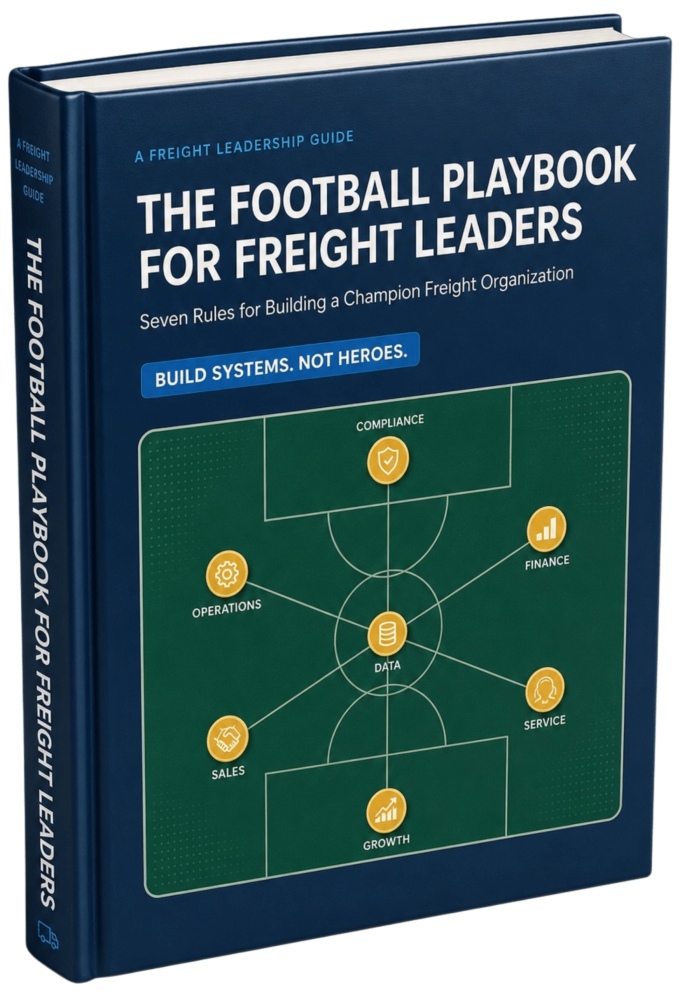
Championship football is not won by asking one brilliant player to defend every attack, make every pass, and score every goal. It is won when the whole team follows one formation, shares information, reacts early, and knows exactly what to do next. Many freight companies do the opposite. They depend on a few experienced people to rescue shipments, remember customer terms, solve customs issues, and prevent billing errors. These people may look like the strength of the company, but their daily heroics often hide a weak operating system.
Download the complete Football Playbook for Freight Leaders, including seven rules, a leadership scorecard, and a 90-day action plan:
Freight forwarding should work like a well-coached football team.
A shipment moves through several functions. Sales wins the account. Pricing prepares the quote. Operations books the shipment. Documentation prepares the papers. Customs manages compliance. Finance checks costs and raises the invoice. Customer service keeps the customer informed.
The customer sees one company.
Inside the company, however, these functions often work like separate teams. They use different spreadsheets, email threads, chat groups, and software tools. Sales knows what was promised. Operations knows what was booked. Finance knows what was billed. But nobody has one complete and current view of the shipment.
This is the freight version of playing without a shared formation.
Everyone must understand the formation
In football, players need freedom to make decisions, but they must still understand the team structure. They need to know their role, where their teammates will be, and what should happen next.
Freight companies need the same clarity.
Every stage of a shipment should have a clear owner. Each team should know what information it must receive, what action it must complete, and what it must pass forward.
The next action should not depend on someone remembering to send a message or searching through an old email chain.
A business cannot scale when the process exists mainly in the minds of its most experienced people.
Handovers are freight’s passing game
A goal may begin with a defender winning the ball, followed by several accurate passes before the final shot.
Freight works in the same way.
A quotation must pass into a booking. The booking must become a job. Shipment data must flow into documentation, customs, tracking, costing, and billing. Each handover must carry complete and correct information.
When these passes fail, the results are familiar:
● Incorrect rates
● Missed cut-offs
● Repeated data entry
● Missing costs
● Delayed invoices
● Wrong customer updates
● Compliance errors
● Margin loss
Many companies respond by asking employees to be more careful.
That does not solve the real problem.
When people must copy information between emails, spreadsheets, and separate systems, errors are part of the process. Staff may work harder, but the risk remains.
Information should move with the shipment. Data entered once should support every later stage.
Shared data controls the midfield
The midfield connects defense and attack. It controls the pace of the game and prevents the team from breaking into separate parts.
Shared data plays the same role in freight.
It connects sales with operations, operations with finance, and shipment execution with customer service. It gives management one view across branches, customers, jobs, costs, and revenue.
Without that shared view, each department may complete its own task while the company loses control of the full shipment cycle.
This is why freight technology should not be treated only as an operations tool. Its larger role is to connect the entire company around the same customer, shipment, cost, and service information.
Defend before the problem reaches the customer
Strong football teams do not wait until the opponent reaches the goal before reacting. They identify danger early.
Freight companies must do the same.
A missing document, an unconfirmed booking, an expired rate, or an unrecorded cost may appear small at first. Left unchecked, it can become a missed vessel, a customs delay, a disputed invoice, or a lost customer.
A good operating system should show where action is needed before the failure occurs.
The purpose is not to create more reports. It is to help people focus on the shipments that need attention now.
Build a strong bench
A championship team cannot depend on the same eleven players in every match. A freight company cannot depend on one operations expert, customs specialist, or finance manager.
Standard processes, shared information, clear roles, and proper training allow other people to step in without causing disruption.
Experience should improve judgment. It should not be the only reason the company can function.
Manage the right scoreboard
Freight leaders need more than shipment volume and revenue.
They need to track gross profit, billing delays, unbilled revenue, cost variance, milestone performance, customer exceptions, and outstanding receivables.
A useful dashboard should help management act today. It should not only explain what went wrong last month.
Freight forwarding will always need skilled and experienced people. Complex shipments require judgment. Customers value personal support. Unexpected events will continue.
The goal is not to remove the heroes.
The goal is to stop needing heroic effort for routine work.
Championship teams are built through clear roles, accurate passing, early defense, strong backup, and one shared system.
Freight companies that follow the same principles can grow without losing control.
Comment on this article