
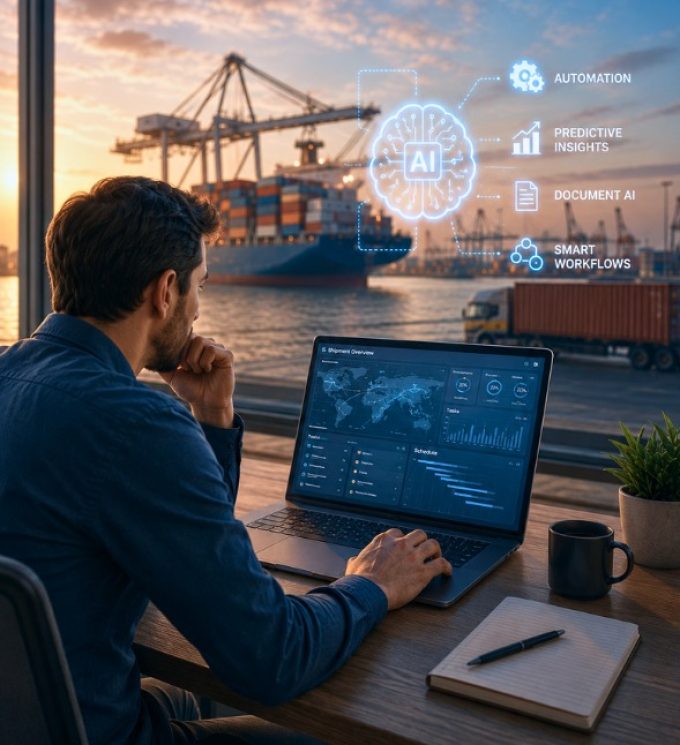
Recent reports around WiseTech Global’s layoffs have triggered an important conversation across the freight technology industry.
The company reportedly linked the downsizing to internal efficiencies created through AI and automation.
From a business perspective, that may sound logical.
But it also raises a bigger question for the entire industry:
Can freight technology companies afford to reduce the human layer too aggressively in the race toward AI-driven efficiency?
After spending more than 35 years building technology for freight forwarders and logistics providers, I believe this industry is fundamentally different from many other software sectors.
Freight forwarding is not a standard SaaS business operating in a predictable environment.
It is an industry built around uncertainty, exceptions, coordination, relationships, and real-time decision-making.
A shipment held at customs.
A missed transshipment.
A billing dispute between partners across countries.
A last-minute compliance change.
A vessel rollover.
A customer demanding answers at midnight.
These situations are not solved only through automation.
They are solved through operational understanding built over years of real-world logistics experience.
There is no doubt AI will transform freight technology.
In fact, it already is.
AI will reduce repetitive data entry.
It will improve document processing.
It will strengthen customer support.
It will enhance visibility and forecasting.
It will help automate workflows that historically consumed enormous human effort.
This is progress.
But there is a difference between using AI to strengthen people and using AI primarily as a reason to reduce people.
That distinction matters.
The logistics industry still depends heavily on human judgement because the global supply chain itself remains fragmented, unpredictable, and constantly changing.
Ports operate differently.
Customs regulations evolve continuously.
Trade lanes shift overnight because of geopolitics.
Customers themselves often work through disconnected systems and incomplete data.
In such an environment, operational intelligence becomes as important as software intelligence.
This is why freight technology companies must think carefully before treating logistics like a pure automation problem.
The danger is not AI itself.
The danger is assuming logistics complexity can be solved only through AI while weakening the operational and customer-facing teams that hold the ecosystem together.
Short-term efficiencies may look attractive.
But over time, excessive reduction in domain expertise, implementation capability, support strength, and product understanding can weaken customer trust and long-term resilience.
Freight technology is not only about writing software.
It is about understanding freight.
That understanding still comes from people.
At our organization, we are investing aggressively in AI, automation, and intelligent systems. But at the same time, we continue investing in talent, expanding teams, and building long-term capability.
This year, while parts of the global technology industry focused on layoffs and restructuring, we completed appraisals across the organization and rewarded performance with salary increases averaging between 15% and 25%.
Not because we are ignoring AI.
But because we believe AI should amplify human capability, not create fear around it.
Some of the best innovations in freight technology still emerge from teams debating operational problems, challenging assumptions, and solving customer pain points that cannot always be understood from dashboards and analytics alone.
Technology builds platforms.
People build industries.
The future of freight technology will belong to companies that successfully combine both.
Comment on this article