Low-cost barge model wins business for Medlog’s Dhaka terminal
Five months after taking over Bangladesh’s underused Pangaon Inland Container Terminal, MSC’s Medlog has attracted ...


VW: D-DAYPLD: KEEP PUSHINGDHL: NEW AIR SERVICEDHL: GUIDANCE UPGRADE REACTIONDHL: NEW HIGH TARGET ON THE STREET DSV: EXPECTATIONS RUN HIGH KNIN: DHL GUIDANCE UPGRADE READ-ACROSSKNIN: NEW OPENINGGM: TECH UPSIDEAMZN: BIG DEBT FUNDING ON ITS WAYDHL: 'STELLAR EXPRESS'DHL: UPDATEDHL: STRONG PRELIMINARY UPDATE CHRW: STILL VERY BEARISH
VW: D-DAYPLD: KEEP PUSHINGDHL: NEW AIR SERVICEDHL: GUIDANCE UPGRADE REACTIONDHL: NEW HIGH TARGET ON THE STREET DSV: EXPECTATIONS RUN HIGH KNIN: DHL GUIDANCE UPGRADE READ-ACROSSKNIN: NEW OPENINGGM: TECH UPSIDEAMZN: BIG DEBT FUNDING ON ITS WAYDHL: 'STELLAR EXPRESS'DHL: UPDATEDHL: STRONG PRELIMINARY UPDATE CHRW: STILL VERY BEARISH
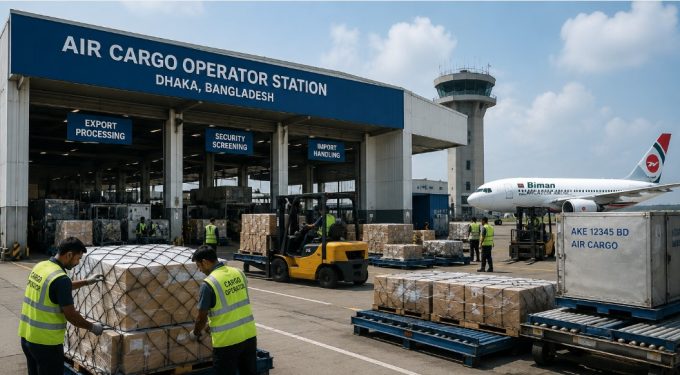
In a move designed to tackle chronic congestion and delays in airfreight exports, Bangladesh will permit private cargo operator stations to be established near its international airports.
The measure, announced by finance minister Amir Khosru Mahmud Chowdhury during the presentation of the national budget earlier this month, responds to long-standing demands from exporters, freight forwarders and logistics providers for faster and more efficient cargo processing.
Under the proposal, both international logistics companies and domestic private operators will be allowed to invest in air cargo clearance activities through dedicated off-airport facilities.
“To simplify trade and reduce supply-chain lead time, I propose issuing a new regulation for establishing Air Cargo Operator Stations, enabling globally renowned logistics companies and domestic private operators to invest in air-cargo clearance activities,” Mr Chowdhury told parliament.
He added that, once implemented, the country’s international airports in Dhaka, Chattogram (Chittagong) and Sylhet would gradually be transformed into full-fledged logistics hubs, supporting the continued growth of Bangladesh’s ecommerce sector.
Currently, exporters typically load cargo at factory premises before transporting it directly to airports, where shipments often face lengthy queues, security checks and warehouse delays before being loaded onto aircraft.
Industry groups welcomed the proposal, arguing that off-airport cargo stations could significantly improve efficiency and reduce bottlenecks.
Inamul Haq Khan, senior vice-president of the Bangladesh Garment Manufacturers and Exporters Association (BGMEA), told The Loadstar: “It is a very positive decision for the air cargo sector. If off-dock facilities are available, we will be able to deliver export cargo and receive import cargo from there.”
He said the benefits could be particularly significant for imports.
“The facilities available for import cargo handling at Dhaka airport are extremely poor. Off-dock facilities will be much more helpful for import cargo handling than export cargoes.
“We feel that having off-dock facilities would make the process of handling air cargo much more convenient compared with managing it solely within airport premises.”
Nurul Amin, former vice-president of the Bangladesh Freight Forwarders Association (BAFFA), described the proposal as one of the most important potential changes for the country’s airfreight industry in recent years.
“The proposed budget measure on the formulation of regulations for establishing Air Cargo Operator Stations has the potential to be one of the most significant reforms for Bangladesh’s airfreight sector in recent years,” he said.
However, he cautioned that the extent of any cost savings would depend on how the regulations are implemented.
“This initiative can reduce airfreight costs if genuine competition in cargo handling is established.”
Mr Amin noted that cargo handling at Dhaka airport is currently carried out by a single handling agent, Biman Bangladesh Airlines, limiting competition.
“Allowing internationally reputed logistics companies and qualified domestic operators to establish Air Cargo Operator Stations could break existing monopolistic practices, improve service quality and efficiency, introduce global best practices and put downward pressure on handling charges,” he said.
He added that delays remained one of the hidden costs of airfreight in Bangladesh.
Export cargo frequently encounters long waiting times, warehouse capacity constraints, manual documentation procedures and bottlenecks during security screening, with screening machines often out of action.
Private cargo stations could reduce pressure on airport facilities by enabling off-airport cargo acceptance and pre-clearance procedures, significantly shortening dwell times and reducing storage and labour costs, Mr Amin said.
He also argued that the move could lower airlines’ operating costs.
“Many airlines serving Bangladesh currently maintain their own cargo staff and infrastructure because existing handling arrangements do not fully meet operational requirements,” he said.
The proposal follows another significant liberalisation measure announced in the budget, under which Bangladesh will remove the 49% cap on foreign ownership of inland container depots (ICDs) from 1 July. Together, the reforms signal a broader government effort to attract foreign investment into the country’s logistics sector and modernise trade infrastructure as export volumes continue to grow.

For uninterrupted access, sign in or sign up to The Daily News, Premium or The Loadstar Enterprise Plan.
Comment on this article