MSC says Iran attack on its box ship was 'completely unjustified'
MSC has confirmed that one of its vessels, the 4,800 teu MSC Sariska V, was ...


KNX: TIME TO SAY GOODBYEODFL: SET THE BAR HIGHBA: PIPELINEBA: SUPPLY CHAIN TESTAMZN: AI WAVESDHL: THE FRENCH CONNECTIONJBHT: MIND THE SPREADMAERSK: GAUGE THE UPSIDE DSV: UP AND DOWNCHRW: FIRST OF ITS KINDMFT: TAKING PROFIT
KNX: TIME TO SAY GOODBYEODFL: SET THE BAR HIGHBA: PIPELINEBA: SUPPLY CHAIN TESTAMZN: AI WAVESDHL: THE FRENCH CONNECTIONJBHT: MIND THE SPREADMAERSK: GAUGE THE UPSIDE DSV: UP AND DOWNCHRW: FIRST OF ITS KINDMFT: TAKING PROFIT

The Hormuz crisis has upended normal container freight rate seasonality, according to Sea-Intelligence analysis, with spot rates on major east-west trades rebounding sharply instead of following the customary post-Chinese New Year decline.
According to the consultancy, the disruption has been particularly pronounced on the transpacific, where spot rates are now hundreds of dollars per 40ft above levels normally expected at this point in the seasonal cycle.
Using Drewry’s World Container Index (WCI) data from 2013 to 2025, Sea-Intelligence analysed seasonal rate movements around Chinese New Year (CNY), defining “week 0” as the period immediately preceding the holiday and examining freight rate developments from the 15 weeks before CNY to the 15 weeks after.
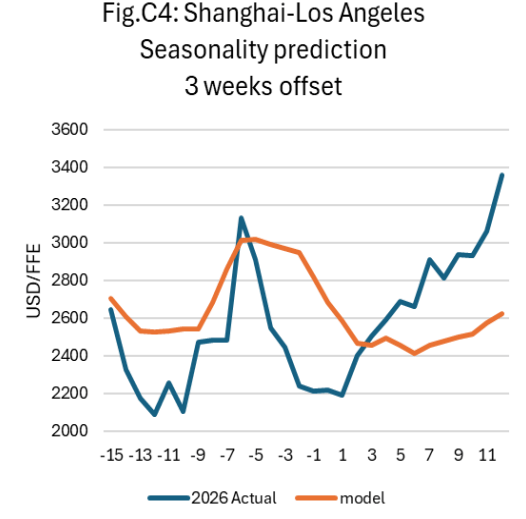
Rates on the Shanghai-Los Angeles trade typically peaked three weeks before CNY, as shippers rushed cargo out before the factory holiday shutdowns. Historically, the holiday is followed by a sustained seasonal slump, but the consultancy said 2026 had deviated sharply from that pattern.
“Not only was the slump prior to the CNY peak deeper than usual, but we also saw it was followed by yet another unusually deep slump after Chinese New Year,” Sea-Intelligence noted. “Then it is followed by a steep, sustained, increase after the onset of the Hormuz crisis.”
To account for the earlier-than-normal decline this year, Sea-Intelligence shifted 2026 data by three weeks, to compare it more accurately with the historical seasonal patterns.
The consultancy then calculated the gap between expected “normal” seasonal spot rates and actual market developments, which it described as a potential “Hormuz premium”.
Source: Sea-Intelligence
“We see a strong steady increase, and are presently at a level which is $735 per 40ft higher than what would have been expected seasonally,” the report said.
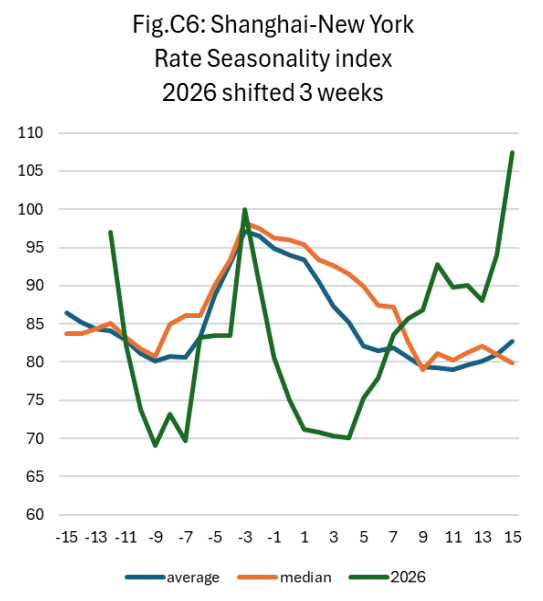
A similar pattern was observed on the Shanghai-New York trade and, after adjusting for the same three-week seasonal shift, Sea-Intelligence calculated a current Hormuz premium of $864 per 40ft on the US east coast route.
Source: Sea-Intelligence
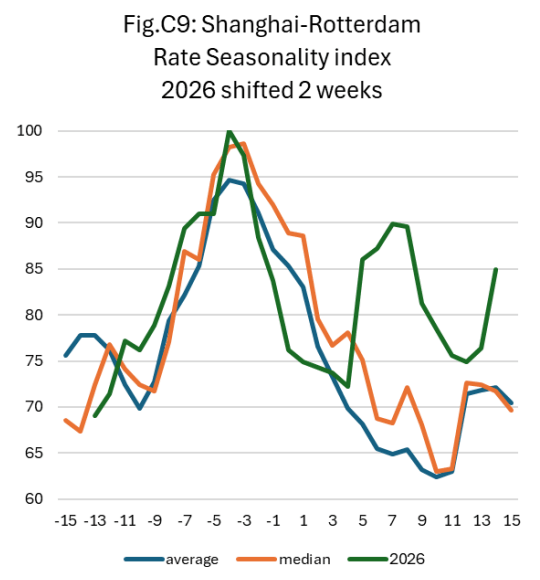
However, the Europe trades showed a more mixed picture. On the Asia-North Europe corridor, the deviation from normal seasonality emerged earlier, with a two-week offset rather than three, while post-CNY declines were less severe than on the transpacific.
Source: Sea-Intelligence
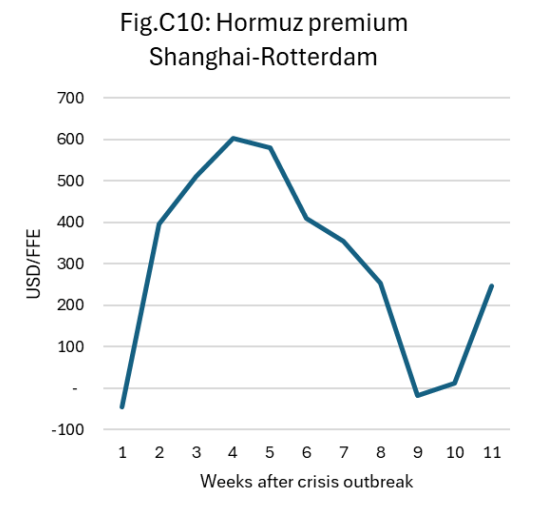
Sea-Intelligence said the impact of the Hormuz crisis on North Europe rates had also been “a lot more volatile”. It found North Europe’s Hormuz premium initially surged to around $600 per 40ft, before disappearing completely, only to re-emerge recently as spot rates climbed again. The latest premium was calculated at $245 per 40ft.
Source: Sea-Intelligence
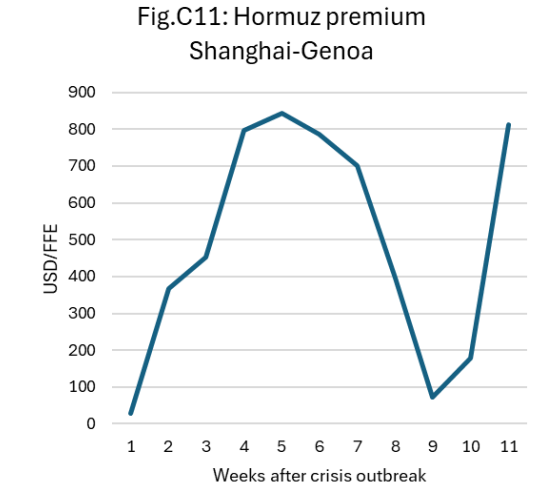
Meanwhile, the Mediterranean trade displayed even sharper swings.
Source: Sea-Intelligence
“We see how the early premium peaked at $844 per 40ft, dropped to zero, but has now come back at $811,” Sea-Intelligence said.
Despite the strong correlation between the timing of the Hormuz crisis and the reversal in freight rate seasonality, the consultancy cautioned that: “First, it must be mentioned that the changes could also be due to other factors than just the Hormuz crisis.
“This could be localised developments in supply and/or demand, as an example.
“However, the break from seasonality does appear to coincide with the outbreak of the Hormuz crisis, and it can therefore be justified, for now, to call it a Hormuz premium.”
Watch the latest episode of The Loadstar’s News in Brief and subscribe so you never miss an episode!

For uninterrupted access, sign in or sign up to The Daily News, Premium or The Loadstar Enterprise Plan.
Comment on this article