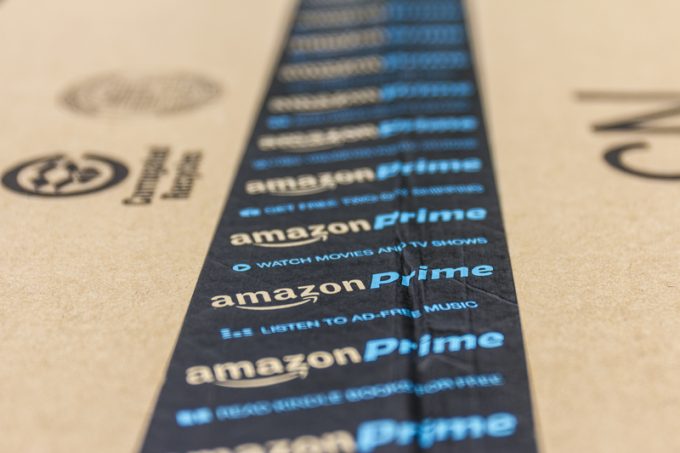
Indianapolis - Circa September 2016: Amazon Prime Parcel Package. Amazon.com is a premier online retailer IV
ID 77563209 © Jonathan Weiss | Dreamstime.com

Once again Amazon is speeding up the rush to consumers’ wallets. It now offers one-hour delivery in hundreds of US cities, flanked by a three-hour service in smaller cities and towns across the country.

Among the tier of locations with one-hour deliveries are Los Angeles, Chicago and Houston, as well as some smaller cities, while the three-hour service is available in more than 2,000 cities and towns.

The new offering does not cover the full gamut of products sold on Amazon’s marketplace. It comprises more than 90,000 products and is built on the company’s same-day delivery network. This is supported by predictive AI inventory placement algorithms to supplement everyday essentials and other popular items. Inside those centres Amazon has set up designated work stations for these rapid orders.

The number of Amazon same-day facilities has grown to over 9,000, and it appears to have been a significant growth engine. Last month Amazon CEO Andy Jassy remarked that same-day had grown into the company’s fastest growing delivery option, jumping 70% over 2024 fast delivery volume.

“The regional invasion by Amazon has been hugely successful,” commented Rick Watson, founder and CEO of RMW Commerce Consulting. “Amazon’s delivery performance right now is unreal and keeps getting faster.”

Management is keeping the foot on the accelerator. Back in December the ecommerce giant launched Amazon Now, a 30-minute delivery service, in Seattle and Philadelphia. According to one report at the time, management was also looking at the launch of a one-hour pick-up offering for consumers to collect their orders from Whole Foods, Amazon Fresh grocery stores and Amazon Go convenience stores.

Presumably the build-up of its rapid delivery capabilities also played a role in Amazon’s ascent to the top of the US parcel delivery hierarchy – in terms of volume. According to ShipMatrix, the company delivered about 6.7bn packages in 2025, for the first time surpassing the US Postal Service (USPS), which handled around 6.6bn ecommerce parcels. UPS came third with 4.4bn parcels.

In terms of revenue, however, UPS and FedEx claimed the largest shares of the US parcel market with 29.8% and 26.4% respectively. The US parcel market revenues climbed 4.1% last year, whereas volume rose a mere 0.4%. ShipMatrix attributes this gap chiefly to the pricing policies of the integrated express carriers and the USPS.

ShipMatrix expects volume growth to pick up again, forecasting 3.9% compound annual growth over the next three years.

Presumably the contest between Amazon and Walmart will continue and spawn more rapid delivery solutions. With over 4,600 stores, which it leverages for speed, the retail behemoth can reach 95% of US households within three hours and the company keeps honing its fulfilment capabilities.

The two contestants are fighting over a tightening market. Over the past three years the retail share of consumer spending has shrunk 9%, Mr Watson pointed out. Consumers now spend more on healthcare, housing and financial services, he explained.

In this sphere Walmart and Amazon have been moving in different direction. Amazon’s growth to capture 11.1% of total US consumer spending in the last quarter was largely driven by discretionary acquisitions – electronics, personal care items, hobby good and furniture. During the Black Friday splurge 49% of all US consumers bought something from Amazon, Mr Watson noted.

In contrast, Walmart’s share of the US retail market has barely changed in recent years, and the biggest engine has been groceries (60% of its business and growing, whereas categories like electronics, hobby goods and clothing have lost ground).

This places Walmart in a segment where higher parcel charges for faster delivery have better traction. Consumers are more inclined to wait a few days longer for a discretionary item, especially if it’s on sale, whereas essential goods are more likely to be ordered at relatively short notice, Mr Watson observed.

Amazon’s new super-fast services do command higher charges. Prime members, who get standard deliveries for free, pay $4.99 for three-hour deliveries and $9.99 for the one-hour service.

According to Mr Watson, Amazon’s edge over Walmart in discretionary purchases stems chiefly from consumer perception. Shoppers expect brands that they find in a shopping mall to be available on Amazon, but not necessarily on Walmart’s website, he said, adding that a traditional association of Walmart with low-income households has also been a factor, but a declining one.

Indeed, retail analysts have pointed out the middle income households increasingly shop at retailers like Walmart.

Mr Watson regards the retail giant’s smaller presence in the discretionary spending segment as an upside, as it offers plenty of room to grow in.

Comment on this article


You must be logged in to post a comment.