Hormuz 'definitely shut', landbridges under pressure – TIR to the rescue?
With tentative hopes of a reopening of the Hormuz Strait dashed by the wave of ...


MAERSK: ANOTHER UPGRADEFWRD: HEALTHY CORRECTION R: RYDER CEO SAYS R: AMAZON ANNOUNCEMENTS RPLD: EV INFRASTRUCTURE PUSHDHL: RAMPING UP 'NEW ENERGY LOGISTICS' GXO: NEW WINAMZN: LTL SERVICE UPDATEGM: ENERGY PROVIDER MODELEXPD: LAYOFFS CONFIRMED DHL: DOWNSIDE RISKDHL: OVERVIEWDHL: DATE CENTRE PUSH IN APAC
MAERSK: ANOTHER UPGRADEFWRD: HEALTHY CORRECTION R: RYDER CEO SAYS R: AMAZON ANNOUNCEMENTS RPLD: EV INFRASTRUCTURE PUSHDHL: RAMPING UP 'NEW ENERGY LOGISTICS' GXO: NEW WINAMZN: LTL SERVICE UPDATEGM: ENERGY PROVIDER MODELEXPD: LAYOFFS CONFIRMED DHL: DOWNSIDE RISKDHL: OVERVIEWDHL: DATE CENTRE PUSH IN APAC
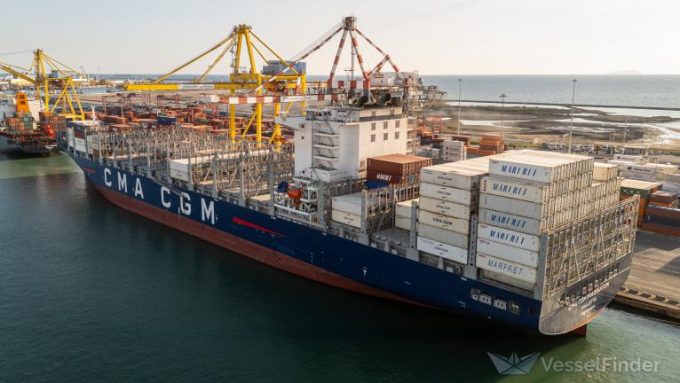
A new container terminal on Colombia’s Caribbean coastline, located on the edge of the vast fruit plantations in the Antioquia region, is due to begin operations soon, handling its first deepsea vessel to Europe.
Construction of the offshore Puerto Antioquia terminal, by CMA CGM-majority owned Puerto Bahia Colombia de Uraba, is set to open its first phase next month, and will create 600,000 teu of dedicated container handling capacity to a port that today is completely reliant on shipboard cranes – geared vessels – to load its banana and pineapple exports.
The new facility at the port of Turbo will offer a 570-metre pier, with 16.3 metres of depth alongside, and be equipped with three ship-to-shore cranes.
According to liner consultancy Alphaliner, the terminal is set to serve its first deepsea vessels after being included on CMA CGM’s Europe-Latin America Medcarib service, on which Marfret and Cosco charter slots.
The inaugural call by a geared container vessel is scheduled to be by the 6,900 teu CMA CGM Imagination on 20 December, Alphaliner noted, after which Turbo will be “served on a weekly basis by the nine high-reefer vessels of 6,800-7,377 teu deployed on the Medcarib”.
“Before directing the Medcarib loop to Puerto Antioquia on a regular basis, CMA CGM successfully completed a nautical test with the 7,377 teu CMA CGM Fort Bourbon in the Gulf of Uraba on 8 November. The vessel performed this trial run without berthing at Antioquia,” Alphaliner said.
The revised Medcarib port rotation will be Algeciras-Malta-Livorno-Genoa-Marseille-Barcelona-Valencia-Tanger Med-Fort-de-France-Pointe a Pitre-Caucedo-Kingston-Cartagena (Colombia)-Buenaventura-Paita-Posorja-Guayaquil-Moin-Turbo-Cartagena (Colombia)-Algeciras.
However, Alphaliner also added that the French carrier’s Uraba shuttle service, which deploys one 1,700 teu vessel on a port rotation of Cartagena-Barranquilla-Manzanillo (Panama)-Turbo, will likely use the new terminal .
“As far as the new terminal is concerned, the 1,691 teu Marfret Guyane is scheduled to start calls at Antioquia late in November, suggesting that the terminal plans a soft launch with smaller ships, before receiving big mainliners next month,” it said.
The new terminal is also expected to begin receiving calls on Maersk Line’s revised Europe-Caribbean CAX service. In July, The Loadstar reported that Maersk was phasing out its CRX and COEX services in favour of the CAX, as well as an expanded Europe-South America west coast CLX route.
“The CAX will offer efficient, direct products from key reefer ports in the Caribbean, with seamless connections to and from our expansive ocean network via our hubs in Panama,” it said.
It added that it would also introduce a call at Turbo, once construction of the new terminal was completed. The new CAX rotation will then be: Antwerp-Southampton-Hamburg-Bremerhaven-Newark-Manzanillo (Panama)-Turbo-Puerto Moin-Manzanillo (Panama).
Currently Maersk’s one call at Turbo is on its NAE feeder service to the US east coast, operated by three geared 3,400 teu ships.
Until Puerto Antioquia opens, cargo handling operations in Turbo continue to resemble a picture from before containerisation, as this description in the book Around the World in Freighty Ways of loading operations on a conventional reefer ship shows:
“Coming to the Colombian port of Turbo was an eye-opener. Port is the wrong word, as we lay at an anchorage in a bay surrounded by jungle, which houses del Monte’s vast banana plantations. This intercontinental supply chain was developed before containers had such a grip on liner shipping, but it was also a kind of rough sketch of containerisation.
“During the sweltering day, workboats towed out several strings of floating pontoons and secured them to mooring buoys. Each pontoon had what appeared to be a pair of sheds, and in the shade of their walls sat groups of dark-skinned men in nothing but shorts. In the cool of the evening the scene was transformed. The hatches of the ship lifted off to reveal cavernous refrigerated holds; the pontoons had been brought closer and the ship’s cranes had removed the shed roofs under which were stacks of pallets loaded with boxes of bananas of the sort you would see in a European market.
“The pallets and the men were then craned into the cargo hold, where they stripped down the pallets and restacked the boxes in the hold to shoulder level. The hold had steel floors which were slid across to create a new level, and so the process started again. Each hold eventually contained 20,000 boxes, all destined for Hamburg and Antwerp, and it looked like thoroughly back-breaking work.
“When all was done, the hands of Turbo were craned back onto the floating pontoons and towed to land.”
For uninterrupted access, sign in or sign up to The Daily News, Premium or The Loadstar Enterprise Plan.

Comment on this article