Rob Smeets steps up as new port of Antwerp-Bruges CEO
The port of Antwerp-Bruges has appointed Rob Smeets (above) as its new chief executive, for ...


WTC: ANOTHER DIFFICULT WEEK CHRW: NEW PRODUCT LAUNCHDSV: LEADING THE DROP RXO: CRATERINGDSV: WHAT TO LIKEDSV: BULLISH BAMZN: 'AI EDGE'HD: HERE IS HOW IT LOOKSAMZN: REG RISKMAERSK: MOST HARMED
WTC: ANOTHER DIFFICULT WEEK CHRW: NEW PRODUCT LAUNCHDSV: LEADING THE DROP RXO: CRATERINGDSV: WHAT TO LIKEDSV: BULLISH BAMZN: 'AI EDGE'HD: HERE IS HOW IT LOOKSAMZN: REG RISKMAERSK: MOST HARMED
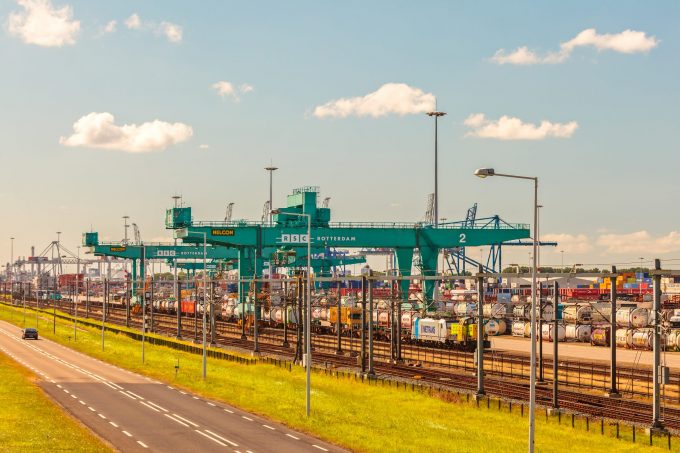
Business leaders are responding positively to the EU initiative merging the Rhine-Alpine and the North Sea-Mediterranean corridors.
They describe it as a “long overdue” decision that could help to ease congestion across the continent’s barge, rail, and road infrastructure.
Due to commence early next year, the alignment of the routes into a single corridor will follow a plan expected to add 10 ports to the network, including Antwerp and Rotterdam, both having struggled with years of inland congestion.
One European rail operator told The Loadstar: “The EU initiative creating the corridor is long overdue. The good news is that it avoids the SNCF network, but let there be no misunderstanding, there are still plenty of challenges.
“Its success will all very much depend on the financing. If the financing is scattered and time-limited, it will become a ‘white elephant’. That means that it will develop as long as the money keeps coming. When the financing stops, the project will perish silently.”
Under the initiative, more than 12,150km of track will be linked into the corridor, which will stretch across seven countries – Belgium, France, Germany, Italy, Luxembourg, the Netherlands, and Switzerland.
Port of Antwerp-Bruges CEO Jacques Vandermeiren said efforts to relocate more cargo through the hinterlands via rail would also help to remove cargo from the continent’s road network, working towards its green pledge.
For its part, Belgium has been keen to bolster its railfreight volumes, with plans in place to increase the rail share through Antwerp to 15% by the start of the next decade, in contrast to the neighbouring Netherlands, which is experiencing declining volumes.
Italy, which is dealing with significant disruption as a consequence of delays in infrastructure projects, could be a major beneficiary of any project, but the source pointed out that electoral considerations could prove a thorn in its side.
They added: “It is not clear who will support the corridor’s funding. It is meant to be spread over EU Cohesion and Connecting Europe Facility Fund, national government contributions, infrastructure managers and private sector investments, and TEN-T budget allocations.
“But the problem is that not a single euro or Swiss franc has been allocated to any of the organisations, nor to any of the railway network owners. And as long as cargo cannot vote and passengers can, rail infrastructure projects will be prioritised towards passengers over cargo.”
Addressing issues in and around the Belgian and Dutch ports is seen as key to alleviating what has been close to a decade of severe congestion on the inland water networks, with barge users contending with typical two- to three-day waits.
Droughts or issues on rail and road often compound these problems, as shippers turn to barges as an alternative. This results in a spiking of delays, particularly at Rotterdam, to upwards of seven days, and efforts to address this have long been stymied.
These issues are playing out on the inland water networks now, with barge operators imposing a series of low-water surcharges and reducing available capacity amid expectations that the situation will only worsen in the later summer months.
One operator began advising customers to consider rail as an alternative, only to find itself undermined by a memo from Kuehne + Nagel warning its customers that the present conditions necessitated pre-booking rail freight three weeks in advance.
Get up to speed on all things supply chain!
For uninterrupted access, sign in or sign up to The Daily News, Premium or The Loadstar Enterprise Plan.

Comment on this article