Carriers keep the price pressure on – a 'shock and awe' PSS the standout
Container spot freight rates on the transpacific and Asia-Europe trades rose for the sixth consecutive ...


HON: DEALS ON THE MENUEXPD: NEW RECORD XPO: THE REBOUNDCAT: PAYOUT UPDHL: LIGHTHOUSEMAERSK: ANOTHER UPGRADEFWRD: HEALTHY CORRECTION R: RYDER CEO SAYS R: AMAZON LTL ANNOUNCEMENTPLD: EV INFRASTRUCTURE PUSHDHL: RAMPING UP 'NEW ENERGY LOGISTICS' GXO: NEW WINAMZN: LTL SERVICE UPDATEGM: ENERGY PROVIDER MODEL
HON: DEALS ON THE MENUEXPD: NEW RECORD XPO: THE REBOUNDCAT: PAYOUT UPDHL: LIGHTHOUSEMAERSK: ANOTHER UPGRADEFWRD: HEALTHY CORRECTION R: RYDER CEO SAYS R: AMAZON LTL ANNOUNCEMENTPLD: EV INFRASTRUCTURE PUSHDHL: RAMPING UP 'NEW ENERGY LOGISTICS' GXO: NEW WINAMZN: LTL SERVICE UPDATEGM: ENERGY PROVIDER MODEL
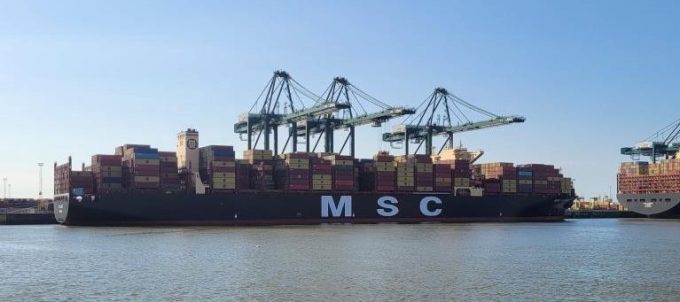
MSC has switched “essentially all” its megamax vessels from Far East-to-North Europe services to the Far East-Med and Asia-West Africa trades to benefit from rising spot rates, according to Alphaliner today.
Alphaliner said this was “a landmark development” for Asia-West Africa trades, on which the largest vessels currently deployed were 16,600 teu. This “surprise move” was “primarily driven by the carrier’s desire to profit from the high rates in the Asia West Africa trade”, according to the analyst.
Before the recent alliance reshuffle, MSC’s largest containerships were deployed on the 2M’s Lion/AE6 service, now replaced by a standalone Lion – but after analysing the Geneva-based carrier’s schedules, Alphaliner highlighted that the fleet of “much smaller” 17 neo-panamaxes, from 13,000 to 16,616 teu, would be assigned to this service.
And it noted that this downsizing of vessels would also be applied to MSC’s three other Far East-North Europe loops, Albatross, Swan, and Britannia.
Alphaliner said its analysis found that some of MSC’s 24,000+ teu ships would be re-deployed to the Asia-West African Africa Express service, while the majority of its megamax fleet – defined by Alphaliner as between 19,200 and 24,300 teu – would sail on three of the carrier’s four standalone Far East-Med loops.
Average vessel size for the Asia-West Med Jade service is 23,500 teu, on the Dragon service 19,200 teu from mid-March, and the Far East-East Med Tiger service has an average vessel size of 18,525 teu.
Further, from tomorrow, the 23,782 teu MSC Diletta will be phased into the Africa Express service, to be followed by more megamax sailings from Asia, including the 24,346 teu MSC Turkiye and 24,116 teu MSC Tessa, along with, as advertised so far, MSC Samar, MSC Gemma, MSC Michel Capplini, MSC Claude Girardet and MSC China.
Alphaliner explained that as MSC was no longer part of an alliance, it was able to react rapidly to changes in supply, demand, and rates.
But it added: “This also means that the capacity shifts within MSC’s network are not necessarily permanent. Depending on the rate environment, MSC could be quick to re-assign megamax tonnage to other trades, such as Europe, Med, the Middle East, or even the transpacific, if rates and volumes warrant this.”
For uninterrupted access, sign in or sign up to The Daily News, Premium or The Loadstar Enterprise Plan.
Comment on this article