
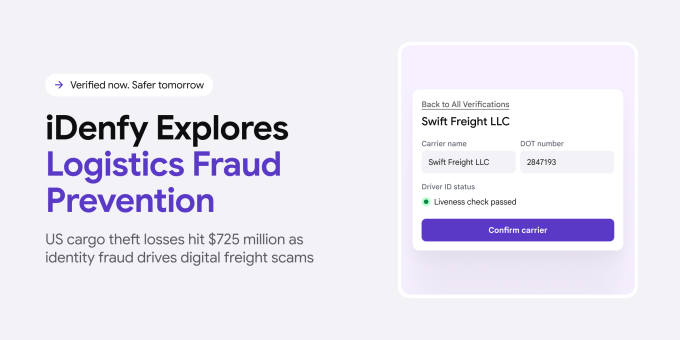
iDenfy explores a new case of an identity verification scam in the logistics sector, as cargo theft hit $725 million last year.
The RegTech giant iDenfy, provider of identity verification and fraud prevention solutions, is studying how tools such as document verification, liveness detection, and fraud monitoring could help logistics companies confirm the identities of drivers, carriers, and third parties involved in freight transactions. Criminals pivot to identity theft and false pick-up schemes. During this particular time, iDenfy recognized an opportunity to leverage the same verification methods relied upon in banking and finance for other sectors, such as logistics, to ensure firms know who they are really handing over their products to at each stage of transit.
The FBI warned the logistics industry about a rise in cyber loopholes in cargo theft cases. Losses hit nearly $725 million in 2025, a 60% jump from the year before, driven by criminals who use impersonation technology and steal high-value freight, since thieves got better at picking valuable targets. The FBI said that criminals have been breaking into the computer systems of freight brokers and carriers using fake emails and fake websites. Once inside, they post fake shipment listings on load boards, pretending to be real companies, and use that false information to redirect shipments.
Here’s how the scam usually works. It starts with a phishing email sent to a freight broker or carrier. The email tempts the victim to click on the portal where they’re asked to download and install remote access software. From there, the criminals gain long-term access to any company’s dispatch system, shipping routes, drivers’ details, invoice formats, and load board credentials, and often buy more of this information elsewhere on the dark web. They then issue fraudulent freight advertisements, claiming to be a firm with legitimate shipping contracts, accepting the cargo for transport.
The $725 million figure only covers losses that were actually reported to Verisk CargoNet. The American Trucking Associations believes the real cost to the US economy is much higher.
Identity fraud is not a new problem in American logistics. In 2017, FedEx uncovered a vendor fraud scheme in which an individual created a series of fictitious companies that were able to generate fabricated identities and business documentation, and used them to submit invoices for services that were never performed. The fraudulent billing went undetected across multiple cycles and cost the company millions of dollars before it was caught. The reason was largely due to the vendor relationship that was accepted at onboarding and never independently re-verified afterward. Industry analysts have since pointed to this case as an early example of a pattern now playing out at a much larger scale across digital freight networks.
Carrier identity becomes the weak point
Highway, the leading provider of Carrier Identity® solutions, in its Q4 2025 Freight Fraud Index report, found that direct theft, often carried out by carriers with a real, legitimate track record, made up nearly half of all reported stolen loads by the end of the year. It shows that criminals are no longer strangers who break in from outside. Many are already inside the system, posing as trusted carriers.
Domantas Ciulde, CEO of identity verification company iDenfy, said this about what happened in the FedEx case. “In both situations, a business got in because its paperwork looked convincing, and nobody went back later to check if that business was still who it claimed to be. Freight moves fast, and criminals have learned that a fake identity can move through a digital load board just as easily as a real one.”
AI makes fake identities harder to catch
Criminals are also using more believable AI-created images and documents. What were previously blurry, mismatched documents look professional today, unlike real documents in the past, which often possessed clear-cut flaws, such as scanned or edited copies that had noticeable inconsistencies.
Domantas Ciulde, the CEO of iDenfy, has mentioned the reason why a single background check at onboarding is no longer enough.
“A carrier that was verified a year ago isn’t guaranteed to be the same carrier today. Their authority can be sold, their email can be hacked, and nobody may notice until a shipment goes missing. The companies handling this well treat verification as something ongoing, not something that ends the day a vendor signs up.”
The Federal Motor Carrier Safety Administration treats this kind of fraud as a serious crime, specifically when someone uses another carrier’s official ID number without permission or pretends to be a licensed broker without being registered. The agency recommends double-checking a broker or carrier’s phone number through its official SAFER system before agreeing to any load, and treating any mismatch as a red flag worth stopping to investigate.
About iDenfy
IDenfy is a company that offers ID, business, AML verification, and compliance software used by more than 1000 businesses around the globe. The platform integrates all components into one – AI document verification, facial biometric liveness detection, AML checks, and KYB (Know Your Business) with support for 200+ countries and territories. It’s ISO/IEC 27001:2022 accredited and SOC 2 Type II audited. For more information, visit idenfy.com.
Media Contacts: [email protected] ; [email protected]
Comment on this article