
Agentic AI is about to move from the margins of supply chain software to the mainstream. The forwarders who benefit will be those who strengthen their rate data right now
Gartner expects enterprise adoption of agentic AI in supply chain software to rise from 5% today to 60% by 2030. That is a fast curve, and it will sort forwarders into two groups: those whose data is ready for AI, and those still wiring it together while competitors pull ahead.
Digitalization has already lifted efficiency and service levels across logistics. AI can do something harder: move net margins. But that gain depends on one thing, the data powering it. For forwarders, that means rates and charges, complete and structured across every mode they move.
AI bolted on as a separate tool will not hold up in logistics. It has to be native to the data. Fragmented data means agents miss options, quote against stale rates, or contradict the human team. A unified rate foundation, shared equally by AI and human experts, fixes that: faster quoting, fewer missed options, more accurate automation and documentation, and customer answers that match what the team would recommend.
Most forwarders are still in progress
In logistics, reliability decides value, and for AI that reliability rests entirely on its data. Most forwarders still trust their manual processes, and the numbers explain why. Research on European forwarders reported by The Loadstar found that only 29% have automated their core operational workflows. The rest still run on email, spreadsheets, PDFs and manual work. That caution is rational. The problem is not the appetite for AI, it is the absence of a foundation reliable enough to run it on.
A complete foundation
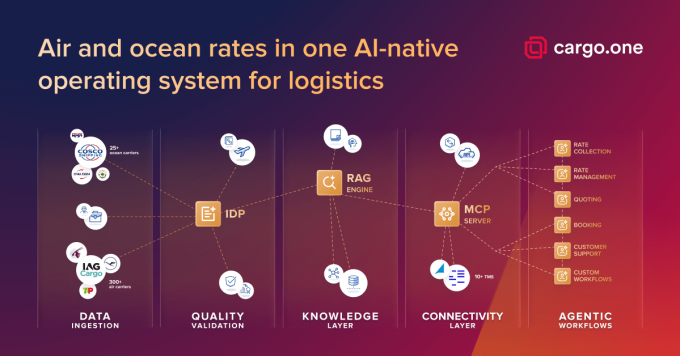
A foundation for strong AI must be multimodal and it has to be a single source of truth. Rate procurement, rate management, quoting, sales and customer support should run across air and ocean from one place, not three disconnected systems.
That is the gap we set out to close. cargo.one launched the industry’s first e-booking platform for air freight in 2018; today over 30,000 users across 172 countries rely on it. By acquiring the ocean pricing platform Cargofive, we unified air and ocean rate data, connecting directly to airlines and to the top ten ocean carriers, and carrying contract, FAK, NAC and spot rates across millions of trade lanes. Trucking, local charges and agent rates sit on top.
AI working alongside the team
The point of this foundation is what it enables AI to do reliably. Last year we automated the mechanical steps forwarders repeat dozens of times a day, such as extracting shipment details and collecting rates. Quotes turned around 68% faster, at 89% accuracy, with anything below the confidence threshold routed to a human rather than shipped.
The principle matters more than the numbers. The AI works in the same workspace as the team, on the same data, under their control. It takes the repetitive work; people handle the work that needs judgement: complex shipments, unusual routings, high-value customers, exceptions. Everything syncs back to the forwarder’s existing systems, and every AI decision is logged and auditable.
The result, in production, is tens of thousands of AI-generated quotes a month. Eight in ten go out with no human intervention, and the time per quote has dropped from around 15 minutes to under one minute. When hundreds of requests land each day, that speed and accuracy is the difference between winning and losing business.
Trust is earned in stages
Forwarders do not hand control to AI on day one, and they should not. Most teams start in co-pilot mode, where the AI prepares quotes, RFIs or support replies for review. As the accuracy proves itself, they move to supervised mode, where the AI runs routine work on its own and flags exceptions. From there, the workflow becomes fully autonomous, end to end. Teams that reach that point have not given up control. They have earned the confidence to run AI on their own data, in their own workspace.
Across our customers, the question has shifted from “should we explore AI?” to “where do we point AI next?”. That shift comes the moment a forwarder sees what a solid multimodal rate foundation makes possible.
Every successful logistics digitalization started by understanding the business and where new customer value sits. The forwarders who win in the next five years will be the ones who treat their rate data as the solid foundation it is, then deploy AI to run on top of it. Logistics will always be a people business. Agentic AI just makes good teams faster, sharper and harder to beat.
This post is sponsored by cargo.one.
This article is © The Loadstar. Reproduction, rewriting, or derivative use requires a license. Contact [email protected] for licensing enquiries.
Comment on this article