

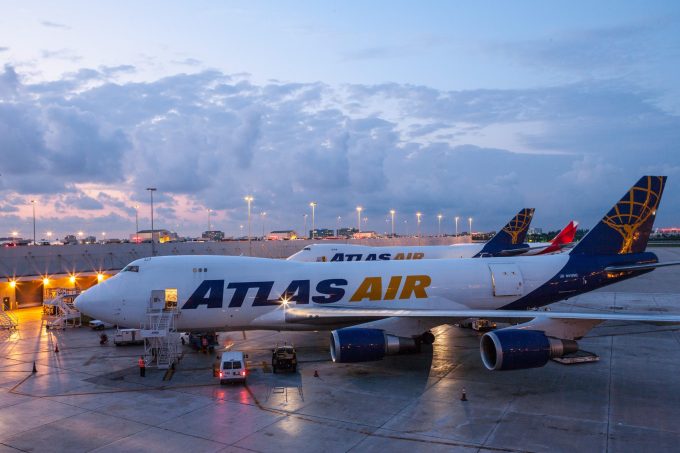
Last month’s news that Apollo Global Management is looking to shed Atlas Air, via a potential $12bn sale, will necessitate some changes at the carrier, according to industry observers.
The $12bn price tag seems quite ambitious for a carrier that was acquired in March 2023 by Apollo for about $3.2bn for the equity, at an enterprise value of some $5.2bn.
Since then, according to aircraft data sites, Atlas Air has acquired seven 777Fs, four of which were new, three new 747-8Fs, and four second-hand 747-400Fs.
But even with the new aircraft, the average age of Atlas Air’s fleet is 21 years.
While that compares reasonably well against compatriots Kalitta Air (22 years), ATSG (31.1), and Amerijet (25.3), it compares very unfavourably against many combination carriers, particularly in the Middle East, as well as FedEx (17.5 years) and Cargolux (16.8).
So Atlas Air is likely to put in an aircraft order this quarter, say sources, to show it is worth more than double its price of three years ago.
That, of course, leaves it just two choices of next-generation freighter: the A350F (first deliveries 2027); or the 777-8F, (first deliveries 2028). The latter has higher running costs, and the A350F is more economical if you can’t consistently maximise the payload.
But geopolitics may have more of a say: not only does Atlas currently have an all-Boeing fleet, but it also is likely to buy American in the current political environment. And, say sources, the Rolls-Royce engines on the A350 are not popular with airlines. The smart money is on a Boeing order within the next month or two.
But there is another option: Atlas could jump ahead on delivery dates by buying the older version of the 777F.
Boeing last month formally petitioned the FAA for regulatory relief that would allow it to continue producing and selling more 777Fs beyond the end of 2027, even though they won’t meet new emissions/fuel-efficiency standards coming into force in 2028.
The manufacturer has asked for a temporary exemption from the new FAA/ICAO emissions rules so that up to 35 additional 777F aircraft can be built and certified after the regulations take effect. Boeing argued this was needed to bridge the gap between current demand and when the next-gen 777-8 freighter is expected to enter service.
An answer is expected from the FAA by May.
But Atlas itself may not want to fly higher-emission aircraft, despite the expectation that they will be cheaper than the newer version.
The other issue which may have a bearing on Atlas’s attractiveness to buyers is its military contracts.
While still under public ownership (and thus with transparent accounting), Air Mobility Command – or military – flying accounted for between 10.5% and 24.6% of Atlas Air’s overall revenues between 2019 and 2023. Current geopolitical moves make it likely that Atlas still derives a healthy portion of its income from the US military.
(Much of this work is thought to be related to Nato, however – a treaty currently under threat.)
Any potential buyer will have a fair amount of homework to do – and some assumptions to make about the state of the world.
Two names so far thought likely to be in the running are Blackstone and Bain Capital. Blackstone is one of the world’s biggest private equity firms and has shown interest in large aviation-related deals and infrastructure assets. Last week it announced an engine lease partnership with Willis Lease Finance to deploy more than $1bn in the next two years. Last year, it also agreed to acquire a 22% minority stake in the UK’s AGS Airports (which operates Glasgow, Aberdeen, and Southampton) in a roughly £235m deal. And in 2019, it developed its Link logistics platform and acquired GLP’s US logistics portfolio.
Bain Capital, meanwhile, is already an investor in Atlas Air via its Titan Aircraft leasing subsidiary, closing a new $410m freighter aircraft investment platform in September last year. However, Bain is also diversifying its portfolio into financial services, data infrastructure, and retail, among other things.
To continue its military flying, Atlas Air needs to be 100%-owned by US entities, thus narrowing the field of potential acquirers. And with a price tag that high, a strategic buyer seems unlikely.
One source close to PE told The Loadstar an $8bn sale price might be acceptable – “but Apollo and Atlas are going to have to explain how the carrier is worth an extra $2bn to $3bn, just three years later”.
Atlas Air did not respond to The Loadstar’s questions on a possible sale or any fleet changes.
Watch and subscribe to The Loadstar’s latest News in Brief Podcast on YouTube!


Comment on this article