Gemini carriers sail past 90% schedule reliability targets in April/May
Gemini Cooperation partners Maersk and Hapag-Lloyd hit their 90% on-time schedule reliability target across all ...


GXO: CONTRACT RENEWALFDX: SELL-SIDE REACTION TO INTERIMSFDX: CONF CALL FDX: EARNINGS BEAT FDX: FREIGHT SPIN-OFF UPSIDEPLD: 'OPPORTUNISTIC DEAL-MAKING'PLD: REJECTED BY SEGROPLD: HUNTINGKNIN: BOND FINANCINGWTC: UP WE GODHL: NEW CFO APPOINTMENTFDX: TRADING UPDATE ON THE WAY TSLA: ON THE MENDGM: TECH STARTUP LISTINGDSV: NEW HIGH TARGET CHRW: BOLT-ON DEAL TIMEDHL: GO GREEN
GXO: CONTRACT RENEWALFDX: SELL-SIDE REACTION TO INTERIMSFDX: CONF CALL FDX: EARNINGS BEAT FDX: FREIGHT SPIN-OFF UPSIDEPLD: 'OPPORTUNISTIC DEAL-MAKING'PLD: REJECTED BY SEGROPLD: HUNTINGKNIN: BOND FINANCINGWTC: UP WE GODHL: NEW CFO APPOINTMENTFDX: TRADING UPDATE ON THE WAY TSLA: ON THE MENDGM: TECH STARTUP LISTINGDSV: NEW HIGH TARGET CHRW: BOLT-ON DEAL TIMEDHL: GO GREEN

MSC’s deployment of much larger vessels on the transatlantic could place “concentrated operational stress” on North American east coast ports, according to analysts.
Between 2012 and 2025, the Med-NAEC tradelane has benefited from “a clear and consistent” pattern, according to analysts at Sea-Intelligence, of average vessel size growth, from some 3,600 teu to around 5,900 teu.
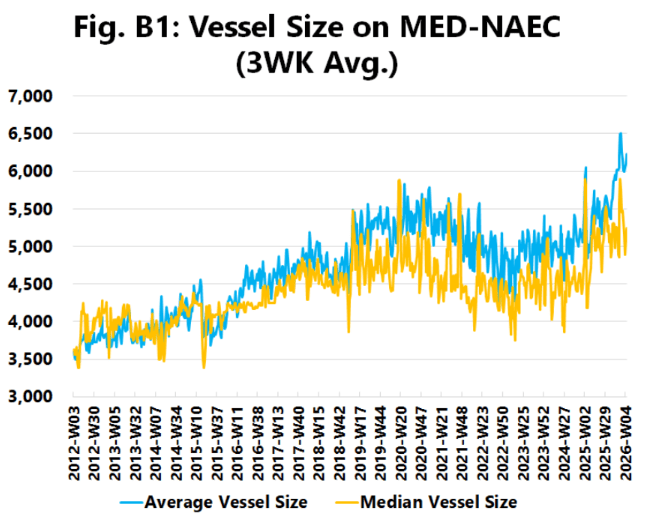
Graph: Sea-Intelligence
However, the maritime data company noted that this consistency had seen see a particularly sharp acceleration over the second half of 2025 which would continue into the first few weeks of 2026.
Based on the latest published carrier schedules for beyond week 46, it found the trade being altered by a small number of new, larger vessels, and from an average vessel size of around 5,500 teu, the median being around 5,150 teu by Q1 26, the average vessel size will rise to some 6,200 teu – but the median will rise to only 5,300 teu.
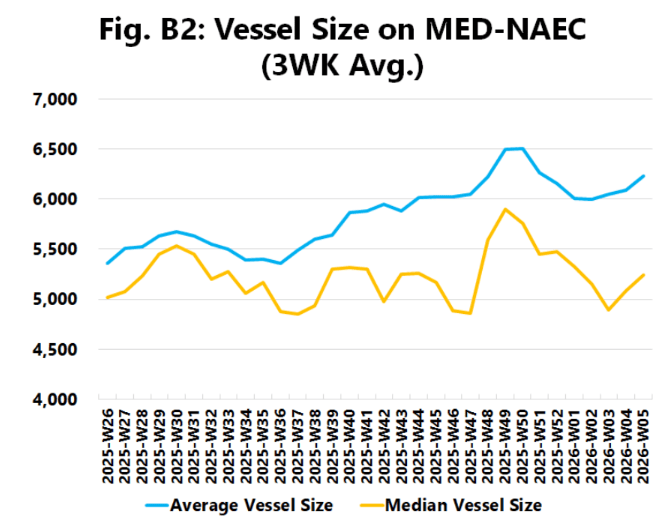
Graph: Sea-Intelligence
“This pattern is characteristic of a tradelane where a limited number of larger vessels are being introduced, rather than a uniform, tradelane-wide vessel size increase,” explained the analyst. “The data clearly indicates that this trend is not spread across the tradelane but instead limited to a single service.”
Indeed, what it called a “sharp divergence” between the average and median vessel sizes was being driven by Geneva-based MSC’s carrier’s Dragon service that deploys 18 vessels of between 13,000 and 15,000 teu.
The liner giant’s introduction of larger vessels has created a “two-tiered vessel size structure” on the tradelane, said the analyst; the largest vessel deployed on any other Med-NAEC trade in H2 25 was 9,600 teu.
“The primary implication is new, concentrated operational stress on NAEC terminals,” the analyst warned.
“These ports must now manage scheduled calls from a new, much larger class of vessel, resulting in a significant increase in container exchange per call,” it urged.
The full port rotation on MSC’s round-the-world Dragon service is: Busan-Ningbo-Shanghai-Nansha-Yantian-Singapore-Malta-Gioia Tauro-Genoa-La Spezia-Marseilles-Barcelona-Valencia-Malaga-Sines-New York-Boston-Norfolk-Charleston-Freeport (Bahamas)-Busan (via Panama Canal).
Listen to this week’s News in Brief Podcast for a neat round-up of all things supply chain!

For uninterrupted access, sign in or sign up to The Daily News, Premium or The Loadstar Enterprise Plan.

Comment on this article